The $4.4B Shift: The Current State and Future of European Archiving
Feb 9, 2026

Justus Schuster
Feb 9, 2026

By the end of 2026, humanity will have generated over 200 zettabytes of data, a staggering volume that overwhelms traditional methods of storage, management, and governance. In Europe, this data surge combined with a complex regulatory landscape, where EU and national mandates demand precise, traceable, and audit-ready handling of every record collides with antiquated methods of archiving. Traditional paper-based archiving is not longer viable and, in many cases, legally insufficient. For both software providers and multinational firms, the shift from periodic post-audits to real-time, audit-proof archiving is no longer a technological option but a requirement for market survival, yet also a strategic opportunity.
The state of the archive market
The market for Enterprise Information Archiving (EIA) in Europe is entering a phase of rapid expansion. It is projected that the annual revenue for the european market alone will surpass USD 4.4 billion by 2030 attributing to a 13.2% compound annual growth rate. The global market is projected to surpass USD 30 billion by 2033.
Notably, the services segment—consulting, system integration, and regulatory maintenance—is outpacing pure software growth. Organizations are increasingly overwhelmed by the difficulty of aligning legacy infrastructure with complex new frameworks.
While large enterprises still account for 67%+ market share, SMEs represent the fastest-growing adoption group, seeking scalable cloud solutions to mitigate GDPR risks, which can result in fines of up to 4% of global turnover.
Persistence of paper
Despite advanced archiving technologies, a “Paper Paradox” remains embedded in European business culture:
- - 61% of IDP workflows still involve paper documents
- - 41% of EU enterprises do not use digital technologies for core processes
The economic case for digitization is clear:
- - 40–70% time savings via automated archiving
- - 90% faster document retrieval
- - Up to 50% of employee time reclaimed from manual records management
The Localization Nightmare for ERP Vendors
The diversity in guidelines across jurisdictions presents a significant localization hurdle for ERP vendors.
- - Initial localization cost per country: USD 25,000–350,000
- - Annual maintenance: 15–20% of acquisition cost
- - ~40% of IT budgets allocated to regulatory compliance
Vendors must maintain extensive RICEFW lists:
- 1. Reports (custom data outputs for analytics, audits, or compliance)
- 2. Interfaces (data exchange between ERP and external/internal systems)
- 3. Conversions (migration and transformation of legacy data)
- 4. Enhancements (extensions or custom business logic beyond standard ERP)
- 5. Forms (structured business documents like invoices or orders)
- 6. Workflow (automated approval and process routing rules)
This creates persistent technical effort, diverting engineering resources from innovation toward maintaining hyper-local compliance logic.
Case Studies in National Volatility
Germany’s Retention Period
Under the Fourth Bureaucracy Relief Act (BEG IV), retention for accounting documents dropped from 10 to 8 years starting January 1, 2025. By mid-2025, the government signaled plans to restore the 10-year period to strengthen tax enforcement.
Poland’s KSeF Mandate
Beginning February 1, 2026, the National e-Invoicing System (KSeF) becomes mandatory for large taxpayers. Invoices not submitted via the state platform are legally invalid, risking VAT deduction loss.
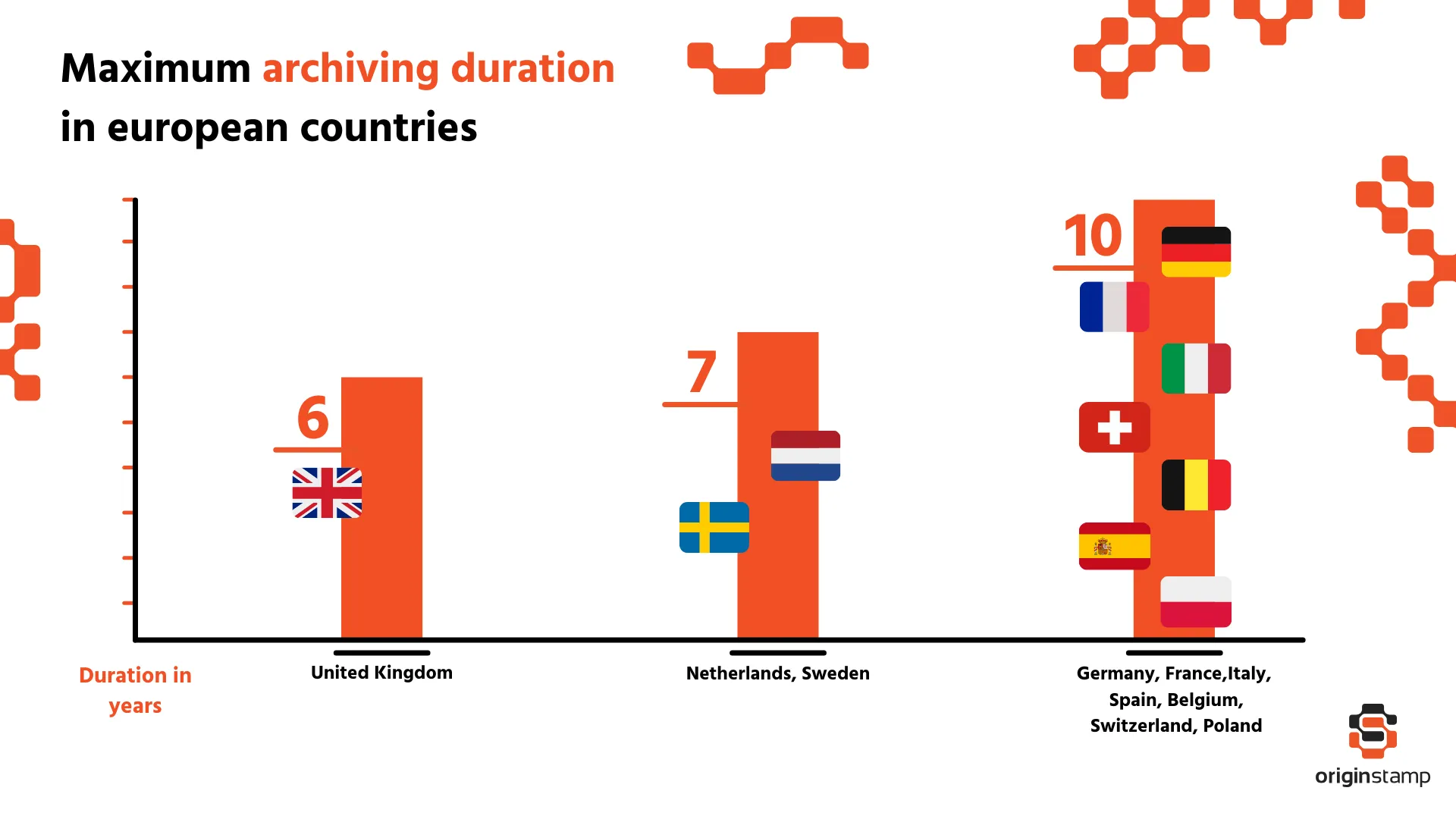
| Country | ERP Adoption Rate | Key Archiving Regulation | Standard Retention | Core Digital Mandate |
|---|---|---|---|---|
| Germany | 56.4% | HGB, AO, GoBD | 8–10 Years | Structured XML (XRechnung) |
| France | 44.1% | Code de Commerce, CGI | 6–10 Years | Mandatory Chorus Pro (B2G) |
| UK | 48.2% | Taxes Management Act | 6 Years | Making Tax Digital (MTD) |
| Italy | 41.5% | Codice Civile, SdI | 10 Years | Mandatory SdI Platform |
| Spain | 60.4% | Código de Comercio, LGT | 6–10 Years | Verifactu Real-Time Reporting |
| Netherlands | 52.8% | Burgerlijk Werboek, AWR | 7 Years | Audit-Proof Accessibility |
| Switzerland | 46.2% | Code of Obligations | 10 Years | GeBüV (Immutability) |
| Poland | 38.7% | Accounting Act, KSeF | 10 Years | Mandatory KSeF Clearance |
| Belgium | 62.5% | Code of Economic Law | 7 Years | Certified E-Signatures |
| Sweden | 46.5% | Bokföringslag | 7 Years | Digital-First Original |
Data Sovereignty
Data sovereignty has become a board-level concern.
92% of Western data resides on U.S.-owned servers, making it subject to extraterritorial reach of the U.S. CLOUD Act The U.S. CLOUD Act allows U.S. authorities to compel U.S.-based companies to provide access to data they control, even if that data is stored outside the United States. The reliance on U.S.-based infrastructure exposes European organizations to potential access by foreign authorities, including under legislation that can be applied extraterritorially. Recent years have demonstrated that enforcement priorities and executive decisions in the U.S. can shift rapidly, creating uncertainty for companies that store sensitive data outside local jurisdiction. This makes it difficult for organizations to fully predict the legal exposure of critical business or personal data. In response, European companies increasingly seek solutions that keep data physically and legally under EU control. Measures such as region-specific storage allow firms to maintain operational independence and mitigate risk from unpredictable regulatory or governmental actions abroad.
OriginVault: The Borderless Standard for Operational Integrity
OriginVault provides a centralized, compliant infrastructure designed to bridge the gap between fragmented national regulations and digital-first operations. While standard ERP systems are often "locked" into the tax logic of a single country, OriginVault serves as a universal compliance layer, making business software instantly marketable across international borders.
The platform is built on a foundation of rigorous security, certified according to ISO 27001 and SOC 2. These certifications confirm that every facet of information security—from risk assessment and access control to system monitoring and incident response—meets the highest internationally recognized standards. This ensures that archived data remains consistently protected, traceable, and audit-ready, regardless of where the business operates.
The Compliance Agent: Automated Cross-Border Scalability
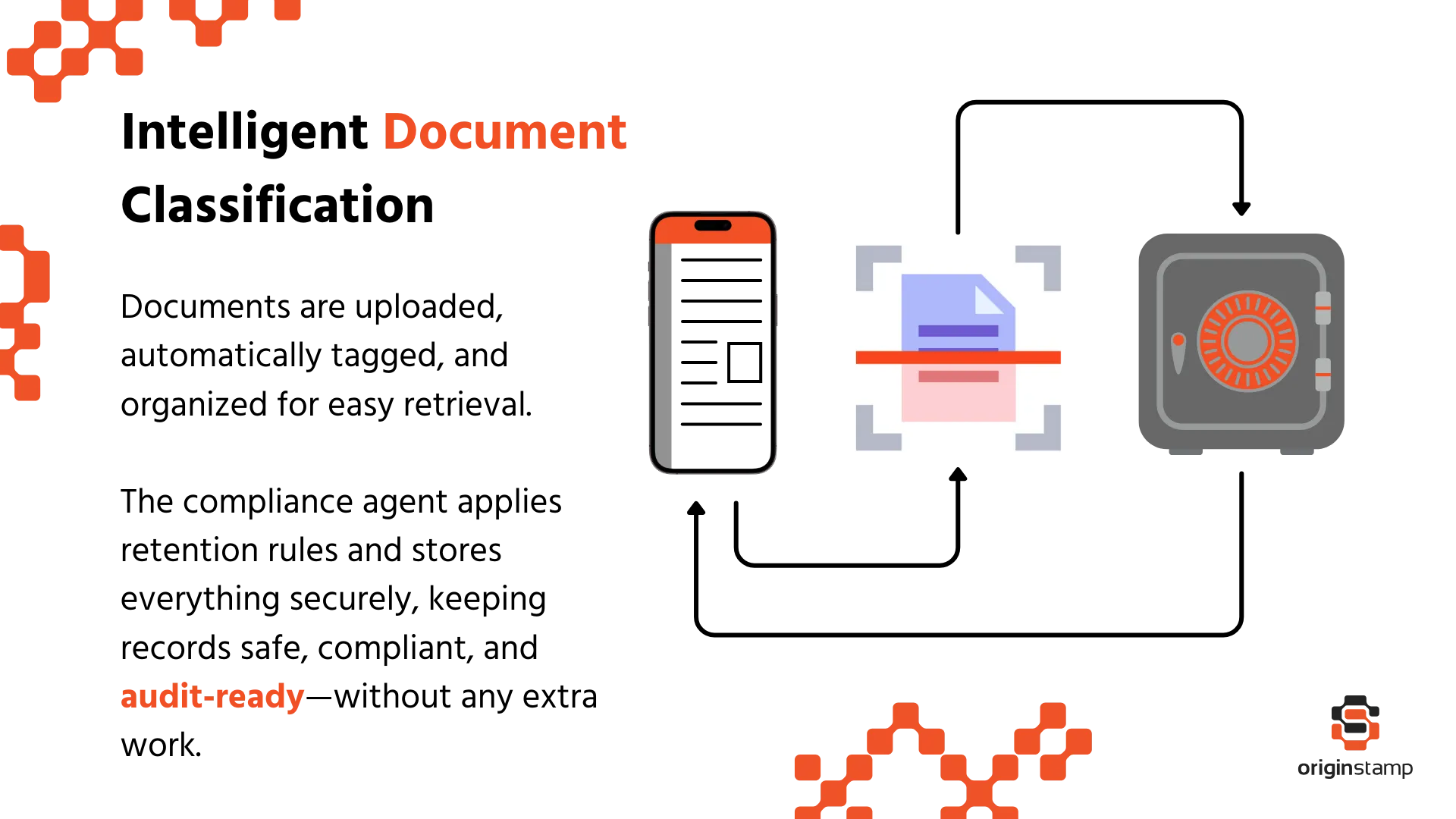
A standout feature of OriginVault is the Compliance Agent, an intelligent assistant that automates the "European Patchwork" of retention laws. Its primary value lies in its jurisdiction-awareness:
-
Global Marketability
The Agent automatically applies the correct retention rules based on the document type and country of origin. This allows ERP vendors to roll out their solutions in multiple jurisdictions without adhjusting a single line of archiving code. -
Precision Lifecycle Management
It intelligently calculates disposal dates, ensuring that records are kept long enough to satisfy tax authoritie but are deleted promptly once legal obligations expire (satisfying GDPR "right to be forgotten" requirements). -
Decoupled Agility
By decoupling compliance logic from the core ERP, vendors can offer a "Certified Archiving" feature that remains agile. When a national government changes a law overnight, OriginVault updates the rules centrally, keeping the ERP vendor and the end-user compliant without manual intervention.
S3 Object Storage & Seamless Data Sovereignty
OriginVault integrates natively with S3-compatible object storage, providing a highly durable and immutable environment. This architectural choice offers two critical advantages:
-
Sovereignty & Control
Unlike proprietary "black box" archives, OriginVault allows organizations to use their own S3 buckets. This ensures that the customer retains full ownership and physical control over their data at all times. -
Easy Transition of Legacy Data
The S3 integration allows for the seamless migration of existing data pools. Whether moving from on-premises servers or other cloud environments, businesses can transition legacy records into a compliant, audit-proof state without complex re-platforming.
By providing a secure, S3-native environment that handles the "legal heavy lifting" of European tax and commercial codes, OriginVault empowers ERP providers to focus on their core product while delivering a world-class, audit-proof archiving solution.
Conclusion
In an environment where regulatory complexity consumes nearly half of IT resources, specialized archiving is no longer a back-office utility.
It is now a strategic lever that:
- - Ensures data sovereignty
- - Reduces operational risk
- - Simplifies compliance
- - Accelerates digital transformation
Organizations that treat archiving as core infrastructure—not an afterthought—will be best positioned to thrive in Europe’s post-analog economy.
Justus Schuster
Marketing
Justus Schuster supports the OriginStamp marketing team in bridging the gap between complex technology and compelling storytelling. As a Working Student with a passion for digital trends, he contributes to content strategies and brand projects with a fresh, creative perspective. With an analytical approach and an appetite for innovation, Justus translates OriginStamp’s core technologies—from blockchain timestamping to AI-driven optimization—into impactful digital formats. He is dedicated to making high-tech solutions easy to understand and engaging for the digital community.