
SEC Rule 17a-4: Compliance Requirements for Brokers
Jan 12, 2026

Hanna Lorenzer
Jan 12, 2026

This guide explains in a clear and practical way how broker-dealers can comply with SEC Rule 17a-4 in technical, organisational and procedural terms. It focuses on the requirements for electronic records (WORM (‘write once, read many’) vs. audit trail alternative), retention periods, ‘prompt production’ to regulators, undertakings (third-party or executive officer), off-channel communication and a viable control and testing concept, which have been modernised since 2022.
SEC Regulation 17a-4 contains guidelines for data management in companies that trade in financial securities such as shares, bonds and futures contracts. This rule requires companies to maintain records of certain transactions and ensure immediate access for six months and delayed access for at least two years, and was published by the SEC on 3 November 2022 Release No. 34-96034. Companies must also keep copies of the records for the same period at an off-site location.
Why 17a-4 is now a Priority
Rule 17a-4 is the foundation of broker-dealer recordkeeping requirements. The SEC recently modernised the rule to reflect current technology: in addition to traditional WORM storage, an audit trail alternative is now permitted, as long as original conditions can be verifiably reconstructed, and every change and every access is logged without exception. At the same time, the regulator is consistently monitoring off-channel communication (e.g. private messengers). Together, these two factors increase the pressure to act: it is not enough to simply store data somewhere – it must be unalterable or audit-proof, traceable, indexed, quickly producible and complete across all productive channels.
Case Example: SEC v. Wells Fargo et al.
In August 2023, the SEC imposed penalties totalling approximately $289 million on eleven major broker-dealers, including Wells Fargo Securities, BNP Paribas and others. The reason was systematic retention violations: employees, including executives, used private messaging apps such as WhatsApp and iMessage for business communications, which could not subsequently be archived or disclosed to the SEC. The authority thus found violations of Rule 17a-4 and the supervisory obligations under the Securities Exchange Act. All affected companies had to submit cease-and-desist declarations and appoint independent compliance advisors to review guidelines, monitoring and technical archiving. The case makes it clear that the SEC expects all business communications – regardless of the channel used – to be recorded, stored and retrievable. Policies without consistent technical control and enforcement are considered insufficient. The SEC takes a particularly critical view of supervisors who use off-channel communication themselves, as this signals a culture of non-compliance. Press Release No. 2023-149
Scope and Core Obligations
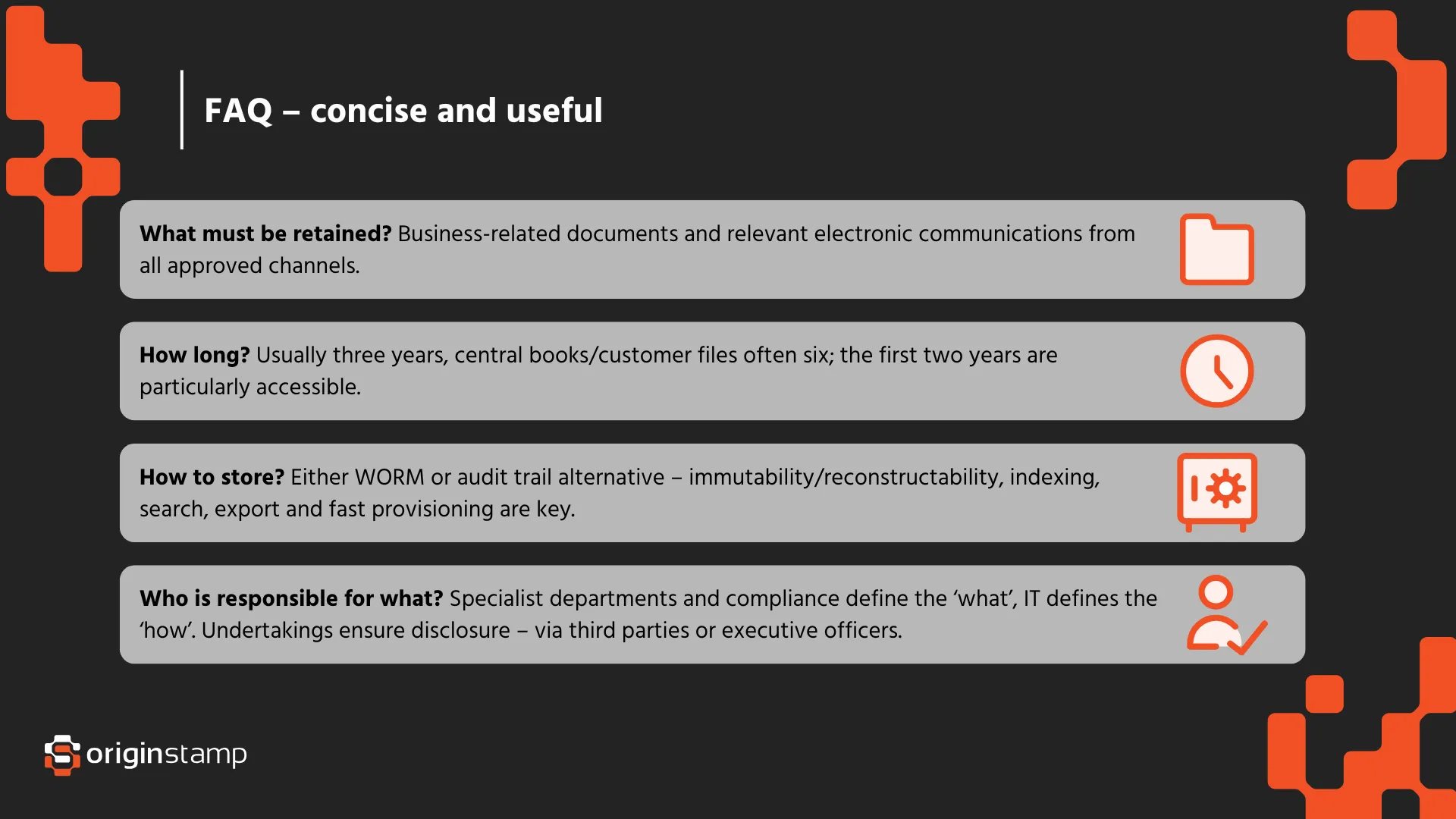
The rule applies to all SEC-registered broker-dealers, flanked by FINRA Rule 4511, which defines general retention requirements. Business-related documents and electronic communications must be retained: books and journals, order and trading records, customer and account files, correspondence via email, chat and other approved channels. Typical retention periods are three years, with central books and customer files usually retained for six years; during the first two years, the information must be particularly easily accessible. The rule is media-neutral: paper is permissible, but in practice electronic storage is almost always required – and with it robust requirements for integrity, retrievability and export.
From Rule to System Design
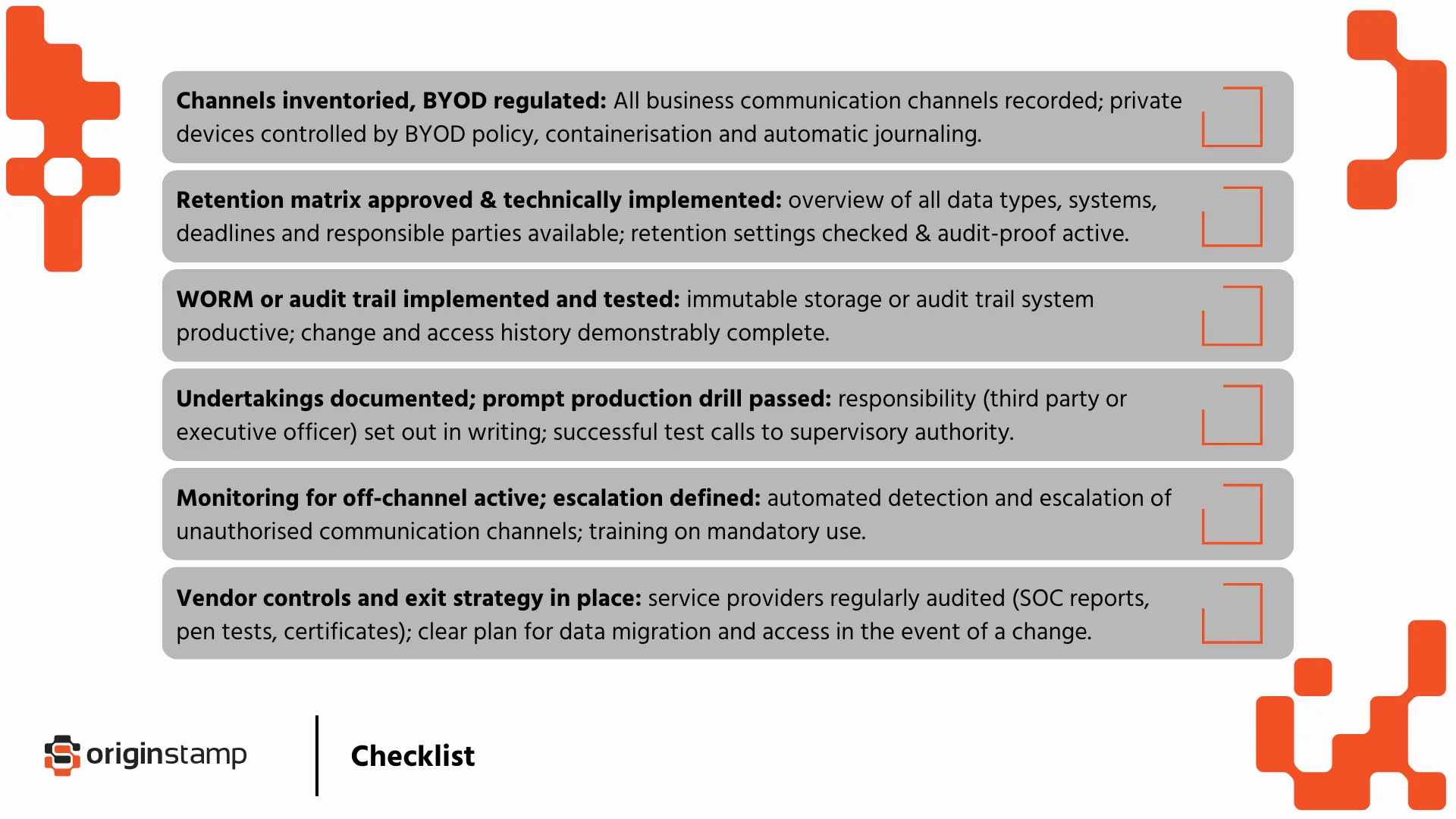
The key architectural decision is: WORM or audit trail alternative. WORM technically prevents deletion and overwriting; it is proven and clearly understandable. The audit trail option offers more flexibility, but requires strong controls: unique identities, immutable change and access history, robust hashing/signing, reproducible exports and regular verification that the ‘original state’ can be proven. Regardless of the path you choose, you need a consistent indexing and search concept, defined export formats, high-performance retrieval for auditors (‘prompt production’) and resilience through versioning, geo-redundancy and disaster recovery. Also essential: undertakings – either by an independent third party or a designated executive officer who ensures timely disclosure.
Governance: Policies, Roles, Responsibilities
Technology alone is not enough. Define which communication and data channels are permitted for business purposes and consistently block unauthorised alternatives. Define a retention matrix that brings together data types, systems, deadlines, storage locations and responsible parties. Regulate BYOD properly (enrolment, containerisation, automatic journaling, exit process). Assign clear roles: Who configures retention? Who approves legal holds? Who is allowed to extract data? Supplement vendor oversight (audit reports, SOC, pen tests) and an exit strategy so that data remains portable at all times.
Easy Compliance with OriginStamp
SEC Rule 17a-4 requires the storage of business-relevant data in a verifiably unalterable and accessible manner. This is exactly where OriginStamp comes in: with tamper-proof timestamps based on blockchain technology, every file, message or transaction is transparently documented and sealed in an audit-proof manner. Changes or deletions are immediately detectable. This makes it easy to ensure technical and organisational compliance: integrity, traceability and evidential value are permanently guaranteed – and your company demonstrably and efficiently meets the requirements of SEC Rule 17a-4. For more information and a contact form, visit originstamp.com.
Hanna Lorenzer
Marketing
Hanna Lorenzer is a working student in Marketing at OriginStamp and strengthens the team through her work in outreach and communication. She develops and executes targeted outreach campaigns, manages contact with external sources, and ensures consistent, clear messaging across all channels. She brings ambition, creative curiosity, and willingness to explore new approaches. With a sharp eye for detail, Hanna edits and refines technical content so it becomes accessible and engaging. She supports the planning and implementation of social media campaigns, contributing ideas for formats, storytelling angles, and campaign structures that align with OriginStamp’s brand.