
AI Content Provenance: Beyond Deepfakes to Digital Truth
Mar 11, 2026

Thomas Hepp
Mar 11, 2026

In October 2023, a Hong Kong finance worker transferred $25 million to fraudsters after attending a video call with what appeared to be his company's CFO and several colleagues. Every face on that call was a deepfake. No malware. No phishing link. Just synthetic video, a wire transfer instruction, and a catastrophic failure of trust. That case didn't just make headlines — it exposed something the tech industry had been quietly avoiding: we have no reliable way to prove that what we see is real.
The visual evidence that once secured legal convictions, closed enterprise deals, and validated corporate audits is no longer inherently trustworthy. AI generation has shattered "seeing is believing" and replaced it with a landscape of absolute digital skepticism. The tech industry's initial response leaned heavily on deepfake detection algorithms — but that's a losing arms race. Modern synthetic media generators use adversarial networks that train against detection mechanisms, creating an endless feedback loop where malicious actors stay one step ahead.
What enterprises, software providers, and legal entities actually need isn't a better magnifying glass to spot fakes. They need a proactive system of cryptographic truth. When generative AI risks erode the fundamental building blocks of digital reality, corporate reputation, operational security, and the admissibility of legal evidence all take the hit. Instead of analyzing a file after the fact to guess its origin — a process riddled with false positives — you need to prove authenticity from the exact moment of creation.
The rapid proliferation of highly convincing synthetic media demands a concrete response: organizations must move away from reactive analysis and toward a system where digital assets carry their own proof of origin — one that's mathematically impossible to fake. That's what proof of originality means in practice: not a watermark someone can strip, but a cryptographic record that can't be altered without detection.
What AI Content Provenance Actually Means
Think of AI content provenance as an unalterable birth certificate for digital assets. It answers three fundamental questions: who created a file, when it was created, and what modifications it has undergone since. Historically, digital origin was tracked using standard metadata — EXIF data attached to images, basic file properties embedded in PDFs. But metadata is fragile. Anyone with basic technical knowledge can strip it, alter it, or fabricate it entirely. True synthetic media verification means moving beyond easily manipulated tags to cryptographic records that travel with the file itself.
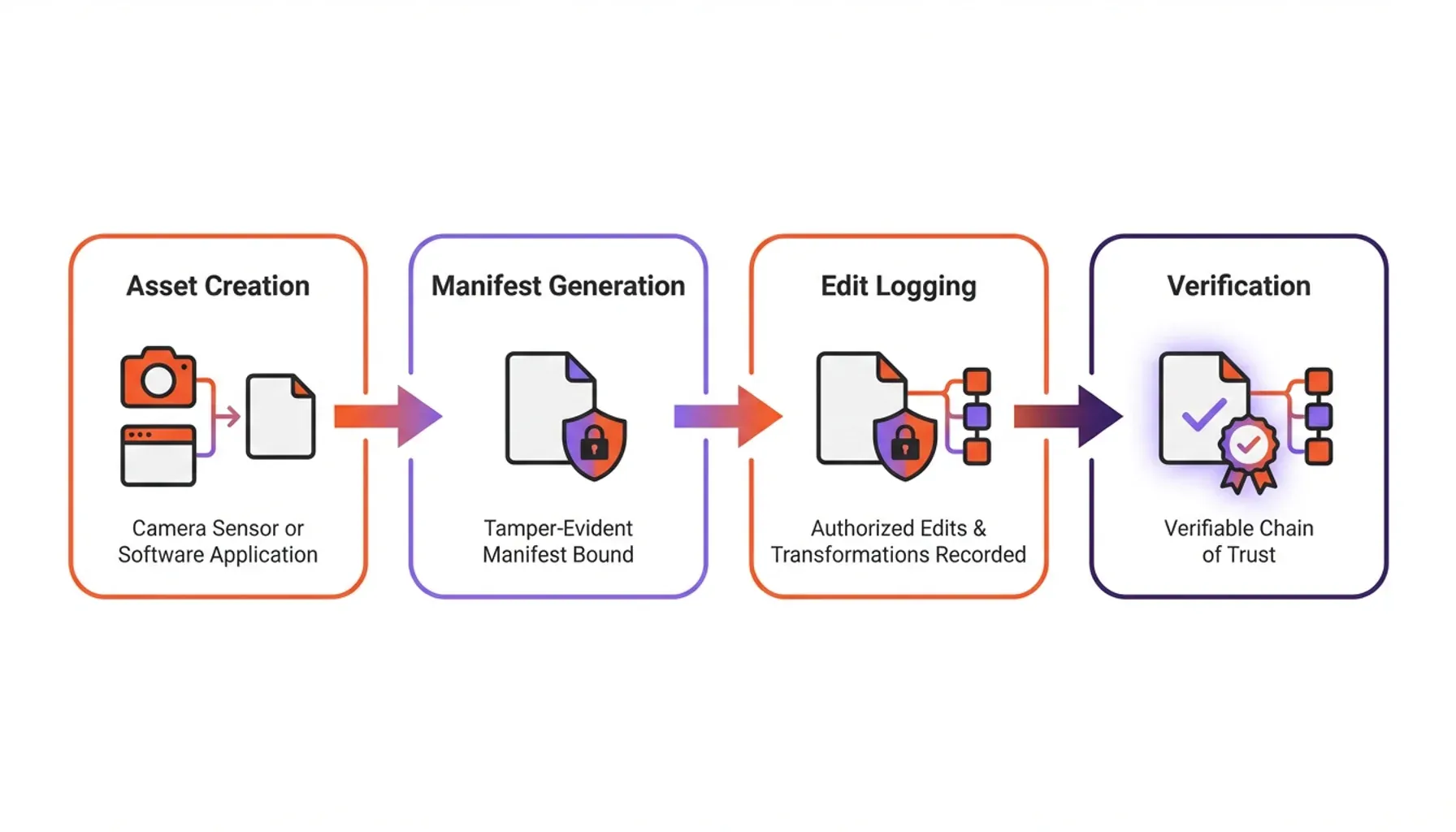
This is where industry frameworks like the C2PA specification become critical infrastructure. The Coalition for Content Provenance and Authenticity establishes a technical architecture that binds information about an asset's origin directly to the file. When an image, document, or video is created — whether by a hardware camera sensor or a software application — the system generates a tamper-evident manifest. This manifest travels with the file, logging every authorized edit or transformation. Think of it as a digital nutrition label: immediate, transparent insight into the ingredients and processing history of any digital asset.
Yet even the best content authenticity initiatives face severe limitations when the underlying ledger recording these manifests remains centralized. If a system administrator or a compromised cloud provider can alter the server where provenance data lives, the entire chain of trust collapses. Genuine AI content provenance requires infrastructure where the proof of existence is mathematically sealed and independently verifiable — entirely separate from the platform hosting the asset.
How an Immutable Ledger Actually Works
The fatal flaw in traditional data archiving is reliance on centralized databases. In a conventional enterprise setup, data integrity is only as strong as the server's security and the trustworthiness of its administrators. A compromised credential, a sophisticated cyberattack, or a malicious insider can alter records without triggering any alarms. Genuine tamper-proof verification requires decentralized infrastructure — a ledger no single party controls.
The foundation of that ledger is the cryptographic hash. Using secure hashing algorithms like SHA-256, any digital file — regardless of size, format, or content — gets processed into a unique, fixed-length string of characters. This hash acts as a digital fingerprint. Change a single pixel in an image or move a single comma in a contract, and the resulting hash looks completely different. Crucially, the hash function is a one-way street: you cannot reverse-engineer the original file from the hash, which keeps the underlying data private and compliant with strict data protection regulations.
Once a SHA-256 hash is generated, it gets aggregated and anchored into decentralized public networks — specifically Bitcoin and Ethereum. Embedding this cryptographic timestamp into the blockchain permanently records the exact state of the digital asset at a specific point in time. This isn't about storing files on a blockchain, which is inefficient, slow, and costly. It's about using the blockchain as an ultimate, unhackable notary public.
The result is proof that anyone can check. Your legal team no longer asks clients, auditors, or courts to blindly trust your internal IT systems. Instead, you provide a hash and a blockchain timestamp. Anyone can independently verify that the file in their possession matches the cryptographic fingerprint anchored on the blockchain. If the hashes match, that's absolute proof the file hasn't changed by a single bit since its timestamp. This methodology, backed by over a decade of peer-reviewed research, removes blind trust and replaces it with facts completely independent of any service provider. For a deeper look at why this infrastructure is rapidly becoming mandatory, read how blockchain timestamping is reshaping data integrity in the AI era.
From Capture to Courtroom: Securing the Chain of Custody
The journey of digital evidence from the moment of capture to its presentation in a legal or corporate setting is riddled with vulnerabilities. Whether you're dealing with intellectual property, financial audit logs, or surveillance footage, your digital chain of custody must remain unbroken. Historically, proving that chain relied heavily on human testimony and internal IT logs — both highly susceptible to error, bias, and manipulation.
Blockchain timestamps eliminate the "he-said-she-said" dynamic in high-stakes disputes. Consider dashcam and bodycam footage for insurance and law enforcement. In an era where deepfake manipulation can alter the appearance of an accident or the identity of individuals involved, raw video files are no longer sufficient evidence on their own. By automatically generating a cryptographic hash at the exact moment footage is captured and anchoring it to the blockchain, your organization creates tamper-evident proof of the video's original state before it ever touches a centralized server.
This represents a profound shift from relying on human testimony to depending on cryptographic proof. When an audit trail is secured via blockchain, it meets the highest standards of international evidentiary requirements and aligns with certified data integrity frameworks. If evidence gets challenged during a corporate audit or in a courtroom, the original timestamp unequivocally proves that the file existed in that exact form at that specific time — long before any potential manipulation could occur. Your digital chain of custody transforms from a procedural vulnerability into a mathematically verified asset.
Implementation Roadmap: Getting This Into Your Stack
Understanding why provenance matters is the easy part. The harder question is: how do you actually build it into the systems your organization already runs? Here's a practical framework.
Step 1 — Choose Your Tooling Stack
The core components you need are a hashing library, a blockchain anchoring service, and a manifest layer if you're working with media files. For hashing, SHA-256 implementations are available natively in every major language. For blockchain anchoring, REST APIs make integration straightforward without requiring any blockchain expertise on your team. For media specifically, the C2PA Rust SDK and the open-source Content Authenticity Initiative tooling provide manifest creation and validation out of the box.
Step 2 — Identify Your Integration Points
The most impactful integration points depend on where your content originates and where it travels:
- CMS platforms (WordPress, Contentful, Drupal): Hook into the publish event. The moment your CMS publishes, every piece of content gets hashed and timestamped before it reaches your CDN or social scheduler. This is your first line of defense against post-publication tampering — and without it, anything that touches your CDN config downstream is unverifiable.
- CDN layer (Cloudflare, Fastly, AWS CloudFront): Attach provenance headers at the edge. Downstream consumers — whether human or automated — can verify authenticity without hitting your origin server.
- Social and distribution channels: Tools like Adobe's Content Credentials embed C2PA manifests directly into image and video files before upload. Platforms including LinkedIn and TikTok have begun surfacing these credentials to end users, making provenance visible at the point of consumption.
- ERP and document management systems: For your contracts, financial records, and audit logs, the integration point is the document creation or approval workflow. Hash on creation, re-hash on every authorized modification, and anchor each state to the blockchain.
Step 3 — Define Your Metrics
You can't manage what you don't measure. The key metrics for a provenance program are:
| Metric | What It Tells You |
|---|---|
| Coverage rate | Percentage of published assets with a valid provenance record |
| Verification latency | Time from asset creation to blockchain anchor confirmation |
| Chain-of-custody gaps | Assets that passed through a system without a re-hash event |
| Dispute resolution time | How long it takes to prove or disprove a tampering claim |
| Regulatory audit pass rate | Percentage of audits where provenance records satisfied evidentiary requirements |
Coverage rate is the most important starting metric. If only 60% of your assets carry provenance records, the 40% gap is where adversaries will focus. Aim for full coverage on all externally published and legally sensitive assets before optimizing for latency.
Step 4 — Operational Best Practices
A few principles separate provenance programs that hold up under scrutiny from those that don't:
Hash at the source, not in transit. The earlier in your workflow you generate a hash, the stronger your chain of custody. Hashing a file after it has passed through a CDN or a third-party editor introduces an unverifiable gap.
Automate re-hashing on every authorized change. A provenance record that only captures the original creation state is useful but incomplete. Every authorized modification — a crop, a caption edit, a contract revision — should generate a new hash anchored to the previous one, creating a linked history rather than a single snapshot.
Store hash records separately from the assets themselves. If your asset storage is compromised, you want your provenance records to remain independently verifiable. Blockchain anchoring handles this by design, but your internal hash database should also live in a separate, access-controlled environment.
Train your team on verification, not just creation. Provenance infrastructure only works if the people receiving assets know how to check it. A one-page verification guide and a simple browser-based checking tool dramatically increase adoption across your organization.
Plan for key management. Cryptographic signing requires private keys. Losing a signing key doesn't invalidate existing timestamps, but it does break your ability to issue new ones under the same identity. Treat signing keys with the same rigor as your most sensitive credentials.
The role of AI in smart display and content distribution systems illustrates how provenance verification is already being embedded at the infrastructure level — not bolted on afterward.
What Actually Breaks When Provenance Fails at Enterprise Scale
Provenance failure isn't abstract. At enterprise scale, it produces specific, measurable damage across legal, operational, and reputational dimensions.
Your legal team loses the ability to enforce contracts. When a counterparty disputes the version of a document that was signed, and your organization can't produce a cryptographically verified original, the dispute defaults to whoever has better lawyers — not whoever has the facts. Courts in multiple jurisdictions have begun requiring tamper-evident audit trails for digital evidence. Without them, your legal team is arguing from a position of "trust us," which is not a legal strategy.
Your compliance posture collapses under audit. Regulatory frameworks including SOC 2, ISO 27001, and the EU AI Act increasingly require demonstrable data integrity controls. When auditors ask your team to prove that a financial log or AI training dataset hasn't been modified since creation, an internal database timestamp doesn't satisfy that requirement. A blockchain-anchored hash does. Without provenance infrastructure, your compliance team is patching gaps manually — and manual patches fail at scale.
Synthetic media poisons your decision pipeline. If a deepfaked video or a manipulated satellite image enters your intelligence or analytics workflow without a provenance check, every downstream decision built on that input is compromised. You don't discover the problem until after the decision has been executed — after the wire transfer, after the press release, after the strategic pivot. By then, the cost isn't a compliance fine. It's operational.
Vendor and partner trust erodes. Enterprise supply chains depend on verified documents: purchase orders, quality certificates, regulatory filings. When a supplier delivers a manipulated compliance certificate and your intake process has no provenance check, your organization becomes liable for the downstream consequences. A single unverified document in a pharmaceutical supply chain or a defense procurement process can trigger recalls, contract terminations, and regulatory investigations.
Your brand becomes a vector. Synthetic media impersonating your executives, your products, or your communications doesn't just damage reputation — it creates legal exposure. If a deepfaked video of your CEO making false market statements circulates before your communications team can respond, and you have no cryptographic proof of what your CEO actually said and when, your legal team is playing defense with no evidence.
These aren't edge cases. They are the predictable consequences of operating without provenance infrastructure in an environment where AI-generated content is indistinguishable from authentic material at first glance.
Decision Intelligence: Verifying Context, Not Just Content
As we move toward 2026, the focus will expand from verifying individual pieces of content to ensuring the integrity of the broader strategic context. Decision intelligence for defense, energy, and critical infrastructure requires more than raw data — it demands verified situational awareness.
The convergence of AI-driven analysis and blockchain-verified inputs ensures that executive decision-making rests on solid ground rather than algorithmic noise or poisoned datasets. When your AI systems ingest data that carries a tamper-evident cryptographic timestamp, the resulting intelligence is fundamentally more reliable. We're rapidly approaching a regulatory inflection point where cryptographic truth transitions from best practice to strict legal requirement — driven heavily by frameworks demanding accountability for artificial intelligence deployments. The real financial and operational impact of the EU AI Act makes the case for proactive integration more clearly than any internal compliance memo ever could.
Securing data sovereignty in an era of automated deception requires infrastructure that is independent of both the data creators and the AI models analyzing it. By anchoring intelligence inputs to a decentralized ledger, your organization maintains verifiable control over its strategic assets. Capabilities maps, market analyses, and situational intelligence stay uncompromised by external manipulation — allowing leaders to act with genuine certainty when the stakes are highest.
A note on the tools referenced in this article: OriginStamp and OriginVault are commercial products built on the cryptographic principles described above. OriginStamp provides blockchain timestamping via API. OriginVault is a white-label archiving layer designed for ERP vendors and large-scale software providers, enabling tamper-evident archiving under their own branding without exposing underlying proprietary data to the blockchain. These products are mentioned here because they represent concrete implementations of the standards discussed — not as a substitute for independent evaluation of your organization's specific requirements.
Conclusion: Provable Authenticity as the New Baseline
The transition from reactive deepfake detection to proactive AI content provenance is no longer a forward-looking ambition — it's an operational necessity. You can no longer afford to guess whether a piece of media, a financial log, or a critical document is authentic. You must prove it — mathematically, independently, and in a way that holds up in court.
By combining SHA-256 hashing, blockchain timestamping, and structured integration across your CMS, CDN, and document workflows, your organization establishes an audit trail that survives both synthetic manipulation and administrative tampering. The implementation roadmap isn't theoretical. The tooling exists, the standards are mature, and the regulatory pressure is building. As explored in our 2024 technology and innovation review, enterprise deployment is no longer a future-state ambition — it's happening now.
In a world saturated with algorithmic deception, the only question worth asking is this: can you prove it, or are you just hoping no one checks?
Thomas Hepp
Co-Founder
Thomas Hepp is the founder of OriginStamp and creator of the OriginStamp timestamp, which has set the standard for tamper-proof blockchain timestamps since 2013. As one of the earliest innovators in the field, he combines deep technical expertise with a pragmatic focus on solving real business problems, and is a recognized voice in blockchain security, AI analytics, and data-driven decision support. His work has earned multiple international awards, including a top Best Project recognition from ETH Zurich and the Swiss Confederation. He publishes regularly on blockchain, AI, and digital innovation.