
Blockchain Timestamping 2025: Data Integrity in the AI Era
Mar 26, 2025

Thomas Hepp
Mar 26, 2025

The Integrity Crisis: Why 2025 Is a Turning Point
Here's a question worth sitting with: if you signed a contract last week, could you prove — mathematically, not just administratively — that no one has touched a single character since you put your name on it? Not "pretty sure." Not "our system shows no edits." Mathematically prove it.
For most organizations, the honest answer is no. And that gap between assumption and proof is exactly where fraud lives in 2025.
For decades, enterprises relied on a fragile architecture of server logs, user permissions, and traditional metadata to establish document authenticity. That architecture rested on two assumptions: that system administrators were infallible, and that digital forgery required rare, highly technical skills. Synthetic media and automated misinformation have shredded both assumptions entirely.
Generative AI has democratized digital forgery. Any high-resolution image, voice recording, or legal contract can now be fabricated or altered in seconds. Courts, regulators, and auditors increasingly recognize that traditional metadata — "Date Modified" stamps, internal server logs — is trivial to manipulate. It no longer holds up in legal disputes or rigorous compliance audits.
Consider a scenario I keep coming back to: a mid-sized logistics firm receives what looks like a routine supplier invoice. The amount has been quietly inflated — not by a hacker breaking into a system, but by a generative AI tool that reconstructed the PDF with altered figures, matching fonts, formatting, and even the original digital signature block. The accounts payable team processes it. The audit log shows the file was "received and approved." The original invoice? Gone, overwritten, unverifiable. By the time litigation begins, there is no mathematically provable record of what the document said on day one. That case gets settled expensively, not won.
To survive this integrity crisis, enterprises need infrastructure that delivers deterministic, tamper-evident proof. This is where immutable blockchain timestamping moves from emerging technology to foundational enterprise requirement. Every digital document or file gets a mathematically provable fingerprint — an immutable record completely independent of any single system administrator, cloud provider, or software vendor. In 2025, proactive data sealing is no longer an optional security layer. It's the definitive baseline for corporate reality.
The Mechanics of Immutability: How Blockchain Anchoring Works
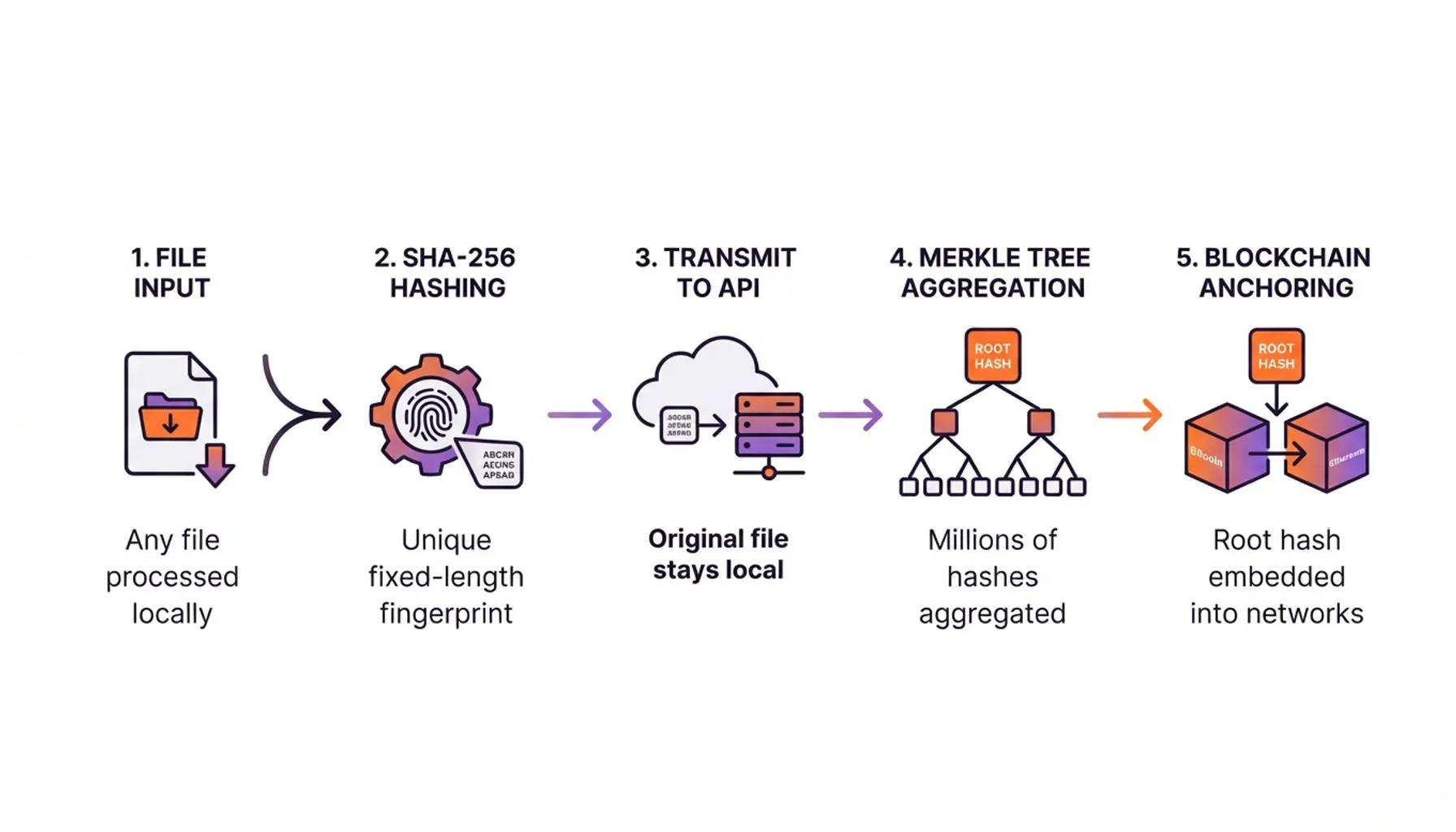
The foundation of a tamper-evident digital ecosystem is advanced cryptography — specifically, the SHA-256 algorithm. Run any file through this function — a PDF contract, a video file, a database export — and it produces a unique digital fingerprint called a hash. This hash is a fixed-length string of characters representing the exact state of that data at a specific millisecond. Change a single pixel in an image or a single comma in a text document, and the resulting hash changes completely. There's no fudging it.
One architectural advantage that often surprises people: the original file never leaves your local environment. Only the cryptographic hash travels to the API. This decoupling of data from the timestamp means sensitive corporate information, patient records, or proprietary source code stays strictly within your secure perimeter — eliminating interception risk during the anchoring process entirely.
Once the API receives the hash, anchoring begins. Rather than writing each hash individually to a blockchain — which would be prohibitively slow and expensive — millions of hashes aggregate using a Merkle tree structure. The single root hash of this tree then embeds into the foundational layers of public, decentralized networks like Bitcoin and Ethereum. This is how distributed ledger technology delivers immutable proof of existence at scale.
The mathematics behind this data seal are uncompromising. Once anchored in these decentralized ledgers, reversing or altering that transaction demands computational power that is virtually impossible to achieve. Even a malicious system administrator with root access to your servers cannot retroactively alter a timestamped record without immediately invalidating the cryptographic proof. Data integrity stops being a matter of corporate policy. It becomes a matter of mathematical law.
What this means operationally is often underappreciated. There is no helpdesk ticket to file, no administrator to call, no audit firm to commission. The proof exists independently of every human process that surrounds it.
Proof Formats, Verification, and Long-Term Validation
Understanding how a timestamp is created is only half the picture. Knowing how to verify it — and trust that verification years or decades later — is equally critical for enterprise deployments.
When a hash anchors to a blockchain, the system generates a cryptographic proof receipt. This receipt typically takes the form of a Merkle inclusion proof: a compact data structure that mathematically demonstrates your specific hash was included in the Merkle tree whose root was written to the chain. To verify a document's integrity at any future point, you rehash the file and check the inclusion proof against the on-chain root. No trusted third party required. The math is self-contained and publicly auditable.
Two additional factors determine how robust that proof actually is over time.
Chain reorganizations and finality. Public blockchains occasionally experience short-lived reorganizations — competing chains of blocks that resolve when the network converges on the longest valid chain. A transaction buried under one block hasn't yet achieved finality; one buried under six or more confirmations on Bitcoin is considered computationally irreversible by the network's own security model. Enterprise-grade timestamping services wait for sufficient confirmation depth before issuing a proof receipt, ensuring the anchor is genuinely permanent rather than provisionally recorded.
Time sources and clock integrity. A blockchain timestamp doesn't record wall-clock time in the conventional sense. Miners and validators set block timestamps within a protocol-defined tolerance window — Bitcoin's consensus rules require each block timestamp to exceed the median of the previous eleven blocks, and NIST's time and frequency standards note that network-level clock drift can introduce variance of several minutes. What a blockchain timestamp definitively proves is ordering: that a specific hash existed before any subsequent block was mined. For legal and compliance purposes, this relative ordering — anchored to a globally distributed, adversarially maintained ledger — is far stronger evidence than a server-generated timestamp any administrator could adjust.
Long-term validation. Proof receipts must remain verifiable across software generations. The Internet Engineering Task Force (IETF) has published standards such as RFC 3161 for trusted timestamping, and emerging frameworks like the C2PA (Coalition for Content Provenance and Authenticity) are converging on interoperable proof formats for digital media. Storing proof receipts in open, standardized formats — rather than proprietary vendor schemas — ensures verification remains possible even if the original service provider ceases to operate. This is the technical definition of provider-independent proof, and it's the standard any serious enterprise deployment should demand.
Combatting AI-Driven Fraud and Deepfakes
The rapid escalation of generative AI has made distinguishing reality from fabrication genuinely hard. Traditional software has responded with AI-detection tools, but these operate on probabilistic models — they analyze a file and return a percentage likelihood that the content was AI-generated. That creates a perpetual cat-and-mouse game. As detection algorithms improve, generative models evolve to bypass them.
Probabilistic detection is inherently flawed because it can't deliver the absolute certainty a court of law demands. You can't walk into a courtroom and say "we're 87% sure this document is real."
The only definitive solution is establishing a verifiable chain of origin at the exact moment of creation. If a digital file receives a blockchain timestamp the millisecond it's captured or created, it carries undeniable proof that it existed in that specific state before any subsequent manipulation — regardless of how sophisticated the generative tools become. You stop trying to detect a forgery. You mathematically prove originality instead.
This deterministic approach is especially critical wherever evidentiary integrity is non-negotiable. Take commercial fleet dashcams or bodycams used by private security and law enforcement. When an incident occurs, that video file must be bulletproof against tampering. By integrating an API that instantly hashes and anchors the video data as it records, organizations build an unbroken chain of custody. Any attempt to splice footage, alter audio, or inject deepfake elements post-recording produces a mismatched cryptographic hash — immediately and irrefutably. Proactive sealing ensures that content provenance and multimedia forensics rest on hard mathematical facts, not subjective analysis.
The same logic applies to financial documents, research data, and internal communications. The NIST AI Risk Management Framework explicitly identifies provenance and authenticity verification as core controls for AI-related risks — making deterministic proof not just useful, but an emerging compliance expectation across government and enterprise sectors alike.
Beyond individual files, the attack surface is widening. Research from MIT's Computer Science and Artificial Intelligence Laboratory has demonstrated that adversarial manipulation of training data — so-called data poisoning — can corrupt AI model outputs at scale without leaving obvious traces in conventional audit logs. When the integrity of the underlying data is compromised, every downstream decision that model informs becomes suspect. Timestamping training datasets, model versions, and inference outputs at each stage of an AI pipeline creates a verifiable lineage that makes poisoning attacks both detectable and legally actionable. Most organizations haven't considered this yet — and it will matter enormously within the next 24 months.
Enterprise Compliance: Beyond Just Archiving
In the highly regulated European market — particularly the DACH region — archiving isn't just about storage. It demands strict adherence to complex legal frameworks. Regulations like GoBD in Germany and GeBüV in Switzerland set rigorous standards for electronic bookkeeping and document retention. Traditional ERP systems often struggle to meet these mandates natively, forcing vendors to invest years of development time and millions in capital building compliant archiving modules from scratch.
A purpose-built compliance layer changes this dynamic entirely. Built specifically for software providers with large end-customer bases, it integrates seamlessly to deliver an out-of-the-box GoBD and GeBüV-compliant document archive that also meets ISO-27001 standards. Because the platform is fully white-labeled, end customers interact only with your brand — while AES-256 encryption and blockchain-sealed audit trails run silently in the background.
An immutable audit trail transforms compliance from a burdensome overhead into a genuine competitive advantage. Every action within the system — every document upload, modification, or deletion request — gets logged, hashed, and anchored. The historical record becomes completely tamper-proof. For software vendors serving healthcare or critical industrial infrastructure, this level of verifiable logging drastically reduces corporate liability. When an auditor questions the integrity of your system, you hand them mathematical proof that the data has remained unaltered since inception — no manual intervention, no costly external audits required.
This matters especially for firms operating across jurisdictions. The recordkeeping requirements under SEC Rule 17a-4 set a high bar for immutable recordkeeping in financial services — and regulators globally are moving in the same direction. The European Securities and Markets Authority (ESMA) has similarly tightened requirements around audit trail integrity for financial instruments, signaling a convergence toward cryptographic-grade verification standards. Meeting that bar proactively, rather than scrambling after an inquiry, is where the real competitive edge lies.
It's also worth examining what happens at the intersection of compliance and AI governance. The EU AI Act, which entered into force in August 2024, imposes documentation and traceability obligations on high-risk AI systems. Organizations deploying AI in credit scoring, recruitment, or critical infrastructure must maintain verifiable records of training data, model versions, and decision outputs. A blockchain-anchored audit trail isn't a peripheral nice-to-have in this context — it's the technical mechanism by which those obligations become demonstrable to regulators.
Strategic Digital Sovereignty: The Swiss Infrastructure Advantage
In an era of geopolitical instability and shifting data regulations, provider-independence is a critical strategic asset. You can no longer afford to have your digital proof tied to a single software vendor or a specific jurisdiction. If a cloud provider rewrites its terms of service, or a software vendor shuts down, the mathematical proof of your data's existence must outlive them.
Operating from Switzerland, this infrastructure leverages strict national data privacy frameworks to guarantee digital sovereignty. Swiss data principles carry global recognition for reliability, neutrality, and legal protection — an ideal bedrock for B2B trust. This environment aligns directly with the demands of cross-border compliance programs, where handling data across multiple jurisdictions requires both legal clarity and technical robustness.
True digital sovereignty also demands technical flexibility. A cloud-agnostic architecture deploys seamlessly across AWS, Azure, or secure on-premises environments. Combined with AES-256 encryption, this keeps data secure and verifiable regardless of where it physically lives. By decentralizing the trust mechanism through public blockchains while maintaining strict localized control over physical data, organizations build a robust hedge against both platform risk and geopolitical volatility.
The ROI of Trust: Business Cases for 2025
The financial case for blockchain timestamping extends well beyond basic security. It directly impacts the bottom line through risk mitigation, operational efficiency, and protection of core corporate assets. In 2025, the return on investment for tamper-evident technology is quantifiable across multiple sectors.
One of the most compelling use cases is intellectual property protection. In patent and copyright disputes, proving prior use unequivocally can save millions in litigation costs. By automatically timestamping research data, source code commits, and design schematics, organizations generate an indisputable timeline of innovation. The World Intellectual Property Organization consistently identifies prior-use evidence as a decisive factor in IP disputes — and a blockchain-anchored timestamp delivers exactly that. If a competitor claims ownership of your idea, you hold mathematically verified proof they're wrong.
Supply chain integrity is another area of massive financial impact. Industrial environments increasingly rely on IoT sensors to track environmental conditions, logistics, and manufacturing tolerances. That data is mission-critical — but if it can be altered in transit or within a central database, you end up with a classic garbage-in, garbage-out problem. Timestamping IoT data at the edge makes quality control metrics immutable, prevents suppliers from covering up errors, and ensures absolute traceability. For industries where a single contaminated batch or a falsified temperature log can trigger recalls worth tens of millions, that's not a nice-to-have. It's essential.
The pharmaceutical sector illustrates this with particular clarity. FDA 21 CFR Part 11 governs electronic records and signatures in drug manufacturing and clinical trials, requiring audit trails that are computer-generated, time-stamped, and protected against modification. Non-compliance risks not just regulatory fines but the invalidation of entire trial datasets — a catastrophic outcome when a single Phase III trial can cost upward of $300 million. Blockchain-anchored timestamps provide the kind of independently verifiable, tamper-evident record that satisfies both the letter and the intent of these requirements.
In Legal Tech, the automation of trust is streamlining operations significantly. Digital contracts, NDAs, and electronic signatures need unassailable proof of execution. Anchoring these documents eliminates the manual overhead of verifying authenticity during audits or disputes — and removes the human error that makes traditional verification processes so vulnerable.
The financial model is stark when laid out plainly. Compare a defined setup and licensing investment against the multi-million CHF devastation — regulatory fines, reputational damage, litigation costs — that follows a severe data breach or a failed compliance audit. Proactive data sealing is one of the most cost-effective risk management decisions available to enterprise leadership today.
Conclusion
The question isn't whether your organization will face a challenge to the integrity of its data. It's whether, when that moment arrives — in a courtroom, a regulatory hearing, or a boardroom — you'll have anything more than someone's word that the record is clean.
Thomas Hepp
Co-Founder
Thomas Hepp is the founder of OriginStamp and creator of the OriginStamp timestamp, which has set the standard for tamper-proof blockchain timestamps since 2013. As one of the earliest innovators in the field, he combines deep technical expertise with a pragmatic focus on solving real business problems, and is a recognized voice in blockchain security, AI analytics, and data-driven decision support. His work has earned multiple international awards, including a top Best Project recognition from ETH Zurich and the Swiss Confederation. He publishes regularly on blockchain, AI, and digital innovation.