
GDPR vs. Retention: A Guide to Document Compliance
Mar 9, 2026

Thomas Hepp
Mar 9, 2026

The Compliance Paradox: GDPR Deletion vs. Legal Retention
A customer emails your support team demanding their data be deleted. Your legal team emails back twenty minutes later: that same customer just filed a tax dispute. Now what?
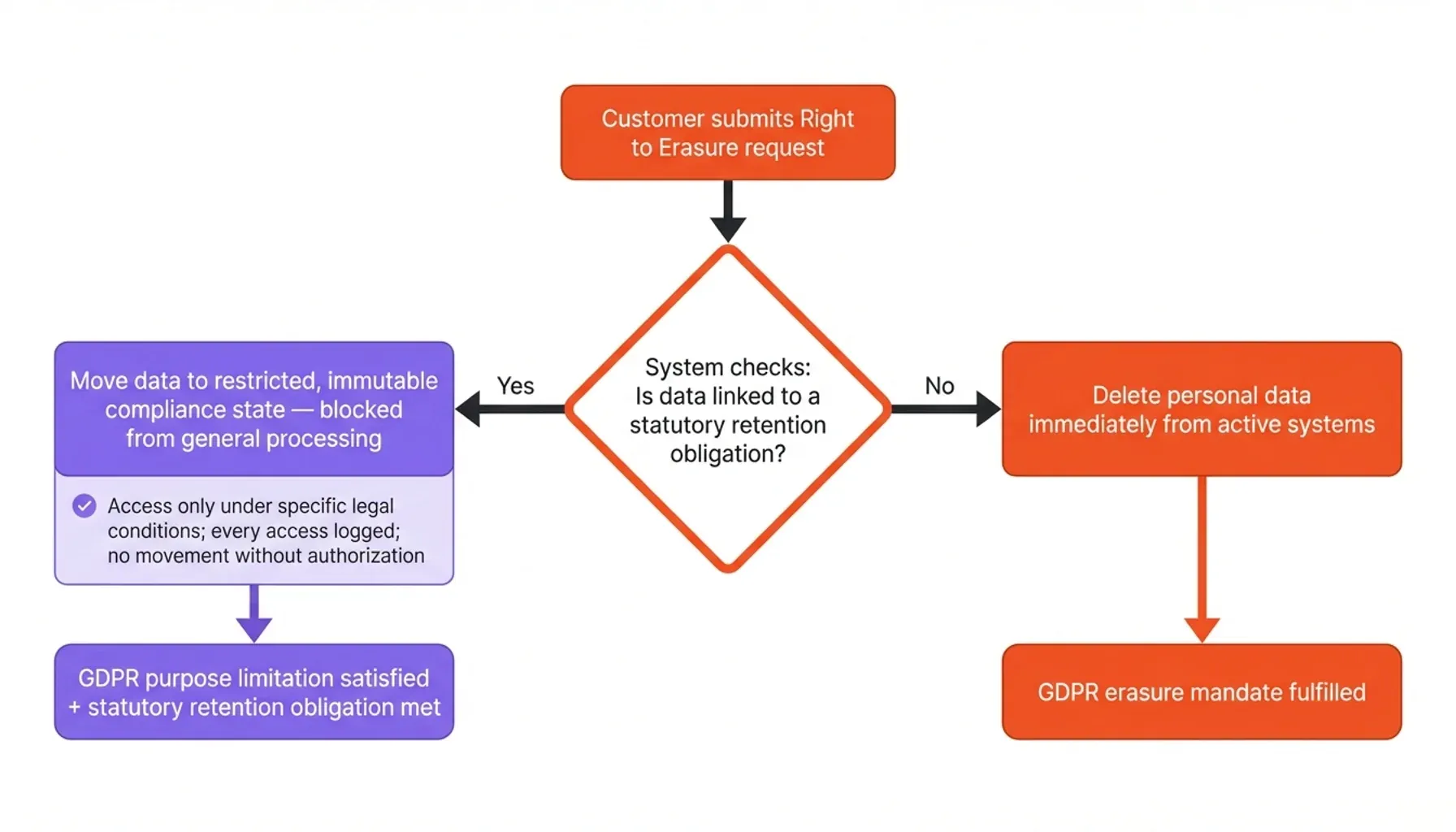
This isn't a hypothetical edge case. It's the daily reality of enterprise data management—a fundamental legal friction between the mandate to delete personal data and the statutory requirement to preserve business records. When a customer exercises their right to erasure, you need to act swiftly to remove personal identifiers from active systems. But if that customer's data ties to a financial transaction, commercial invoice, or tax-relevant document, immediate deletion directly violates statutory retention periods like the German GoBD or the Swiss GeBüV.
This is the document compliance paradox in its purest form. Severe privacy fines sit on one side; loss of evidentiary value—or tax penalties—on the other. Manual document management fails entirely under this kind of regulatory pressure. Relying on human intervention to track which documents must be deleted, which must be retained, and which are subject to legal holds inevitably produces critical compliance breaches.
The cost of getting it wrong extends far beyond regulatory fines. In corporate litigation or tax audits, a compromised document archive means total loss of evidentiary value in court. If you cannot definitively prove that a retained document has remained completely unaltered since its creation, that document becomes legally worthless.
Resolving this paradox hinges on purpose limitation. Think of it like a sealed evidence locker in a police department: the contents are accessible only under specific legal conditions, every access is logged, and nothing moves in or out without authorization. When customer data is no longer needed for its original processing purpose—active support or marketing—but must still be retained for tax auditing, you need to move it into exactly that kind of restricted, immutable state. The data is blocked from general processing and preserved exclusively for compliance audits. Done right, this approach bridges the gap between GDPR mandates and strict commercial retention laws without violating either.
What "Document Compliance" Actually Means (And Why the Definition Matters)
Before architecting a technical solution, it pays to be precise about what "document compliance" actually means—because the term gets used loosely in ways that obscure its real scope.
Document compliance is the organizational and technical discipline of ensuring that records are created, classified, stored, accessed, and destroyed in accordance with applicable legal, regulatory, and contractual obligations. It covers not just how long a document is kept, but how it is protected, who can access it, and what proof exists that the entire lifecycle was handled correctly.
The scope is broader than most organizations initially assume. Document compliance applies to structured data (database records, ERP transactions), unstructured data (emails, PDFs, contracts), and semi-structured data (spreadsheets, forms). It spans every department that generates or processes records: finance, HR, legal, operations, and IT. And it extends across the entire document lifecycle—from the moment a record is created to the moment it is verifiably destroyed.
Common Regulatory Drivers
The specific obligations your organization faces depend on your industry, geography, and the types of data you process. The most common regulatory drivers include:
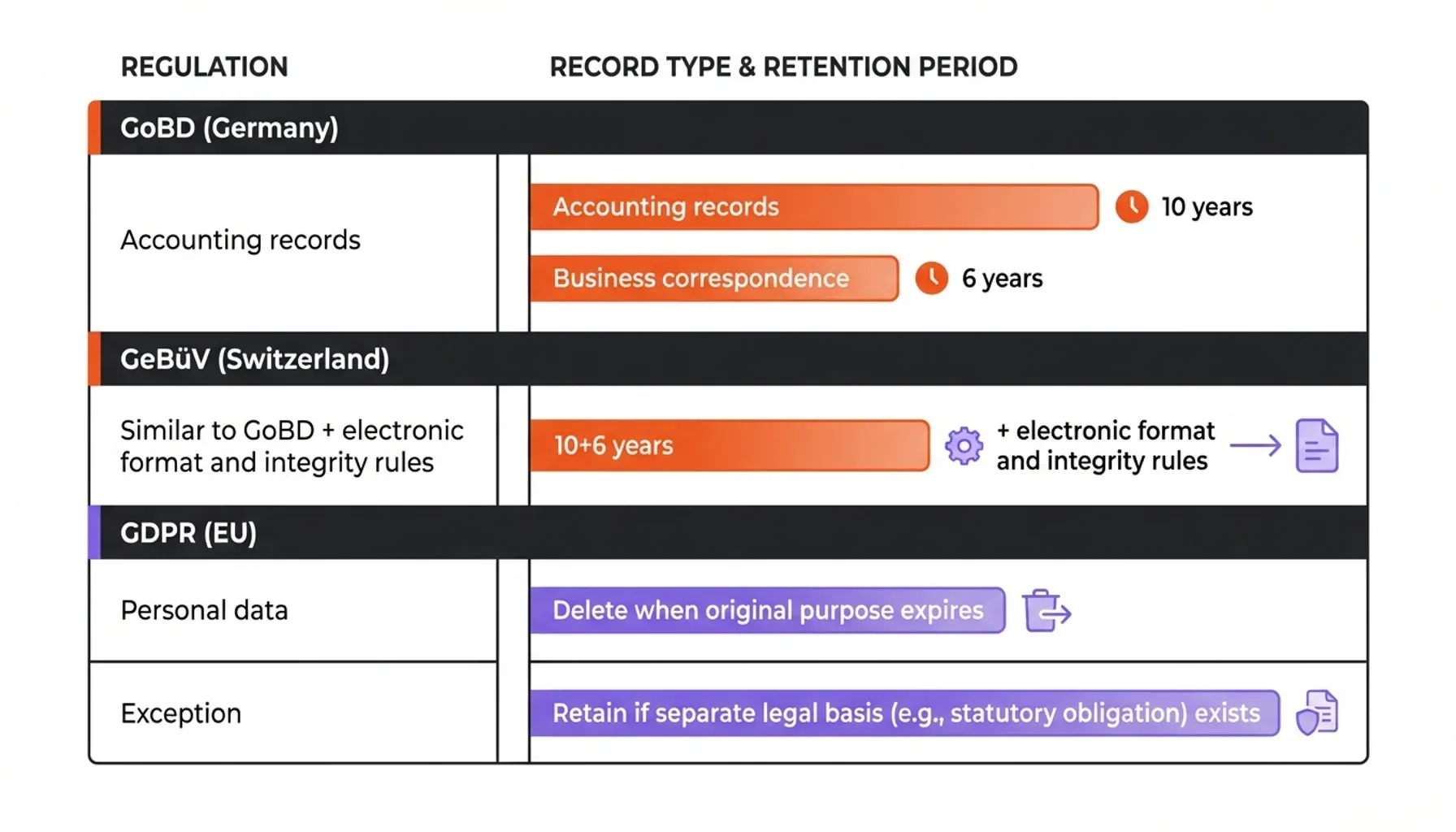
Tax and commercial law. Most jurisdictions require businesses to retain financial and commercial records for a defined statutory period—typically six to ten years. In Germany, the GoBD (Grundsätze zur ordnungsmäßigen Führung und Aufbewahrung von Büchern) mandates ten-year retention for accounting records and six years for business correspondence. Switzerland's GeBüV imposes similar requirements with additional rules on electronic format and integrity. These obligations are non-negotiable and carry criminal liability for willful non-compliance.
Privacy regulation. The EU General Data Protection Regulation (GDPR) requires that personal data be retained only as long as necessary for its original processing purpose. Once that purpose expires, the data must be deleted—unless a separate legal basis, such as a statutory retention obligation, justifies continued storage. This creates the direct collision with tax law described above.
Sector-specific regulation. Healthcare organizations processing patient data face obligations under HIPAA in the United States or equivalent national laws in Europe. Financial services firms must comply with frameworks like SEC Rule 17a-4 in the US or MiFID II in the EU. Pharmaceutical and manufacturing companies contend with product liability timelines that can extend retention requirements to thirty years or more.
Contractual obligations. Beyond statutory requirements, many enterprise contracts—particularly in defense, public administration, and critical infrastructure—impose their own document retention and audit-readiness obligations. These are legally binding even where no specific regulation applies.
Understanding which of these drivers applies to each document category in your organization is the essential first step. Without that mapping, any retention schedule you build is guesswork.
Compliance Frameworks and Standards: Mapping Regulations to Document Controls
Regulatory obligations don't exist in isolation—they map directly to specific technical and procedural controls that your document management infrastructure must implement. Understanding this mapping is what separates organizations that achieve genuine compliance from those that simply check boxes.
GDPR and Document Controls
GDPR's impact on document management is pervasive. Its core principles—purpose limitation, data minimization, storage limitation, and integrity and confidentiality—each translate into concrete system requirements.
Storage limitation requires that documents containing personal data carry a defined retention period and that automated deletion executes when that period expires. Your archive must support metadata-driven lifecycle policies, not just passive storage.
Integrity and confidentiality (Article 5(1)(f)) requires that personal data be protected against unauthorized processing, accidental loss, destruction, or damage. In practice, this mandates encryption at rest and in transit, access controls tied to role-based permissions, and audit logs that record every interaction with a document.
Data subject rights—including the right of access (Article 15), right to rectification (Article 16), and right to erasure (Article 17)—require that your systems can locate, produce, correct, or delete specific records on demand. This is operationally impossible without a well-structured metadata layer and a reliable document classification scheme.
ISO 27001 and Document Security Controls
ISO 27001, the international standard for information security management systems, provides a framework that directly supports document compliance. Its Annex A controls include requirements for asset classification, access control, cryptography, physical and environmental security, and supplier relationships—all of which apply to document archives.
For organizations seeking ISO 27001 certification, document control is explicitly addressed in clause 7.5, which requires that documented information be available, adequately protected, and subject to defined processes for creation, updating, and control. Aligning your document management practices with ISO 27001 not only supports certification but also provides a defensible framework for demonstrating due diligence to regulators and enterprise customers.
SOC 2 and Audit Readiness
SOC 2, developed by the American Institute of Certified Public Accountants (AICPA), evaluates service organizations against five Trust Services Criteria: security, availability, processing integrity, confidentiality, and privacy. For B2B SaaS providers and cloud-based ERP vendors, SOC 2 Type II certification has become a de facto requirement for enterprise sales.
Document compliance directly supports SOC 2 readiness. The confidentiality criterion requires that information designated as confidential is protected throughout its lifecycle. The availability criterion requires that systems remain available for operation as committed—which includes the ability to retrieve archived records on demand. Immutable audit logs, encrypted storage, and defined retention policies are all evidence artifacts that auditors examine during a SOC 2 assessment.
HIPAA and Healthcare Records
The Health Insurance Portability and Accountability Act (HIPAA) imposes specific requirements on the retention and protection of protected health information (PHI). The HIPAA Security Rule requires covered entities and business associates to implement technical safeguards including access controls, audit controls, integrity controls, and transmission security.
From a document compliance perspective, HIPAA requires that PHI retained in electronic form be protected by encryption, that access be logged and auditable, and that records be retained for a minimum of six years from the date of creation or last effective date. Critically, HIPAA's breach notification rule requires covered entities to notify affected individuals and the Department of Health and Human Services within 60 days of discovering a breach—a deadline that is impossible to meet without a functioning incident detection and audit trail system.
Mapping the Matrix
In practice, most large organizations face overlapping obligations from multiple frameworks simultaneously. A European healthcare SaaS provider might face GDPR, HIPAA (if serving US customers), ISO 27001 (as a certification requirement), and SOC 2 (for enterprise sales). Each framework imposes slightly different controls, but the underlying document management requirements converge on a common set of capabilities: classification, encryption, access control, immutable audit logging, defined retention periods, and verifiable deletion.
When these frameworks overlap, choosing between a DMS, ECM, or dedicated archive is one of the most consequential infrastructure decisions an organization can make.
Document Lifecycle Governance: Creation, Classification, Version Control, and Approval Workflows
Retention schedules and cryptographic integrity controls only work if documents are governed correctly from the moment they are created. Lifecycle governance is the operational discipline that makes compliance technically enforceable—and it starts well before a document reaches the archive.
Creation and Capture
Every document that enters your organization's information ecosystem should be captured through a controlled process that assigns baseline metadata at the point of creation. This metadata—document type, originating system, business unit, date of creation, and applicable regulatory category—drives every downstream compliance decision. Documents that enter the system without proper metadata classification become compliance liabilities: you cannot apply retention rules to records you cannot categorize.
For documents generated by ERP systems—invoices, purchase orders, payroll records, tax assessments—metadata capture should be automatic, driven by the transaction type that generated the document. For unstructured documents like contracts, correspondence, and technical reports, organizations need either a structured intake workflow or an AI-assisted classification layer that assigns categories based on content analysis.
Classification Schemes
A robust classification scheme is the backbone of document lifecycle governance. It defines the categories of documents your organization produces, maps each category to its applicable regulatory obligations, and assigns default retention periods and access controls.
A practical classification scheme typically operates on two levels. The first level defines broad document families: financial records, personnel records, legal records, technical documentation, customer records, and operational records. The second level defines specific document types within each family: tax invoices, employment contracts, litigation correspondence, product specifications, and so on.
Each document type in the scheme should carry a defined set of attributes: the applicable regulatory framework (GoBD, GDPR, HIPAA), the retention period and trigger event, the access control tier, and the destruction method. This structured approach lets automated systems apply the correct policy to every document without human intervention—and it forms the foundation of a well-architected ERP archive.
Version Control
For documents that evolve through multiple drafts—contracts, policies, technical specifications—version control is a compliance requirement, not just a convenience. Regulators and courts are often interested not just in the final version of a document but in the history of its development: when specific clauses were added, who approved changes, and whether the final version reflects the agreed terms.
A compliant version control system must maintain a complete, immutable history of every document version, with timestamps and author attribution for each change. Critically, earlier versions must be retained according to the same rules as the final version—you cannot delete draft versions of a contract simply because the final version has been executed.
Version control also intersects with integrity verification. Each document version should carry its own cryptographic hash, allowing you to prove not just that the final version is unaltered, but that the entire revision history is authentic.
Approval Workflows
Many document types—financial authorizations, legal agreements, regulatory submissions—require formal approval before they become legally effective. Embedding approval workflows directly into your document management system serves two compliance functions.
First, it creates an auditable record of who reviewed and approved a document, when, and under what authority. This is directly relevant in regulatory investigations and litigation, where the question of who knew what and when is often central.
Second, it prevents documents from entering the archive in an unapproved state—a common source of compliance risk in organizations that rely on email-based approval processes. When approval is a system-enforced step rather than an informal convention, you eliminate ambiguity about whether a document is final and subject to retention obligations.
Building a Modern Retention Schedule
To navigate competing regulatory frameworks, you need a modern, automated retention schedule. That means moving away from static spreadsheets and manual archiving toward dynamic, metadata-driven policies that govern the entire lifecycle of enterprise information.
Start by categorizing your data types to assign accurate retention rules. Financial records—invoices, ledgers, tax assessments—typically carry a strict 10-year retention mandate across most European jurisdictions. Personnel files follow different timelines, often requiring deletion shortly after termination unless specific legal disputes arise. Technical documentation, manufacturing logs, and product liability records may need retention periods spanning decades, depending on your industry. Getting these categories right is foundational when defining the requirements for a comprehensive ERP archive.
Mapping retention triggers accurately is equally critical. The standard trigger for financial and commercial documentation is the 'end of year' rule. Under this framework, the statutory retention period doesn't begin on the exact date a document was created—it starts at the end of the calendar year in which the document was finalized. A commercial invoice generated in March 2024, for example, begins its 10-year retention countdown on December 31, 2024. Systems that fail to calculate this offset expose you to premature deletion and subsequent audit failures.
Automating the document lifecycle is the only sustainable way to manage these overlapping timelines. A modern retention schedule uses metadata tags to automatically route documents through their lifecycle phases: active use, restricted archiving, and eventual automated destruction. This metadata-driven approach applies policies uniformly across millions of records—no human error, no gaps.
The system also needs to execute legal holds during active litigation. When a dispute arises, standard GDPR deletion protocols and routine retention expirations must be immediately suspended for all relevant documents. A robust compliance engine lets your compliance officers place a legal hold via metadata, effectively freezing the document's lifecycle and preserving critical evidence—without violating broader privacy standards across the rest of the database.
Compliance Monitoring and Risk Management
Building a retention schedule is one thing. Keeping it working under real-world pressure is another. Compliance isn't a one-time implementation—it's an ongoing operational discipline that requires policies, training, incident response, and continuous improvement baked into your culture.
Policies and governance. Every organization handling personal data needs a documented data governance framework that maps regulatory obligations to specific roles and systems. This isn't just a legal formality. A well-structured policy tells your IT team exactly which documents fall under GoBD, which fall under GDPR, and who is accountable when the two collide. Without this clarity, you're relying on individual judgment in high-stakes moments—and that's where compliance breaks down.
Training and awareness. Your technology is only as strong as the people operating it. Compliance officers, IT administrators, and even frontline staff who handle customer data requests need regular, role-specific training. This is where most organizations underinvest. A single undertrained employee mishandling a GDPR erasure request—or failing to flag a document for legal hold—can unravel months of careful technical implementation. Training should cover not just procedures, but the why behind them: what's at stake legally, financially, and reputationally.
Incident response. Despite best efforts, compliance incidents happen. A document gets deleted prematurely. A legal hold is applied too late. An unauthorized user accesses restricted records. You need a defined incident response plan that specifies detection, containment, notification, and remediation steps. Under GDPR, certain data breaches require notification to supervisory authorities within 72 hours—a deadline that's impossible to meet without a rehearsed response process. Blockchain-anchored audit trails become invaluable here: they give your incident response team a precise, tamper-evident record of exactly what happened and when.
Continuous improvement. Regulatory frameworks evolve. The shifting landscape of European archiving requirements means that a compliance posture that was solid two years ago may have gaps today. Schedule regular compliance reviews—quarterly at minimum—to reassess your retention schedules, test your legal hold workflows, and audit your access controls. Treat each near-miss or regulatory update as an input into your improvement cycle, not just a problem to be patched.
Data Integrity: The Missing Link in Document Compliance
A retention schedule ensures documents are kept for the right amount of time. But it doesn't address the most critical requirement of digital archiving: authenticity. A stored document is legally useless without mathematically provable evidence of its original state. If an auditor or judge can't be certain that a digital invoice, contract, or technical log has remained completely unaltered since it was archived, you lose your ability to defend yourself.
This is where standard enterprise backups fall short. A backup creates a copy of data at a specific point in time—it doesn't provide a tamper-evident audit trail. If a system administrator with elevated privileges alters a document in the active database, the next backup simply copies the altered version. To achieve true document compliance, you need to move beyond simple storage and implement cryptographic hash functions to secure data integrity.
The foundation of modern data integrity is the SHA-256 hash function. When a document is finalized, the archiving system processes the file through a cryptographic algorithm and generates a unique, fixed-length string of characters—a digital fingerprint. Even the slightest alteration—changing a single comma, modifying a date—produces a completely different hash value. Securely storing this hash lets you instantly detect unauthorized modifications and prove that the document is exactly as it was when originally sealed.
In jurisdictions with stringent regulatory requirements like Switzerland, proving this integrity isn't optional. The Swiss GeBüV standard dictates strict rules for the electronic preservation of commercial records, requiring absolute proof of origin and immutability. Achieving KRM-certification (Kompetenzzentrum Records Management) demonstrates that an archiving solution meets these rigorous standards—ensuring the technology provides the cryptographic safeguards needed to maintain document authenticity over decades of storage. For IT leaders evaluating whether a DMS, ECM, or dedicated archive best fits their compliance requirements, the ability to mathematically guarantee this level of data integrity is the defining factor.
Blockchain Timestamping and Notarization: Proof of Existence and Provenance
Cryptographic hashing proves a document hasn't been altered. But it doesn't prove when it was created or by whom. To establish a legally defensible timeline and chain of provenance, you need to permanently anchor the document's hash to a verifiable point in time—and, where required, to a verifiable identity. Blockchain timestamping and digital notarization together deliver exactly that: an immutable Proof of Existence at a specific, indisputable moment, combined with non-repudiation that no single party can later deny.
How Blockchain Timestamping Works
Blockchain fundamentally changes how trust is established in digital environments. By utilizing a decentralized architecture that ensures transparency and auditability, blockchain timestamps eliminate the need to trust a single centralized authority or software vendor. When a document is hashed, that hash is aggregated and anchored into a block on public ledgers like Bitcoin or Ethereum. Once the block is confirmed, the timestamp is mathematically sealed—computationally impossible to backdate, modify, or erase.
The advantage of public ledgers over private, centralized databases is profound. In a private database, a rogue administrator or sophisticated threat actor can manipulate access logs, alter timestamps, and cover their tracks. Public blockchains distribute identical copies of the ledger across thousands of independent nodes globally. Altering a historical timestamp would require compromising the majority of the network simultaneously—practically impossible. This approach is widely recognized for establishing mathematically provable trust in open, adversarial environments, shifting the burden of proof from vulnerable internal systems to global mathematical consensus.
OriginStamp has pioneered this peer-reviewed blockchain infrastructure for over 12 years. Acting as the core integrity layer, OriginStamp enables you to generate tamper-evident blockchain timestamps for millions of records simultaneously. This decentralized trust model means you can prove the exact state and time of a document's existence completely independently of any specific vendor, administrator, or internal IT infrastructure. The mathematical proof lives on the blockchain permanently—decades later, auditors or legal entities can independently verify a document's authenticity.
Non-Repudiation and Digital Notarization
Blockchain timestamping establishes when a document existed in a specific state. Non-repudiation goes one step further: it establishes that a specific party created, received, or approved that document and cannot later deny it. Together, these two properties form the backbone of provenance—the documented chain of custody that answers who did what, to which document, and when.
Several complementary notarization methods work alongside blockchain timestamps to build this chain:
Qualified electronic signatures (QES). Under the EU's eIDAS Regulation, a qualified electronic signature carries the same legal weight as a handwritten signature. When a QES is applied to a document, it cryptographically binds the signer's verified identity to the document's hash at a specific time. Combined with a blockchain timestamp, this creates a record that is both tamper-evident and identity-bound—the signer cannot repudiate the act, and the document's state at the moment of signing is permanently verifiable.
Trusted timestamping authorities (TSA). RFC 3161-compliant timestamping authorities issue signed timestamp tokens that bind a document hash to a precise time, certified by a trusted third party. TSA timestamps are widely accepted in legal proceedings across EU jurisdictions and integrate directly with PKI infrastructure. They complement blockchain timestamps by providing a certificate-backed time reference that courts and auditors recognize within existing legal frameworks.
Hash registries and notarization services. Beyond public blockchains, several jurisdictions operate or recognize official hash registries—centralized services where document fingerprints are registered with a government-backed or accredited authority. These registries provide a legally recognized record of document existence that carries explicit statutory weight in some national legal systems, particularly for intellectual property and commercial contract disputes.
Audit log notarization. For compliance-critical workflows, the audit log itself—not just the documents it records—can be periodically hashed and blockchain-anchored. This creates a tamper-evident chain of custody for the entire compliance record: not only can you prove a document's state at archival, but you can prove that the log recording every subsequent access and action has itself remained unaltered.
The practical implication is that a mature document compliance architecture doesn't rely on any single notarization method. It layers them: a QES at signing, a blockchain timestamp at archival, TSA tokens for legal proceedings, and periodic audit log anchoring for chain-of-custody integrity. Each layer addresses a different attack surface and satisfies a different evidentiary standard.
Use Cases, Benefits, Limitations, and Legal Admissibility
Blockchain timestamping and notarization aren't theoretical concepts—they have concrete, well-defined applications across regulated industries. Understanding where they fit, where they don't, and how courts treat them is essential before you build them into a compliance architecture.
Use cases. The most mature use case is financial record integrity: anchoring the hash of every invoice, ledger entry, or tax document to a public blockchain at the moment of archival. This gives auditors a cryptographic reference point entirely independent of your internal systems. A second major use case is contract lifecycle management—timestamping each executed version of a contract creates an irrefutable record of what was agreed and when, directly relevant in commercial disputes. In healthcare, timestamping clinical trial data and patient records supports both regulatory submissions and litigation defense. In software development, timestamping code commits and release artifacts supports intellectual property claims and product liability defenses.
Benefits. The primary benefit is vendor-independent proof. Because the timestamp lives on a public blockchain, its validity doesn't depend on the continued existence or trustworthiness of any single company. A document timestamped today can be verified in thirty years by any party with access to the public ledger—no proprietary software required. The secondary benefit is tamper-evidence at scale: you can timestamp millions of documents per day with negligible marginal cost, making it practical to apply cryptographic proof to entire document populations rather than selected high-value records.
Limitations. Blockchain timestamping proves that a specific hash existed at a specific time—it does not prove the content of the document was accurate, lawfully obtained, or created by the claimed author. It also does not replace a qualified electronic signature under eIDAS, which carries its own legal weight in EU jurisdictions. Additionally, the immutability of the blockchain cuts both ways: if a document is timestamped in error—say, a draft rather than the final version—that incorrect timestamp cannot be removed. Process discipline around what gets timestamped and when is therefore critical.
Legal admissibility. The legal status of blockchain timestamps varies by jurisdiction, but the trajectory is clearly toward broader acceptance. In the EU, the eIDAS Regulation (Article 41) establishes that an electronic timestamp cannot be denied legal effect solely on the grounds that it is in electronic form. Several EU member states have gone further: Germany's courts have accepted blockchain timestamps as evidence of document existence in commercial disputes, and Switzerland's digital signature law explicitly recognizes hash-based integrity proofs. In the United States, blockchain timestamps have been admitted as evidence under the Federal Rules of Evidence in multiple cases, typically treated as business records or self-authenticating documents depending on the context. The practical standard courts apply is whether the timestamping process was reliable, consistently applied, and independently verifiable—criteria that public blockchain infrastructure meets by design.
Technical Implementation: OriginVault for ERP Vendors
For B2B SaaS providers and ERP vendors, building a legally compliant, blockchain-backed archiving system from scratch is a massive drain on engineering resources. GoBD compliance, cryptographic hashing, and long-term data preservation fall far outside the core competencies of most software platforms. OriginVault solves this by acting as an invisible compliance layer—a white-label archiving engine that integrates directly into existing software ecosystems.
This infrastructure lets ERP vendors offer legally compliant archiving as a premium feature without dedicating years to internal development. Because OriginVault operates entirely under the ERP provider's branding, end users experience a seamless, native archiving solution.
A critical component of this architecture is strict multi-tenancy. ERP vendors typically serve thousands of end customers, each with distinct regulatory requirements and GDPR obligations. OriginVault ensures data silos are strictly separated within a single instance. One tenant's data, metadata, and encryption keys are mathematically isolated from all others—cross-contamination is impossible, and GDPR data sovereignty rules are strictly enforced.
To protect data from internal threats, OriginVault uses an AES-256 data seal. This advanced encryption standard makes archive contents entirely opaque to unauthorized users. Critically, the combination of AES-256 encryption and the blockchain certificate means that even system administrators with root access cannot modify, read, or silently delete documents without instant detection. The system operates under a zero-trust model—the infrastructure itself assumes internal networks could be compromised.
Deployment flexibility matters just as much for enterprise clients with diverse IT strategies. OriginVault is fully cloud-agnostic, supporting deployment across AWS, Microsoft Azure, or on-premise environments. This flexibility lets ERP vendors meet the precise data residency and infrastructure requirements of highly regulated industries—healthcare, defense, public administration—without compromising the underlying security architecture.
Best Practices for Audit-Proof Archiving
Achieving document compliance isn't a one-time technical implementation. It requires continuous adherence to strict operational best practices. Technology provides the foundation, but your internal processes must align with regulatory frameworks to keep an archive truly audit-proof.
One of the most critical operational safeguards is the four-eyes principle for sensitive data deletion. While standard retention schedules automate routine destruction of expired documents, exceptional circumstances—court-ordered expungements, specific GDPR erasure requests—may require manual intervention. In these cases, a single user should never have the authority to permanently execute a deletion. The system must enforce a workflow where one authorized officer initiates the deletion request and a second, independent officer reviews and approves it. This dual-authorization model prevents accidental data loss and protects against malicious internal sabotage.
Equally important: maintain a continuous, blockchain-backed audit trail for every document action. An archive is only as reliable as its log files. Every time a document is ingested, accessed, placed on legal hold, or eventually destroyed, that action must be recorded. By anchoring this audit trail to the blockchain, you create an immutable history of the document's lifecycle. If an auditor questions why a specific financial record was deleted, you can provide cryptographic proof that the deletion occurred precisely at the end of its 10-year statutory retention period, in full compliance with commercial law. Organizations operating under strict broker-dealer recordkeeping requirements like SEC Rule 17a-4 know that a tamper-evident audit log is the ultimate defense during regulatory inquiries.
Another best practice is the architectural separation of searchable metadata from encrypted content blobs. To comply with privacy regulations, actual document content should remain heavily encrypted—the content blob. But to keep the archive functional and searchable for authorized users, metadata (document type, date, retention policies) should live in a separate, rapidly queryable database layer. This delivers fast retrieval times during audits without exposing the underlying sensitive data.
Finally, run regular compliance health checks. Don't wait for a subpoena. Your IT and compliance teams should routinely simulate document retrieval requests, verify blockchain timestamps, and test the integrity of AES-256 encrypted seals. Proactive health checks mean that when a real audit hits, you can instantly produce mathematically verified evidence—transforming a potentially stressful investigation into a standard operational procedure.
Future-Proofing: From Compliance to Strategic Advantage
Viewing document compliance purely as a regulatory burden is a missed opportunity. Forward-thinking organizations recognize that robust data integrity and automated retention policies dramatically reduce operational overhead and eliminate legal debt. When document lifecycles are fully automated, IT teams shift their focus from manually managing storage limits and executing deletion scripts to higher-value work—and e-discovery requests that once took weeks resolve in hours.
The broader industry trend points in one direction: compliance is becoming a competitive differentiator, not just a cost center. In an era of deepfakes, AI-generated content, and tightening privacy laws, the ability to guarantee document authenticity is increasingly what enterprise procurement teams demand before signing. Organizations that embed cryptographic integrity and automated lifecycle governance into their core infrastructure don't just pass audits—they win contracts. The strategic value of this shift is explored in depth in the digital archiving whitepaper, which maps how compliance investment translates into measurable business outcomes.
Digital sovereignty is the other defining trend. As geopolitical tensions reshape data governance—from Schrems II to evolving US cloud access laws—organizations actively seek infrastructure that keeps their records immune to foreign jurisdictional overreach. Anchoring document archives to Swiss infrastructure and Europe's strictest data protection frameworks is no longer a niche preference; it's a procurement requirement in defense, public administration, and critical infrastructure. This shift is reshaping the economics and architecture of European archiving at scale.
What good looks like, in practice, is an organization that has mapped every document category to its regulatory obligations, automated lifecycle transitions so that no human judgment stands between a retention trigger and its execution, and anchored the entire chain of custody to cryptographic proof that exists independently of any internal system. Metadata drives classification from the moment of creation. SHA-256 hashes seal every finalized record. Blockchain timestamps make the timeline mathematically irrefutable. Legal holds freeze the lifecycle instantly when litigation arises. Dual-authorization workflows govern every exceptional deletion. And quarterly health checks ensure the system performs exactly as designed when a real audit arrives. That's not a compliance program—it's a trust infrastructure.
Thomas Hepp
Co-Founder
Thomas Hepp is the founder of OriginStamp and creator of the OriginStamp timestamp, which has set the standard for tamper-proof blockchain timestamps since 2013. As one of the earliest innovators in the field, he combines deep technical expertise with a pragmatic focus on solving real business problems, and is a recognized voice in blockchain security, AI analytics, and data-driven decision support. His work has earned multiple international awards, including a top Best Project recognition from ETH Zurich and the Swiss Confederation. He publishes regularly on blockchain, AI, and digital innovation.