
International Data Retention: Global Compliance Guide
Mar 9, 2026

Thomas Hepp
Mar 9, 2026

The Complexity of Global Data Retention Standards
Here's a paradox that keeps compliance officers up at night: keeping data too long creates liability, but deleting it too soon is a crime. And the gap between those two outcomes can cost you everything.
I spoke recently with a legal counsel at a Fortune 500 manufacturer who described her company's cross-border retention situation as "playing Jenga with live grenades." Every time her team pulled a record to satisfy a GDPR deletion request, they risked destabilizing an audit trail that a US regulator might demand intact six months later. She wasn't being dramatic. She was being precise.
Consider what happened to Meta in Ireland in 2023. The Irish Data Protection Commission hit the company with a €1.2 billion GDPR fine — the largest in the regulation's history — partly because data that should have been deleted was still flowing across borders without adequate legal basis. The rules were clear. The infrastructure wasn't built to follow them. That's the trap.
For global enterprises, the shift from physical record-keeping to digital-first infrastructure has entirely rewritten the rules of corporate governance. International data retention compliance is no longer a localized IT issue. It's a board-level strategic imperative that dictates market access, investor confidence, and existential risk exposure.
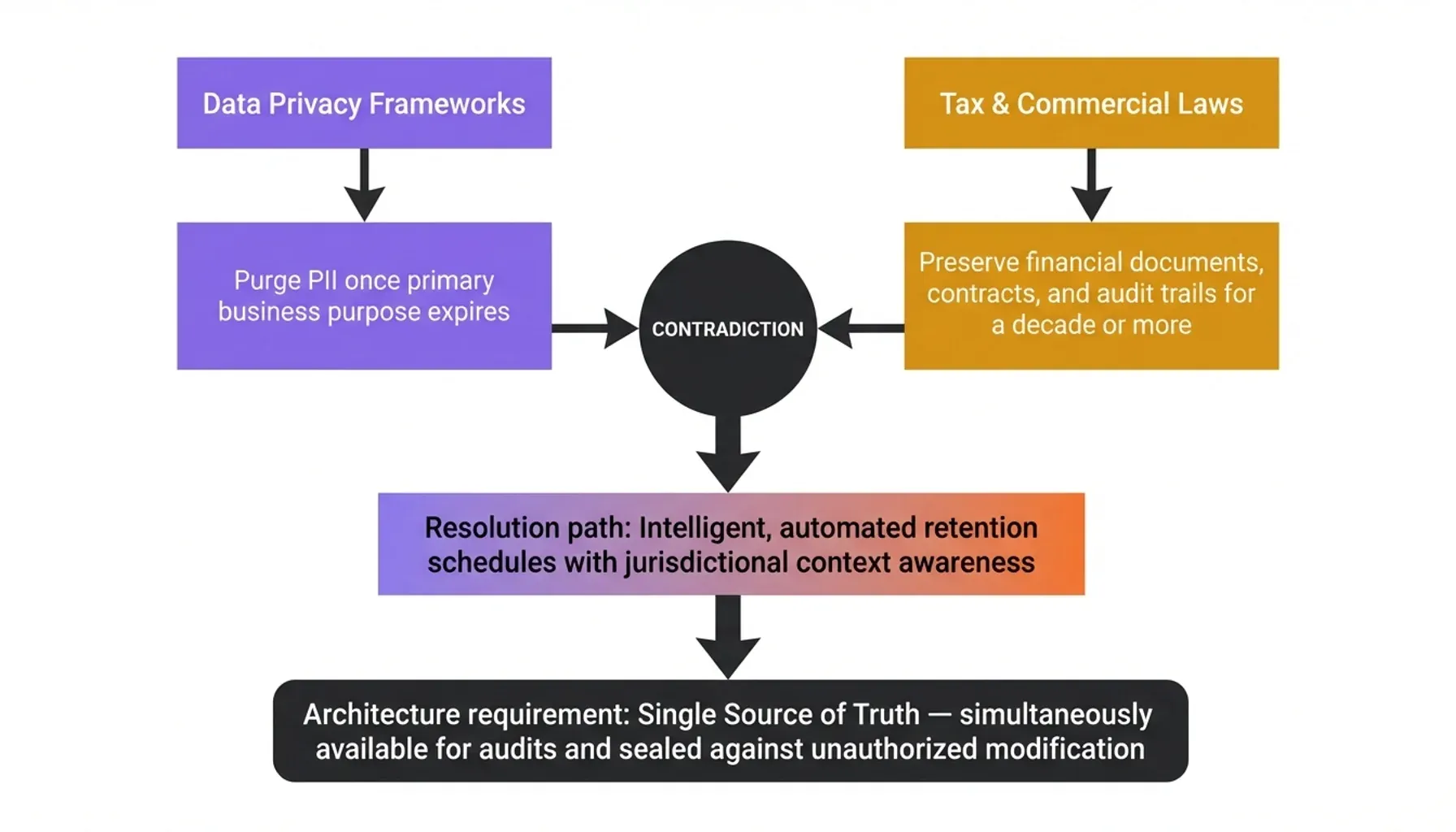
The complexity stems from a direct collision between two regulatory philosophies. Data privacy frameworks demand aggressive minimization — organizations must purge personally identifiable information the moment its primary business purpose expires. But tax authorities and commercial laws mandate strict retention periods, often requiring financial documents, contracts, and audit trails to be preserved immutably for a decade or more. These two demands don't just conflict. They contradict each other.
Balancing these mandates requires moving away from fragmented, departmental storage toward a unified "Single Source of Truth." When an enterprise operates across dozens of borders, relying on localized backup drives or disjointed cloud repositories guarantees compliance failures. True digital governance requires an architecture where data is simultaneously available for authorized audits and mathematically sealed against unauthorized modification.
A "delete everything" policy is just as dangerous as a "keep everything" approach. Organizations must deploy intelligent, automated retention schedules that understand the jurisdictional context of every file. Without programmatic oversight, companies face crippling fines, compromised intellectual property, and catastrophic failures during legal discovery. The dramatic reshaping of enterprise investment decisions driven by these pressures is already visible across the European archiving market.
Data Residency, Cross-Border Transfers, and Sovereignty Requirements
Before you even think about retention periods, answer a more fundamental question: where is your data actually allowed to live?
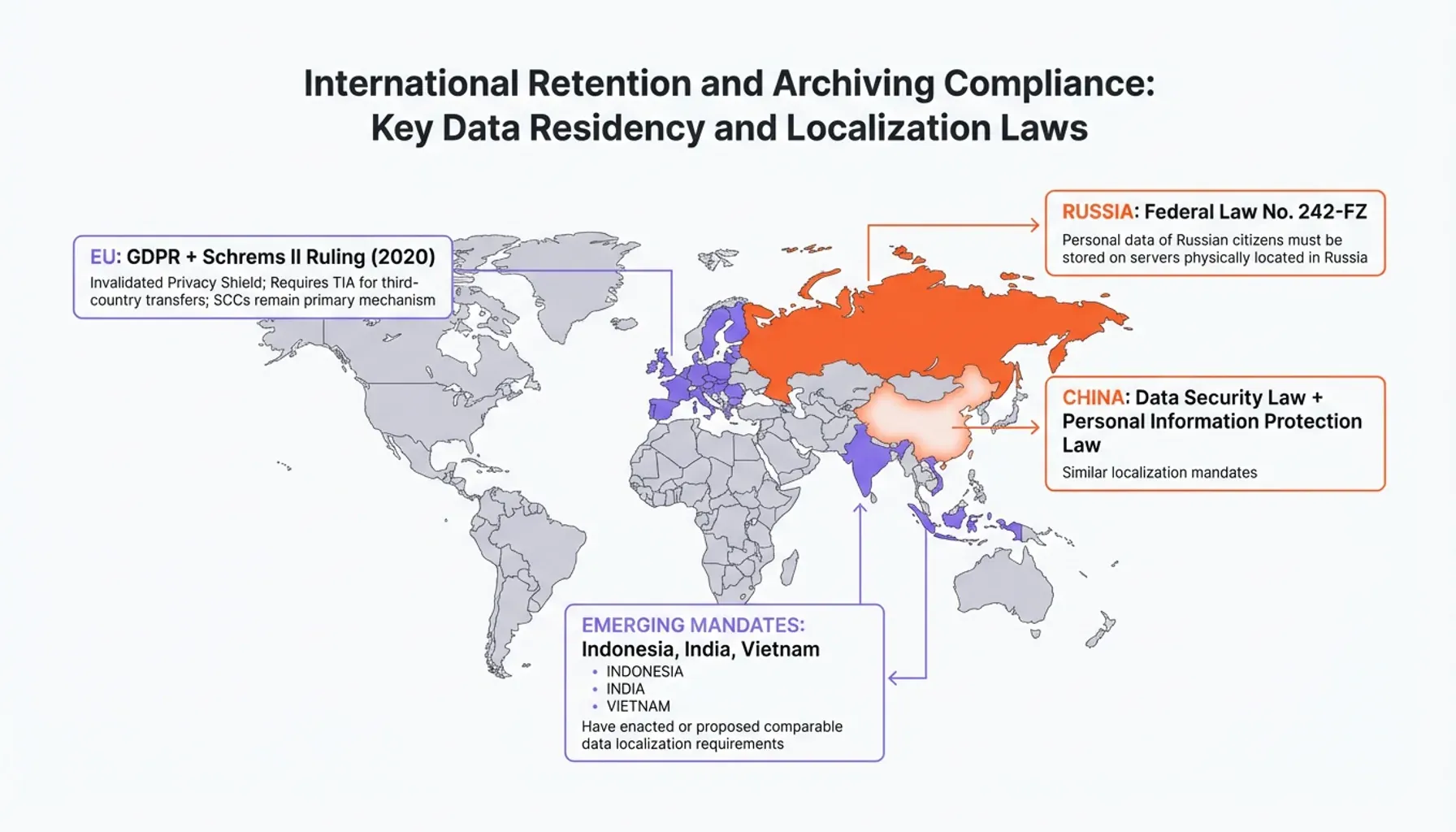
This isn't a technical preference. It's a legal requirement — and one of the most misunderstood dimensions of international compliance. Data residency laws dictate that certain categories of data must be stored within specific geographic boundaries. Russia's Federal Law No. 242-FZ requires personal data of Russian citizens to be stored on servers physically located in Russia. China's Data Security Law and Personal Information Protection Law impose similar localization mandates. Indonesia, India, and Vietnam have all enacted or proposed comparable requirements. The rules changed. Many multinationals are still catching up.
The GDPR and Schrems II Earthquake
For European operations, the legal basis for transferring personal data outside the EU was fundamentally destabilized by the Court of Justice of the European Union's 2020 ruling in Data Protection Commissioner v. Facebook Ireland Limited and Maximillian Schrems — better known as Schrems II. The court invalidated the EU-US Privacy Shield framework, which had underpinned thousands of transatlantic data transfers. Overnight, companies that had relied on Privacy Shield had no valid legal mechanism for their transfers.
The ruling didn't just affect US companies. It forced every organization transferring EU personal data to any third country to conduct a Transfer Impact Assessment — a rigorous analysis of whether the destination country's surveillance laws undermine the protections guaranteed under GDPR. Standard Contractual Clauses (SCCs) remain the primary transfer mechanism, but they now require supplementary technical and organizational measures when the destination country's legal framework falls short.
I've seen companies assume that signing SCCs was enough. It isn't. Schrems II made clear that paper contracts don't override government surveillance powers. You need technical guarantees — encryption where the data importer cannot access the keys, pseudonymization, and in some cases, data localization itself.
What This Means for Your Archive Architecture
The practical implications are significant. Your archiving infrastructure must enforce geographic data boundaries at the object level. A document containing EU personal data cannot simply be replicated to a US data center for redundancy without a valid transfer mechanism in place. Multi-region cloud deployments must be configured with explicit data residency controls — not just default settings.
Cloud-agnostic deployment becomes critical here. Whether an end-customer mandates on-premise installation for maximum digital sovereignty, or requires data to remain within AWS EU (Frankfurt) or Azure Switzerland North, the archiving infrastructure must enforce those boundaries programmatically — not just as a policy document sitting in a drawer.
Navigating Conflicting Deletion and Retention Mandates
The most operationally painful aspect of international data retention compliance isn't knowing the rules. It's reconciling rules that directly contradict each other — often for the same document, at the same time.
The clearest collision point is between GDPR's right to erasure and the retention floors imposed by tax and commercial law. Under GDPR Article 17, a data subject can request deletion of their personal data, and the controller must comply unless a legal exception applies. Under Germany's HGB and AO, financial records containing personal data must be retained for up to ten years. Under the EU's Anti-Money Laundering Directives, customer identity documents must be kept for five years after a business relationship ends. These obligations don't cancel each other out. They stack — and the organization must navigate the intersection precisely.
The resolution framework starts with legal basis mapping. GDPR Article 6(1)(c) permits retention when processing is necessary to comply with a legal obligation. AML retention requirements, HGB mandates, and SOX obligations all qualify. But this exception is narrowly scoped: it covers only the specific data elements required by the relevant law, for the specific period that law mandates, and nothing beyond. Retaining a customer's full profile — including browsing history, preference data, and marketing identifiers — because AML law requires you to keep their identity document does not inherit AML's legal basis. That distinction is where most compliance teams get it wrong.
The practical solution requires data element-level retention tagging, not document-level policies. A single customer onboarding record may contain identity data (AML retention: 5 years post-relationship), financial transaction data (HGB retention: 10 years), and marketing consent records (GDPR: delete on withdrawal). A compliant archive must treat these as separate retention objects — even when they originate from the same file — and enforce independent lifecycle rules for each. This granularity is impossible to achieve with manual processes or generic cloud storage. It requires a purpose-built retention engine with jurisdictional awareness built into the ingestion workflow.
Legal hold management adds another layer of complexity. When litigation or a regulatory investigation is anticipated, organizations must suspend automated deletion — even for data that has reached its scheduled expiry — and preserve everything potentially relevant. The challenge is doing this without violating GDPR's data minimization principle for data that falls outside the hold's scope. A well-architected system applies legal holds at the document level, freezing specific records while continuing to enforce deletion schedules for unaffected data. Organizations that respond to legal holds by freezing entire data repositories routinely create new GDPR exposure in the process of managing their litigation risk.
Key Regulatory Frameworks: From GoBD to GeBüV
While retention periods vary by country, electronic record-keeping requirements are converging around one concept: mathematically provable data integrity. Regulators no longer accept simple database logs as proof of authenticity. They require cryptographic guarantees that a document has remained entirely unaltered since its creation.
In Germany, the Ministry of Finance enforces GoBD-compliant archiving. This framework governs the proper management and storage of books, records, and documents in electronic form. GoBD explicitly demands immutability, completeness, and traceability. If an invoice or tax document is archived, the system must guarantee it cannot be modified or deleted before its legal retention period expires — even by system administrators.
Switzerland operates under GeBüV (the Business Records Ordinance), which establishes the legal basis for electronic archiving. To meet these requirements, enterprises rely on KRM-certified architectures that ensure evidential value. GeBüV compliance mandates that digital archives carry the same legal weight as physical paper trails, requiring robust digital signatures and tamper-evident logging.
In the United States, financial institutions face similarly rigid standards. Sarbanes-Oxley (SOX) and specific SEC regulations mandate that broker-dealers preserve electronic records in a non-rewriteable, non-erasable format. The precise technical and operational requirements under SEC Rule 17a-4 illustrate the universal necessity for WORM (Write Once, Read Many) compliant storage.
The common denominator across all borders is the demand for an immutable audit trail and a cryptographic data seal. Whether facing an auditor in Berlin, Zurich, or New York, the ability to mathematically prove a document's history is your ultimate defense.
The Technical Pillars of Audit-Proof Archiving
Building infrastructure that satisfies global regulators requires more than secure cloud storage. It demands an integrated technology stack designed specifically for audit-proof document storage — one that removes human trust from the equation and replaces it with cryptographic certainty.
The first pillar is the cryptographic hash. When a document enters the archive, the system runs it through a hashing algorithm (such as SHA-256) to generate a unique digital fingerprint. Alter a single pixel in an image or a single comma in a text file, and the resulting hash changes completely. Any tampering becomes immediately evident. This is the baseline for data integrity verification, as defined by NIST's cryptographic standards program.
The second pillar is the AES-256 data seal. Encrypting data at rest prevents unauthorized access — particularly from internal threats. Sealing archived data with AES-256 encryption and a cryptographic certificate neutralizes "Admin Risk." Even IT administrators with root access cannot modify or read sealed documents without triggering an irreversible alert in the audit log. Understanding what a compliant enterprise archive actually requires means mastering these encryption standards first.
The third pillar is software-defined immutability. Historically, companies relied on expensive optical disks or specialized hardware to prevent data overwriting. Today, advanced software architectures enforce immutability at the application and object-storage levels, aligning with ISO/IEC 27001 information security standards. Hardware WORM is no longer the only path. It's not even the best one.
The fourth pillar is metadata management. An archive is useless if you can't find anything in it during an audit. Comprehensive metadata indexing provides the context — author, creation date, jurisdictional tags, retention schedules — necessary to orchestrate automated lifecycle management across millions of files.
Blockchain Timestamping and Notarization: Use Cases, Limitations, and Integration with Retention Policies
Hashing and encryption secure the data. But proving when a document existed — and that it hasn't changed since that exact moment — requires an external, decentralized anchor. That's where blockchain timestamping comes in.
A blockchain timestamp is cryptographic proof that a document existed in a specific form at a specific point in time. By anchoring the SHA-256 hash of a document to public, decentralized ledgers like Bitcoin or Ethereum, organizations create tamper-evident proof of existence that anyone can verify mathematically, forever. Because public blockchains are immutable and distributed across thousands of nodes globally, retroactively altering a timestamp is computationally impossible.
Where blockchain timestamping genuinely adds value:
- Contract notarization. Anchoring the hash of a signed contract at execution time creates an independently verifiable record that the document existed in that exact form on that date — useful in cross-border disputes where notary systems differ.
- Intellectual property protection. Creators and inventors can timestamp design files, source code, or research data to establish prior art without filing formal registrations.
- Audit trail reinforcement. For regulated industries, blockchain timestamps provide a second, vendor-independent layer of integrity verification on top of internal audit logs — critical when regulators question whether internal records could have been manipulated.
- Long-term archiving. Traditional digital signatures rely on certificate authorities that can expire, be compromised, or go out of business. A blockchain timestamp remains verifiable decades later, independent of any issuing authority.
The limitations you need to understand:
Blockchain timestamping is not a silver bullet, and I'd be doing you a disservice if I didn't say so plainly. First, the blockchain only proves that a specific hash existed at a specific time. It says nothing about the content, authenticity, or legal validity of the underlying document. A fraudulent contract, once timestamped, is still a fraudulent contract. Second, public blockchain timestamps are permanent and public — the hash itself is exposed on-chain. While the hash doesn't reveal document content, organizations handling highly sensitive metadata should evaluate whether even hash exposure creates risk. Third, blockchain timestamps currently lack universal legal recognition. Courts in Germany, Switzerland, and the EU have not uniformly accepted them as equivalent to qualified electronic signatures under eIDAS. They function best as a supplementary layer, not a standalone compliance mechanism.
Integrating blockchain timestamps with retention policies:
The most effective implementations treat blockchain timestamping as an event-driven trigger within the retention lifecycle. When a document is ingested into the archive, its hash is immediately anchored on-chain, creating an immutable record of the ingestion event. When the retention period expires and automated deletion is triggered, a second hash — of the deletion certificate — is anchored, creating verifiable proof that destruction occurred at a specific time. This two-event chain (creation anchor + destruction anchor) gives regulators and auditors a mathematically provable lifecycle for every document, without requiring them to trust the archiving vendor's internal logs.
This decentralized approach also solves a vendor dependency problem that traditional Time Stamp Authorities (TSAs) cannot. If the TSA goes out of business or suffers a breach, the trust in those timestamps evaporates. A blockchain timestamp outlasts any SaaS vendor. The proof remains verifiable directly on the public ledger, ensuring long-term digital sovereignty.
Strategic Benefits for ERP and Software Vendors
For ERP, ECM, and DMS vendors, international compliance is often viewed as a massive development hurdle. Building a legally compliant archiving system from scratch requires years of engineering, millions in R&D, and navigating a labyrinth of regional certifications. But there's another way to look at it.
By integrating a pre-certified, white-label archiving engine, software vendors can transform a legal burden into a highly profitable "Compliance-as-a-Service" revenue stream. The compliance requirement doesn't disappear — it becomes your competitive moat.
OriginVault operates precisely on this model. It doesn't sell archiving directly to end-users; it sells European market access and effortless compliance for ERP partners. By embedding a KRM-certified, blockchain-sealed archiving layer, vendors can instantly offer GoBD and GeBüV compliance out of the box. Development cycles shrink. Engineering teams focus on core product features rather than chasing regulatory updates.
Multi-tenant archiving is a critical requirement for these vendors. A modern archiving engine must support thousands of end-customers, ensuring each client operates within a strictly segregated, encrypted data space within a single instance. Multi-tenancy lowers infrastructure overhead while maintaining strict data isolation. That's not a nice-to-have. It's table stakes.
Cloud-agnostic deployment ensures vendors can meet the specific hosting requirements of diverse clients — whether an end-customer mandates on-premise installation for digital sovereignty, or prefers AWS or Azure deployments. The case for treating compliant archiving as a strategic business differentiator is strongest precisely when compliance becomes a feature your competitors can't easily replicate.
Common Pitfalls in International Data Archiving
Despite heavy investments in IT infrastructure, organizations frequently fall into traps that compromise their compliance posture.
The conflicting mandates trap. A multinational might face a scenario where European GDPR mandates the deletion of an employee's records, while US financial regulations demand those same records be retained for an ongoing audit. Without a granular, policy-driven retention engine, you're in a legal catch-22. The rules pull in opposite directions. Nobody wins without automation.
The Dark Data trap. Many enterprises treat their archives as digital dumping grounds, moving petabytes of unstructured data into cold storage without proper indexing. Archiving without searchability isn't archiving. It's hoarding. When regulators request specific communications or transaction logs, the inability to produce intact files within a mandated timeframe results in severe penalties — regardless of how secure the storage medium is.
The backup-as-archive mistake. Many IT departments mistakenly rely on disaster recovery backups as an archiving solution. Backups restore a system to a previous state after failure. They get routinely overwritten, lack granular retention policies, and provide no tamper-evident evidence. Confusing a backup with a true immutable archive destroys the chain of custody required for digital evidence preservation. These are fundamentally different tools.
The Admin Risk blind spot. If an IT administrator can manually delete or alter records within the database without leaving an immutable audit trail, the entire system fails compliance audits. Regulators require proof that the system is sealed against internal manipulation just as rigorously as against external cyber threats. The threat inside the firewall is real. Your architecture needs to account for it.
The data residency assumption. Organizations frequently assume that storing data in a major cloud provider's EU region automatically satisfies all European data sovereignty requirements. It doesn't. Post-Schrems II, you need to verify that your cloud provider's support access, metadata processing, and subprocessor chains don't route EU personal data to jurisdictions without adequate protection. The decision between a DMS, ECM, or a dedicated archive system has direct implications for how granularly you can enforce these residency controls.
Retention Periods by Jurisdiction: A Practical Reference
One of the most operationally complex aspects of international data retention compliance is the sheer variation in mandated timeframes across jurisdictions — and the fact that those timeframes apply differently depending on document type, industry sector, and the regulatory body enforcing them. What follows is a practical reference, not an exhaustive legal guide. Always verify current requirements with qualified local counsel.
Germany
Germany's retention landscape is governed primarily by the German Commercial Code (HGB) and the German Tax Code (AO), both enforced under the GoBD framework. The core retention periods are:
- 10 years: Books of account, annual financial statements, opening balance sheets, inventories, management reports, booking receipts, and all records relevant to taxation. This applies to both paper originals and electronic reproductions.
- 6 years: Business letters (received and copies of sent), commercial correspondence, and other business documents not falling under the 10-year category.
A critical nuance: retention periods begin at the end of the calendar year in which the document was created or the business transaction was completed — not from the document's creation date. A contract signed in March 2024 starts its 10-year clock on January 1, 2025. Organizations that calculate retention from document date rather than year-end routinely under-retain.
Switzerland
Swiss retention requirements under the Code of Obligations (OR) and the GeBüV ordinance mirror Germany's structure but with some distinctions:
- 10 years: Accounting books, annual reports, audit reports, and all supporting documentation for financial statements.
- 10 years: Business correspondence with legal or financial significance.
Switzerland's GeBüV framework places particular emphasis on the reproducibility of archived records — meaning the archive must be capable of rendering documents in a human-readable format throughout the entire retention period, even as software versions change. Organizations that archive in proprietary formats without migration strategies risk technical non-compliance even when the data itself is intact.
United States
US retention requirements are fragmented across federal agencies, state laws, and industry-specific regulators. Key federal mandates include:
- 7 years: Tax records (IRS guidance recommends 7 years for records related to bad debt deductions or worthless securities).
- 7 years: SOX-mandated audit workpapers and records that support financial statements for public companies.
- 6 years: Broker-dealer records under SEC Rule 17a-4, with the first 2 years requiring immediate accessibility.
- 3 years: General employment records under FLSA; longer periods apply for ERISA pension records (6 years) and OSHA exposure records (30 years for toxic substance exposure).
The US system's complexity increases significantly at the state level. California, New York, and Texas each impose additional retention requirements for employment records, consumer data, and regulated industries that can extend beyond federal minimums.
European Union (Sector-Specific)
Beyond GDPR's data minimization principle, EU sector-specific regulations impose their own retention floors:
- 5 years: Anti-money laundering (AML) records under the EU's 6th Anti-Money Laundering Directive — customer due diligence records, transaction records, and supporting documentation.
- 5 years: MiFID II transaction reporting records for investment firms.
- 10 years: EMIR trade repository records for derivative contracts.
The GDPR tension is real here: AML law requires you to retain customer identity documents for 5 years after a business relationship ends. GDPR requires you to delete personal data when it's no longer needed. The resolution is that AML obligations constitute a legal basis for retention under GDPR Article 6(1)(c) — but only for the specific data required by AML law, for the specific period mandated, and no longer. Retaining more data than AML requires, for longer than AML mandates, does not inherit AML's legal basis. This is a distinction many compliance teams miss.
The Retention Calendar Problem
The practical challenge isn't knowing the retention periods. It's applying them correctly across millions of documents with different creation dates, different governing jurisdictions, different document types, and different triggering events. A single customer contract might contain personal data governed by GDPR, financial terms governed by HGB, and intellectual property provisions governed by the laws of a third country. Each element may carry a different retention obligation.
Manual retention calendars fail at scale. The only viable solution is a policy-driven archiving engine that automates jurisdictional lifecycle management — one that tags documents at ingestion with jurisdictional metadata, calculates retention expiry from the correct triggering event, and enforces deletion — or legal hold override — automatically. The alternative is a spreadsheet that someone updates quarterly and nobody fully trusts.
Incident Response and Breach Notification Under Global Retention Frameworks
Retention compliance doesn't operate in isolation. When a data breach occurs, the intersection of retention obligations and breach notification law creates a second layer of regulatory exposure that organizations frequently underestimate.
Under GDPR Article 33, controllers must notify their supervisory authority of a personal data breach within 72 hours of becoming aware of it — where feasible. That 72-hour clock starts ticking the moment the organization has reasonable grounds to believe a breach has occurred, not when the investigation is complete. The notification must include, among other things, the categories and approximate number of data subjects affected, the categories and approximate number of records concerned, and the likely consequences of the breach. None of this is possible without a well-maintained, searchable archive.
Here's where retention architecture becomes directly relevant to breach response. Organizations that have properly tagged and indexed their archived data can rapidly identify which records were affected, which data subjects are involved, and which jurisdictions' notification requirements apply. Organizations with dark data — unindexed, untagged archives — face a different reality: they cannot answer the regulator's basic questions within 72 hours, and that failure itself constitutes a separate compliance violation.
The US breach notification landscape is more fragmented but equally demanding. The FTC's Health Breach Notification Rule requires vendors of personal health records to notify affected individuals, the FTC, and in some cases the media within 60 days of discovering a breach. State laws add further complexity: California's CCPA imposes its own breach notification requirements, and all 50 US states now have breach notification statutes with varying timeframes, thresholds, and covered data categories.
The practical implication for archive architecture is this: your retention system must double as a rapid-response forensic tool. When a breach occurs, you need to query your archive by data subject, data category, time range, and geographic scope — within hours, not days. This requires the same metadata indexing and jurisdictional tagging infrastructure that drives retention lifecycle management. The investment in proper archive architecture pays dividends not just during audits, but during the worst moments your security team will ever face.
Are You Already Exposed? A Five-Step Diagnostic
Most organizations don't discover their compliance gaps during a calm strategic review. They discover them during a regulator audit, a legal hold, or a data subject access request that the system can't answer cleanly. Here's how to find out whether your organization is already exposed — before someone else does.
Diagnostic 1: Can you prove where every regulated document currently lives? Pull a sample of ten financial records, ten HR files, and ten customer contracts. For each one, identify the physical server or cloud region where the primary copy resides, where any replicas exist, and whether each location satisfies the residency requirements of the jurisdiction that governs that document. If you can't answer this for a random sample in under an hour, your data mapping has gaps that a regulator will find.
Diagnostic 2: Do your transfer mechanisms hold up post-Schrems II? List every third country — outside the EU/EEA — to which your organization transfers personal data. For each destination, confirm you have a valid legal basis: current SCCs, a binding corporate rules approval, or an adequacy decision. Then go one step further: verify that the technical measures accompanying those SCCs (encryption, access controls, pseudonymization) are actually implemented in the infrastructure, not just described in a policy document. A gap here is not a theoretical risk. It's the exact fact pattern that triggered the Meta fine.
Diagnostic 3: Is your archive actually immutable — or just hard to access? Ask your IT team to demonstrate what happens when an administrator attempts to modify or delete a document within its retention period. If the answer is "they'd need special permissions" rather than "the system makes it cryptographically impossible and logs the attempt immutably," you don't have an archive. You have a storage system with access controls. Those are not the same thing under GoBD, GeBüV, or SEC Rule 17a-4.
Diagnostic 4: Can you produce a verifiable destruction certificate? When a retention period expires and a document is deleted, does your system generate a tamper-evident certificate of destruction — including a timestamp, the document's hash, and the policy that triggered deletion — that you could hand to a regulator as proof? If deletion is happening silently, without an auditable record, you're exposed on two fronts: you can't prove you deleted what GDPR required you to delete, and you can't prove you retained what tax law required you to keep.
Diagnostic 5: Does your integrity proof survive vendor failure? If your archiving vendor went out of business tomorrow, could you still independently verify the integrity and timestamp of every document in your archive? Or does the proof of authenticity live entirely inside that vendor's proprietary system? This is the vendor dependency trap that blockchain timestamping is specifically designed to solve. If your answer is "we'd have to trust the export files," your long-term digital sovereignty is more fragile than it looks.
These five diagnostics won't tell you everything about your compliance posture. But if you find gaps in more than two of them, you already have the roadmap for where to focus. The goal isn't a perfect system on day one. It's knowing exactly where you stand before a regulator, a court, or an acquirer asks the same questions with higher stakes.
By shifting focus from mere storage to mathematically provable data integrity, enterprises and software vendors can navigate the complex web of global regulations with confidence. Trust is no longer a promise. It's a verifiable fact built into the architecture itself.
Thomas Hepp
Co-Founder
Thomas Hepp is the founder of OriginStamp and creator of the OriginStamp timestamp, which has set the standard for tamper-proof blockchain timestamps since 2013. As one of the earliest innovators in the field, he combines deep technical expertise with a pragmatic focus on solving real business problems, and is a recognized voice in blockchain security, AI analytics, and data-driven decision support. His work has earned multiple international awards, including a top Best Project recognition from ETH Zurich and the Swiss Confederation. He publishes regularly on blockchain, AI, and digital innovation.