How Blockchain Enables Trust Beyond Earth
Apr 1, 2025

Thomas Hepp
Apr 1, 2025

The Final Frontier of Data Integrity
Here's a thought experiment that haunts aerospace engineers: it's September 21, 2003, and NASA's Galileo spacecraft is making its final plunge into Jupiter's atmosphere after 14 years of operation. Mission controllers had meticulously logged every telemetry packet, every thruster firing, every anomaly. But how do you prove those logs were never touched? How do you guarantee, years later, that the record is exactly what the instruments reported — and not what someone needed it to say?
Legacy systems have no clean answer. Blockchain does.
Beyond Earth's atmosphere, data is the only lifeline. Whether it's a telemetry stream from a low-Earth orbit satellite or a life-support diagnostic from a deep-space module, the accuracy of transmitted information dictates the survival of multi-billion-dollar missions. Space exploration has always demanded extraordinary engineering precision, but as we expand our orbital infrastructure, it now demands something equally hard to engineer: trust in the data itself.
Satellite telemetry and deep-space communications face growing threats from tampering, signal degradation, and cyber-attacks targeting space infrastructure. A single altered packet in a navigation sequence — or a manipulated sensor reading — can trigger catastrophic hardware failures. To secure these networks, the aerospace sector is abandoning centralized security models in favor of decentralized, cryptographic verification. Understanding how blockchain technology works at a fundamental level makes clear why space agencies and private enterprises are using it to establish a mathematical anchor for extraterrestrial datasets — an anchor sunk not into seabed but into cryptographic consensus, visible to anyone, movable by no one. No administrator, no adversary, and no accident can quietly drag it loose.
This transition rests on cryptographic hashing. When a telemetry packet generates in orbit, an onboard computer immediately runs it through a SHA-256 algorithm, producing a unique digital fingerprint before the data ever crosses the vacuum of space. NASA's Jet Propulsion Laboratory has long treated deep-space transmission integrity as a mission-critical requirement. OriginStamp's core technology anchors these hashes to public blockchains, creating an immutable, tamper-evident record — independent of any single network administrator or ground station provider — that guarantees the data received on Earth is exactly what the instruments transmitted from orbit.
Securing Satellite Telemetry with Blockchain Timestamps
The NewSpace economy has fundamentally redrawn the orbital map. Where space once belonged exclusively to heavily funded national agencies, thousands of private satellite constellations now crowd low-Earth orbit. This democratization delivers immense analytical power, but it also opens severe security vulnerabilities. When Earth Observation (EO) data flows from dozens of competing private entities, establishing satellite data integrity becomes a genuinely thorny logistical problem.
If you're an analyst receiving EO imagery from three competing providers simultaneously, how do you know which dataset to trust when they disagree? That's not a hypothetical — it's a daily operational reality for climate scientists and defense intelligence teams alike.
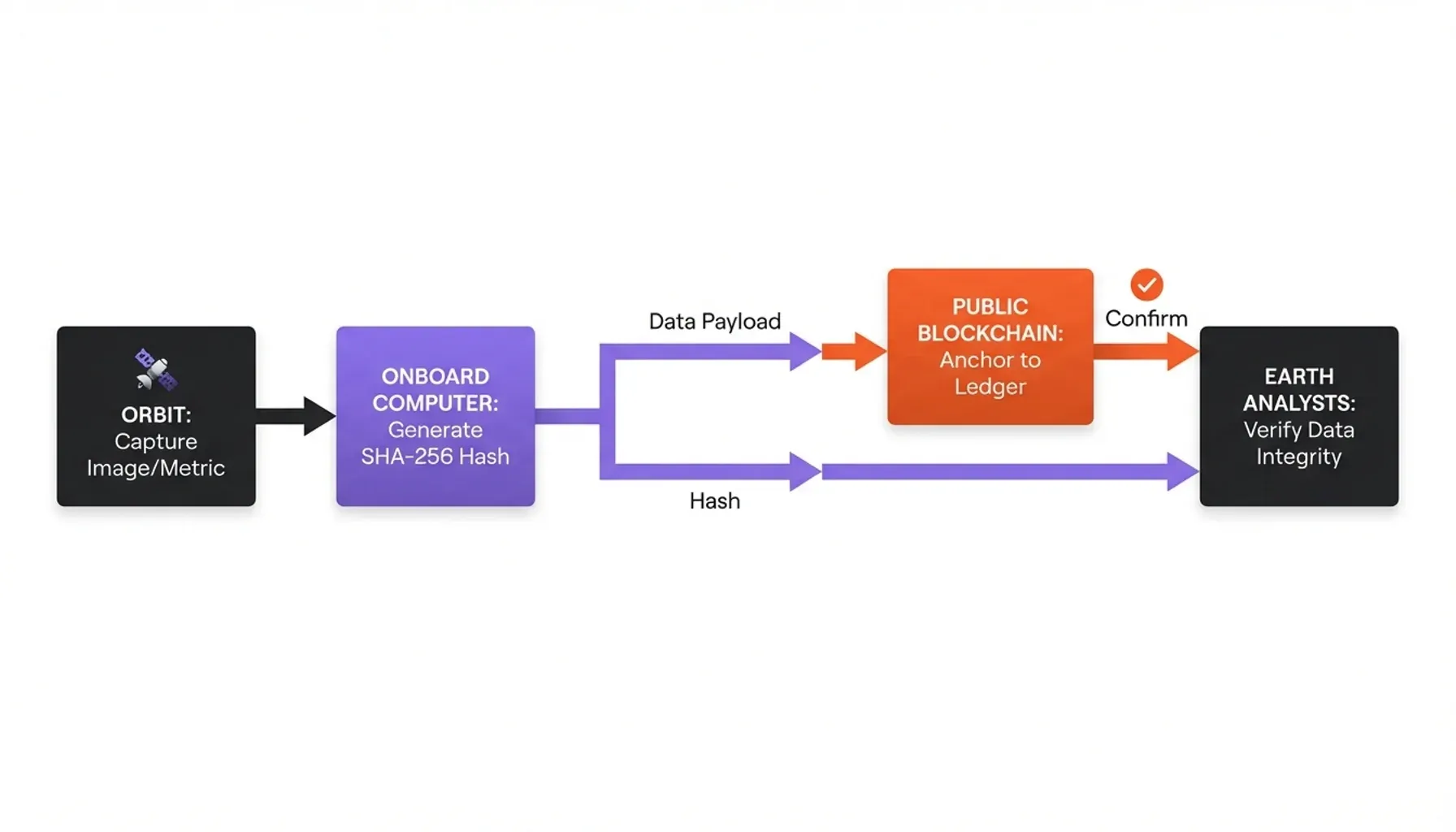
To lock down EO data from the moment of capture to the moment of analysis, aerospace companies lean hard on cryptographic hashing. When a satellite captures an image or records an environmental metric, the onboard computer generates a hash of the raw file and transmits it alongside the data payload. Understanding how blockchain timestamping anchors that hash to a decentralized ledger is crucial here: analysts on Earth can then mathematically prove the data survived transmission and ground processing without alteration — the hash is that anchor sunk into cryptographic consensus, holding the record fast against any storm of post-hoc manipulation.
Tamper-evident telemetry matters most where the stakes are highest — climate monitoring, maritime surveillance, and defense intelligence. Take the tracking of global shipping fleets. Malicious actors routinely spoof Automatic Identification System (AIS) signals to conceal illegal fishing or evade international sanctions. When satellite imagery cross-references and exposes these activities, the underlying data must hold up in court.
Blockchain timestamps give satellite operators absolute proof of authenticity for environmental and surveillance evidence. The World Meteorological Organization has consistently emphasized that verifiable, unaltered climate records are non-negotiable for enforcing international environmental agreements. OriginStamp's infrastructure seals every byte of telemetry with an AES-256 data seal and a blockchain certificate — rendering it tamper-proof even against system administrators with root access.
Blockchain Fundamentals for Space Missions: Architectures, Consensus, and Constraints
Before we go further, I want to be direct about something the industry often glosses over: deploying blockchain in space is not simply a matter of copying a terrestrial architecture and pointing it at the sky. The physics of space operations impose hard constraints on every layer of the stack. If you're an engineer evaluating blockchain for a mission, the first question isn't "which chain?" — it's "what do my power budget, bandwidth ceiling, and communication windows actually allow?"
Architecture Choices
Three broad architectures suit space mission requirements, each with distinct trade-offs:
Public blockchains (Bitcoin, Ethereum) offer maximum decentralization and censorship resistance. Anchoring a hash to Bitcoin means no single entity — not even OriginStamp — can alter the record. The downside is zero control over block times, gas fees, or network congestion. For periodic anchoring of mission logs, that's entirely acceptable. For real-time telemetry validation, it is not.
Permissioned blockchains (Hyperledger Fabric, Quorum) let a consortium of agencies — say, NASA, ESA, and JAXA — run their own validator nodes. You gain predictable latency and governance control, but you reintroduce a degree of centralized trust. If the consortium's validators collude or get compromised, the integrity guarantee weakens.
Hybrid sidechain models combine both: a local permissioned chain handles real-time operations aboard a spacecraft or station, while its cryptographic state root periodically anchors to a public chain for external auditability. This is the architecture that makes the most sense for deep-space missions, and I'll return to it in the latency section.
Consensus Choices Under Space Constraints
Consensus mechanisms designed for Earth-based networks assume something space cannot provide: fast, reliable, bidirectional communication. Here's how the main options stack up:
- Proof of Work (PoW) is computationally expensive and power-hungry. On a spacecraft where every watt is budgeted, PoW is essentially off the table.
- Proof of Stake (PoS) slashes energy consumption dramatically but still requires nodes to communicate within seconds to finalize blocks — a non-starter for Mars-to-Earth links.
- Practical Byzantine Fault Tolerance (PBFT) and its derivatives work well for small, known validator sets (like a crew of six on a lunar base) but don't scale beyond a few dozen nodes.
- Delegated Proof of Stake (DPoS) offers a middle ground: a small elected validator set finalizes blocks quickly with low power draw, making it a strong candidate for habitat-level chains.
Power, Bandwidth, and Storage Constraints
A CubeSat operating on 10 watts of solar power cannot run a full blockchain node. You need lightweight clients — think SPV (Simplified Payment Verification) nodes that store only block headers rather than full transaction histories. Bandwidth on deep-space links is measured in kilobits per second, not gigabits. Every byte matters. Compressing state roots to a few hundred bytes before transmission isn't optional; it's a design requirement.
Storage aboard spacecraft is radiation-hardened and expensive. Storing full ledger histories on-orbit is impractical. The right model stores only cryptographic commitments on-orbit and replicates full history to Earth-based or lunar-based nodes with larger storage budgets.
These constraints are precisely why the proof of existence model — anchoring a hash rather than the full data — is so well-suited to space applications. You get the integrity guarantee without the bandwidth and storage overhead of transmitting entire ledger states across millions of miles. The anchor holds; the chain doesn't have to travel with it.
Space Logistics Blockchain: Supply Chain Traceability from Factory Floor to Mars
Building a sustainable presence on the Moon or Mars requires a logistics network of staggering complexity. A single deep-space vehicle contains millions of individual components, sourced from thousands of specialized manufacturers worldwide. Tracking parts, fuel, and life-support consumables across an interplanetary supply chain exposes the limits of legacy ERP systems almost immediately.
If you're a mission planner responsible for a crewed Mars transit vehicle, you need to know — with certainty — that every component in that vehicle is exactly what the manufacturer certified it to be. A counterfeit micro-valve in a carbon dioxide scrubber isn't a warranty issue. It's a crew-loss scenario.
The aerospace industry constantly battles the "Critical Path" problem: ensuring that every component — from a titanium thruster bell to that micro-valve — meets rigorous aerospace quality standards like ISO 9001 and AS9100. A space logistics blockchain solves this by creating an unbroken, tamper-evident chain of custody for every physical asset — that same anchor sunk into cryptographic consensus, now applied to the physical world.
Parts Pedigree and Maintenance Records
When a manufacturer produces a component, the blockchain record begins immediately. Specifications, testing data, material certifications, and quality assurance sign-offs all get hashed and anchored to the chain at the point of production. As the part moves from factory floor to integration facility to launch pad, every scan, inspection, and custody transfer appends to this immutable audit trail.
This matters enormously for launch vehicle integration. A launch campaign for a crewed mission might involve components from 50 countries and 500 suppliers. Today, verifying the provenance of a suspect component during a launch hold means phone calls, emails, and paper records — a process that can take days. With a supply chain blockchain, a technician scans a QR code and instantly retrieves the complete, cryptographically verified history of that part, from the raw material supplier to the integration stand.
Maintenance records benefit equally. Every scheduled inspection, every unplanned repair, and every component swap generates a blockchain entry tied to the specific part's serial number. If a thruster fails in orbit, engineers trace the exact provenance of the faulty component back to the specific manufacturing or maintenance event — with absolute certainty that quality assurance logs were not altered post-failure to dodge liability. That kind of parts pedigree is what separates a defensible post-incident investigation from a finger-pointing exercise.
Launch-to-Orbit Chain of Custody
Launch manifests themselves deserve the same treatment. A blockchain-anchored manifest creates a timestamped, tamper-evident record of exactly what loaded onto a vehicle and when — critical for post-incident investigations, insurance claims, and regulatory compliance. Every payload, every hazardous material certification, and every last-minute substitution gets a permanent entry in the chain before the countdown clock reaches zero.
Payload manifests for commercial launches involve multiple customers, each with their own chain of custody requirements. A blockchain-based payload management system lets each customer independently verify that their hardware loaded onto the vehicle matches the specifications they certified — without exposing other customers' proprietary data. Each customer sees only their own records, but the overall manifest integrity remains verifiable by the launch provider.
In-space manufacturing adds another dimension entirely. As NASA's in-space manufacturing research demonstrates, producing components aboard the ISS or future stations creates products that never touch Earth's supply chain. These components need their own provenance records from the moment of fabrication. A blockchain record created at the point of manufacture in orbit — anchored to a public chain during the next Earth contact window — establishes an unbroken chain of custody for hardware that was literally born in space.
Propellant Tracking and In-Space Refueling
The emerging in-space refueling economy introduces propellant as a tracked commodity. In-space refueling depots — a key element of NASA's Artemis architecture — need to track propellant provenance, purity certifications, transfer quantities, and custody handoffs between commercial providers and government customers. A blockchain-based propellant ledger creates an auditable record of every transfer, protecting both the supplier (proof of delivery) and the customer (proof of specification compliance).
For software vendors powering these logistical operations, automating compliance delivers a massive competitive advantage. Integrating an OriginVault-style data seal into space-faring ERP systems adds an invisible compliance layer: documents, safety certifications, and supply chain transfers automatically seal with AES-256 encryption and a blockchain certificate, keeping the digital infrastructure supporting interplanetary expansion resilient, audit-proof, and free of single points of failure.
On-Orbit Identity, Authentication, and Access Control
Here's a scenario that keeps spacecraft security engineers up at night: a command arrives at a satellite's uplink receiver. It looks legitimate. It carries the right frequency signature. It instructs the satellite to fire its thrusters. How does the satellite know that command came from an authorized ground station — and not from an adversary with a dish and a signal generator?
This is the on-orbit identity problem, and it's one of the most underappreciated security challenges in the space industry. If you're responsible for a constellation of 500 satellites, managing device identities, rotating cryptographic keys, and enforcing access control across a fleet that communicates intermittently and operates autonomously for hours at a time is a genuinely hard systems engineering problem.
Device Identity and Cryptographic Authentication
Every spacecraft, payload, ground station, and autonomous system in a space network needs a verifiable digital identity. Blockchain provides the infrastructure for a decentralized public key infrastructure (dPKI) — a system where device identities and their associated public keys are registered on-chain at manufacture or commissioning, and can be independently verified by any authorized party without trusting a central certificate authority.
When a ground station issues a command, it signs the command with its private key. The satellite verifies the signature against the ground station's public key on the blockchain. If the signature is valid and the key hasn't been revoked, the command executes. If an adversary injects a spoofed command without a valid signature, the satellite rejects it — automatically, without human intervention, even during a communication window when ground controllers aren't actively monitoring.
This matters beyond just command authentication. Telemetry data carries more weight when it's cryptographically signed by the instrument that generated it. A signed, blockchain-anchored telemetry record proves not just that the data wasn't altered in transit, but that it originated from a specific, verified sensor — not a spoofed signal or a ground-based injection.
Key Management in Hostile Environments
Cryptographic keys are the root of trust in any blockchain system. In space, key management faces threats that simply don't exist on Earth. Radiation can flip bits in memory, potentially corrupting private keys stored in standard flash memory. Crew members may be incapacitated. Ground contact may be unavailable for days.
Robust space-grade key management requires several layers:
- Hardware Security Modules (HSMs) with radiation-hardened memory to protect private keys from bit-flip attacks
- Multi-signature (multisig) schemes requiring M-of-N crew members or ground controllers to authorize critical transactions, eliminating any single point of human failure
- Threshold signature schemes that distribute key shares across multiple nodes — including Earth-based backups — so the mission can continue signing transactions even if some nodes go offline
- Key rotation protocols that automatically cycle signing keys on a schedule, limiting the blast radius if a key gets compromised
The National Institute of Standards and Technology (NIST) is actively developing post-quantum cryptographic standards that will matter enormously for long-duration missions. A Mars mission launching in 2035 might still be operating in 2050, by which time quantum computers capable of breaking current elliptic-curve cryptography could exist. Building post-quantum resilience into space blockchain architectures today isn't paranoia — it's basic mission planning.
Secure Command and Control for Autonomous Systems
As spacecraft become more autonomous — executing weeks of pre-planned operations without real-time ground oversight — the command authorization model needs to evolve. A blockchain-based command authorization ledger records every command issued, the identity of the authorizing operator, and the cryptographic proof of authorization. If an autonomous system executes an unexpected action, engineers can immediately audit the command ledger to determine whether the action was pre-authorized, triggered by an onboard decision algorithm, or injected by an external adversary.
For crewed missions, this extends to crew access control. If you're an engineer signing off on a Mars habitat life-support log, you need more than a password audit trail — you need a cryptographically signed, blockchain-anchored record that proves exactly who authorized each system change, when they authorized it, and what the system state was at that moment. That record is the anchor that holds accountability fast even when the mission is 200 million kilometers from the nearest courthouse.
Space Traffic Management and Orbital Event Logging
Here's a problem that doesn't get nearly enough attention outside specialist circles: low-Earth orbit is getting crowded fast, and the consequences of a collision are catastrophic and permanent. The Kessler Syndrome — a cascade of collisions generating debris that triggers further collisions — isn't science fiction. It's a documented risk that grows with every new constellation deployment.
Managing this traffic requires more than radar tracking. It requires an immutable, universally trusted record of who did what, when, and why — in an environment where multiple nations, commercial operators, and military entities share the same orbital shells with no single governing authority.
Immutable Maneuver Logs and Conjunction Alerts
Every time a satellite fires its thrusters to adjust its orbit, that maneuver changes the conjunction geometry for every other object in the vicinity. Today, operators report maneuvers to Space-Track.org — the U.S. Space Force's orbital catalog — but reporting is voluntary for many commercial operators, and the records are centrally managed. A blockchain-based maneuver log changes the accountability structure entirely.
When an operator executes a maneuver, the onboard flight computer generates a signed record: timestamp, delta-V vector, fuel consumed, resulting orbital elements. That record anchors to a shared blockchain immediately — or during the next contact window for deep-space assets. Every other operator in the vicinity can independently verify the maneuver occurred as reported, without trusting the maneuvering operator's word or a central authority's database.
Conjunction alerts work the same way. When a conjunction analysis system identifies a close approach between two objects, the alert — including the probability of collision, the time of closest approach, and the recommended avoidance maneuver — anchors to the blockchain. If an operator chooses not to maneuver, that decision also gets recorded. The result is an immutable collision-avoidance record: a permanent, tamper-evident log of every close approach, every alert issued, and every response taken or withheld.
Liability, Debris Attribution, and Legal Accountability
This immutable record has profound legal implications. Under the Liability Convention, a launching state is absolutely liable for damage caused by its space objects on Earth's surface, and fault-liable for damage in orbit. But attributing fault in orbit — proving that Operator A's failure to maneuver caused a collision with Operator B's satellite — currently relies on after-the-fact forensic analysis of radar data and voluntary disclosures.
A blockchain-based orbital event log flips this dynamic. The record of who received a conjunction alert, when they received it, and what action they took is permanently on-chain before any incident occurs. Post-collision liability disputes become a matter of reading the ledger rather than reconstructing events from contested evidence. Insurers, regulators, and international arbitration bodies gain a shared, trusted source of truth that no single party controls.
Frequency Coordination and Spectrum Compliance
Radio frequency interference between satellite constellations is already a serious operational problem, and it will get worse as mega-constellations scale. Blockchain-based frequency coordination logs can record every transmission event — frequency, power level, beam direction, duration — creating a verifiable compliance record for ITU Radio Regulations enforcement. If an interference complaint arises, both parties can point to their respective on-chain transmission logs rather than arguing from memory or internal records that the other party has no way to independently verify.
Smart Contracts for Space Operations and Commercial Agreements
If space logistics blockchain handles the physical layer of the space economy, smart contracts handle the commercial and operational layer. I'd argue this is where things get genuinely exciting — because smart contracts don't just record what happened. They enforce what should happen, automatically, without human intervention. And in an industry where a single contractual dispute can ground a launch campaign for months, that matters enormously.
Satellite Tasking and SLA Enforcement
Today, purchasing imaging time from a commercial Earth observation satellite involves contracts, account managers, and manual order processing. A smart contract collapses this entire workflow. A customer deposits payment into an escrow contract, specifies the imaging parameters (coordinates, resolution, time window), and the contract automatically releases payment to the satellite operator when the delivered imagery meets the verified specifications. If the satellite misses the window or delivers degraded imagery, the contract automatically triggers a partial refund or a re-task — no dispute resolution required.
Service Level Agreement (SLA) enforcement works the same way. A telecommunications satellite operator promising 99.9% uptime to a maritime customer can encode that SLA directly into a smart contract. The contract monitors telemetry feeds in real time. The moment uptime drops below the threshold, it automatically calculates the penalty and executes the credit — before the customer's operations team even files a complaint. This isn't a theoretical future state. Commercial satellite operators are already exploring automated SLA frameworks as the constellation economy scales beyond what manual contract management can handle.
Data Marketplaces and Licensing
Smart contracts also unlock a new model for space data commerce. Today, if you want to license Earth observation data from a satellite operator, you negotiate a contract, sign an NDA, wire a payment, and wait for a data transfer. A blockchain-based data marketplace compresses this to minutes. The data provider tokenizes access rights to specific datasets — a particular imaging pass, a specific frequency band's telemetry archive, a processed climate dataset — and encodes the licensing terms in a smart contract. You pay, the contract verifies payment, and it automatically grants you a cryptographically authenticated access token. The license terms are self-enforcing: the token expires when the license period ends, and the on-chain record proves exactly what you were licensed to access and when.
This model is particularly powerful for scientific data sharing. Research institutions that need to demonstrate data provenance for peer review — proving that the dataset they analyzed is identical to what the satellite transmitted — can point to the blockchain-anchored hash as independent verification. The proof of existence record becomes part of the scientific methodology, not just an administrative artifact.
Escrow, Insurance Triggers, and Autonomous Payments
Smart contracts shine brightest in scenarios where human intervention is physically impossible or prohibitively slow. Consider launch insurance: today, a launch failure triggers a months-long claims process involving adjusters, legal teams, and contested evidence. A smart contract-based insurance policy encodes the payout conditions directly: if the blockchain-anchored launch telemetry confirms vehicle loss before orbit insertion, the contract automatically releases the insured amount to the policyholder. No adjuster required. No contested evidence. The telemetry is the evidence, and it's immutable.
The same logic applies to in-space milestones. A commercial lunar lander contracted to deliver cargo for a government customer can have payment structured as a series of smart contract escrow releases: 20% upon confirmed launch, 30% upon confirmed lunar orbit insertion, 50% upon confirmed surface delivery — each trigger tied to a blockchain-anchored telemetry event that neither party can dispute or manipulate.
For deep-space missions, autonomous payment execution becomes a necessity rather than a convenience. A crewed Mars mission cannot wait for a human to manually approve a payment to a commercial resupply provider when the communication round-trip takes 44 minutes. The smart contract executes the payment the moment the resupply vehicle's blockchain record confirms successful docking and cargo transfer — no human in the loop required.
Cross-Border Commerce and Automated Orbital Slot Management
The space economy increasingly involves transactions between entities in different legal jurisdictions — a U.S. launch provider, a European satellite manufacturer, a Japanese ground station operator, and an Australian data customer might all participate in a single mission. Smart contracts denominated in stablecoins or central bank digital currencies (CBDCs) execute cross-border payments instantly upon verified delivery of services, bypassing the correspondent banking delays and foreign exchange risks that plague international aerospace procurement today.
Orbital slots and radio frequency spectrum are finite, internationally regulated resources. A satellite operator's right to use a specific orbital slot and frequency band can be encoded as a tokenized license on a blockchain, with the contract automatically flagging — or even throttling — transmissions that violate the agreed parameters. As mega-constellations crowd low-Earth orbit, automated spectrum coordination via smart contracts could prevent interference disputes that currently take years to resolve through diplomatic channels.
Interplanetary Data Security: DTN, Cross-Chain Messaging, and Key Management
Delay-Tolerant Networking
Standard internet protocols assume a connection exists between sender and receiver. In deep space, that assumption collapses. A signal from a Mars rover to Earth takes between 3 and 22 minutes one way. TCP/IP connections time out. Packets get lost. The link drops entirely when planets move behind the Sun.
Delay-Tolerant Networking (DTN), developed in collaboration between NASA and the Internet Research Task Force, solves this by treating the network as a store-and-forward system. Nodes hold data bundles until a contact window opens, then forward them toward the destination. Think of it as cosmic email rather than a phone call.
For blockchain applications, DTN changes the game entirely. Instead of requiring real-time consensus, a spacecraft node bundles its signed transaction data, stores it locally, and forwards it during the next Earth contact window. The receiving node on Earth validates the bundle and anchors the state root to a public blockchain. The integrity chain stays unbroken even across communication blackouts lasting hours or days — the anchor holds, regardless of how long the storm lasts.
Cross-Chain Messaging
As the space economy matures, you'll inevitably have multiple chains operating simultaneously: a lunar habitat chain, a Mars outpost chain, an Earth-based mission control chain, and potentially commercial partner chains. These chains need to communicate without blindly trusting each other.
Cross-chain messaging protocols — similar to IBC (Inter-Blockchain Communication) in the Cosmos ecosystem — let chains exchange cryptographically verified messages. A resource transfer from a lunar depot to an Earth-based resupply contractor can trigger a smart contract on both chains simultaneously, with each chain independently verifying the other's state proof. No single intermediary holds the keys to the transaction.
For interplanetary supply chains, this is transformative. A propellant delivery from an Earth manufacturer to a Mars-bound vehicle can execute a multi-chain escrow: payment releases on the Earth chain only when the Mars chain confirms receipt and quality verification. The math enforces the contract. No lawyers required in low-Mars orbit.
Resilient Encryption for Deep-Space Links
Encrypting data in transit across deep-space links requires more than standard TLS. The Consultative Committee for Space Data Systems (CCSDS) has developed dedicated security protocols for space links, including the CCSDS Space Data Link Security (SDLS) standard. Layering blockchain-based integrity verification on top of SDLS-encrypted channels gives you both confidentiality and tamper evidence — the data is encrypted in transit and its hash is permanently anchored before transmission, visible to anyone, movable by no one.
Decentralized Governance for International Space Stations
Operating a multi-national asset in the vacuum of space creates unique administrative headaches. Orbital habitats have historically relied on complex diplomatic agreements and centralized command structures to manage resources, maintenance schedules, and life-support systems. But as commercialized space stations and lunar bases come online, managing shared assets without a single central authority demands a new governance model.
When multiple private corporations and international agencies share a habitat, trusting a single entity's database to track oxygen consumption, power allocation, and structural maintenance is a critical vulnerability. Trust must be distributed. Smart contracts automate maintenance logs and enforce resource allocation protocols without a centralized arbiter. If a specific module exceeds its power quota, a smart contract automatically adjusts distribution based on pre-agreed, mathematically enforced parameters — no negotiation, no delay, no politics.
The foundation of this decentralized governance is an immutable audit trail. Investigating a hardware failure or a life-support anomaly demands an exact, unalterable timeline of events. Traditional databases can be edited, accidentally corrupted, or manipulated to obscure liability. A blockchain-backed system guarantees that every sensor reading, maintenance action, and automated decision stays permanently on record.
This approach aligns directly with the liability and transparency requirements in the Outer Space Treaty and subsequent international space law frameworks. For aerospace software providers exploring what OriginVault's technical architecture makes possible for mission-critical logging, the value proposition is straightforward: OriginVault archives mission-critical logs in a legally compliant, cloud-agnostic environment. Sealing long-term mission logs with blockchain certificates lets international partners collaborate with absolute certainty that the operational history of the station remains an unchangeable, factual record.
Protecting Intellectual Property in the Orbital Economy
The microgravity environment of low-Earth orbit has become a highly lucrative laboratory. Pharmaceutical companies crystallize proteins impossible to synthesize on Earth. Materials scientists forge flawless fiber optics. The orbital economy is driving breakthroughs that will define the next century of industrial manufacturing. But conducting R&D in a shared, remote environment creates serious exposure to corporate espionage and data theft.
If you're running a proprietary synthesis experiment aboard a commercial station, the moment your automated lab module records a positive result is the moment you need to establish priority — before that data traverses a shared communication link that multiple parties can access.
Protecting these discoveries requires robust mechanisms to establish prior art on the blockchain for zero-G patents and proprietary research data. When an automated lab module completes a synthesis process, the resulting data needs immediate protection. Generating a cryptographic hash of the research results and timestamping it on a decentralized ledger lets corporations mathematically prove they possessed specific intellectual property at an exact moment in time.
This blockchain timestamp functions as an ironclad shield against IP theft in the space sector. If a competitor intercepts the telemetry stream or attempts to claim the discovery as their own, the original research team presents the immutable blockchain record as definitive proof of prior art. That level of independent verification is precisely why blockchain vastly outperforms centralized provider logs for IP protection.
Centralized databases — even those managed by reputable space agencies — require the data owner to trust the security protocols and integrity of the database administrator. As WIPO's frameworks for emerging technology IP adapt to extraterrestrial R&D, relying on third-party trust is no longer sufficient. OriginStamp's decentralized infrastructure anchors proof of existence to public ledgers like Bitcoin and Ethereum, making it mathematically impossible for any entity — including OriginStamp itself — to alter the timeline of discovery.
Integration with Space Infrastructure Standards: CCSDS, TT&C, GNSS, and Cloud Pipelines
Blockchain doesn't operate in isolation aboard a spacecraft. It has to integrate with decades of established space communication standards, ground infrastructure, and increasingly sophisticated cloud and edge computing pipelines. Getting this integration right is the difference between a blockchain deployment that enhances mission operations and one that creates new failure modes.
CCSDS: The Lingua Franca of Space Communications
The Consultative Committee for Space Data Systems (CCSDS) sets the international standards governing how spacecraft communicate with ground stations. CCSDS protocols cover everything from telemetry framing and packet structures to file delivery and data link security. Any blockchain implementation in a space mission context must speak CCSDS fluently.
In practice, this means the hash generation and signing process must integrate at the CCSDS packet level. When a spacecraft generates a CCSDS telemetry frame, the integrity layer computes a hash of the frame payload before encapsulation and transmission. The hash travels alongside the frame — or in a dedicated CCSDS ancillary data field — and anchors to the blockchain upon receipt at the ground station. The CCSDS Space Packet Protocol already includes provisions for authentication data, making it a natural integration point for blockchain-based integrity certificates.
The CCSDS SDLS protocol adds encryption and authentication at the link layer. Combining SDLS with blockchain anchoring gives you a two-layer integrity guarantee: SDLS protects the data in transit against interception and injection attacks, while the blockchain record proves the data's state at the moment of transmission — independently of whether the SDLS session keys were later compromised.
TT&C Integration: Commanding and Telemetry Verification
Tracking, Telemetry, and Command (TT&C) systems are the nervous system of any spacecraft operation. Commands flow up; telemetry flows down. Both directions benefit from blockchain-based integrity verification, but the command uplink direction is particularly critical — a spoofed or replayed command can destroy a spacecraft.
Integrating blockchain verification into the command uplink means every command sequence gets a cryptographic hash generated at the ground station before transmission. The hash anchors to the blockchain, creating a timestamped record of exactly what command was authorized, by whom, and when. If an anomaly occurs — a thruster fires unexpectedly, an instrument powers down without authorization — engineers immediately compare the spacecraft's executed command log against the blockchain-anchored authorization record to determine whether the command was legitimate or injected by an adversary.
Thomas Hepp
Co-Founder
Thomas Hepp is the founder of OriginStamp and creator of the OriginStamp timestamp, which has set the standard for tamper-proof blockchain timestamps since 2013. As one of the earliest innovators in the field, he combines deep technical expertise with a pragmatic focus on solving real business problems, and is a recognized voice in blockchain security, AI analytics, and data-driven decision support. His work has earned multiple international awards, including a top Best Project recognition from ETH Zurich and the Swiss Confederation. He publishes regularly on blockchain, AI, and digital innovation.