
Blockchain Timestamping Guide: Securing Digital Proof
Dec 19, 2025

Thomas Hepp
Dec 19, 2025

In 2017, a Wisconsin court threw out a key piece of digital evidence in a corporate espionage case. Opposing counsel demonstrated — in under ten minutes — that the server logs the plaintiff had submitted as proof of unauthorized access carried timestamps a system administrator had rolled back. The case collapsed. Years of litigation, millions in legal fees, and the evidence was worthless because one person with root access had changed a system clock.
That story captures something that keeps CTOs and legal teams up at night: digital records are inherently fragile. A few keystrokes can alter a document, backdate a server log, or modify a critical piece of intellectual property. For decades, organizations have relied on centralized system clocks and internal access controls to maintain data integrity. The core flaw is that this approach — built on Network Time Protocol (NTP) servers and centralized administrative privileges — requires absolute trust in human operators and tolerates single points of failure. If an administrator can change the system time, any timestamp that system generates is legally and operationally meaningless in a dispute.
Blockchain timestamping removes human trust from the equation entirely. Instead of relying on a centralized server to verify when a document was created or modified, it anchors a cryptographic fingerprint of that data to a decentralized ledger. The result is a mathematical proof that is immutable, transparent, and completely independent of any single service provider or authority.
This represents a concrete transition from "trusting an authority" to "verifying through mathematics." By leveraging distributed ledger technology, organizations can definitively prove that a specific digital asset existed in its exact current form at a specific moment in time. This is not just a technical upgrade — it is a structural transformation in how digital evidence is authenticated, audited, and defended.
How a Hash Becomes an Immutable Record
To understand the power of a blockchain timestamp, you need to examine the underlying cryptography. The process begins with a cryptographic hash function, most commonly SHA-256. Run a file, document, or dataset through this algorithm, and it produces a unique 64-character alphanumeric string — a cryptographic fingerprint.
Think of this fingerprint as a digital DNA sequence for the file. It is deterministic: the same file always produces the same hash. But it is also exquisitely sensitive. Change a single pixel in an image or a single comma in a text document, and the resulting hash changes completely. Hashing is also a one-way mathematical function — you cannot reverse-engineer the original document from the hash alone.
That one-way nature guarantees privacy by design. When an organization uses an API to secure its data, the actual files never leave the corporate servers. Only the cryptographic hash travels to the timestamping infrastructure. Sensitive intellectual property, confidential patient records, and proprietary financial data stay within the organization's secure environment.
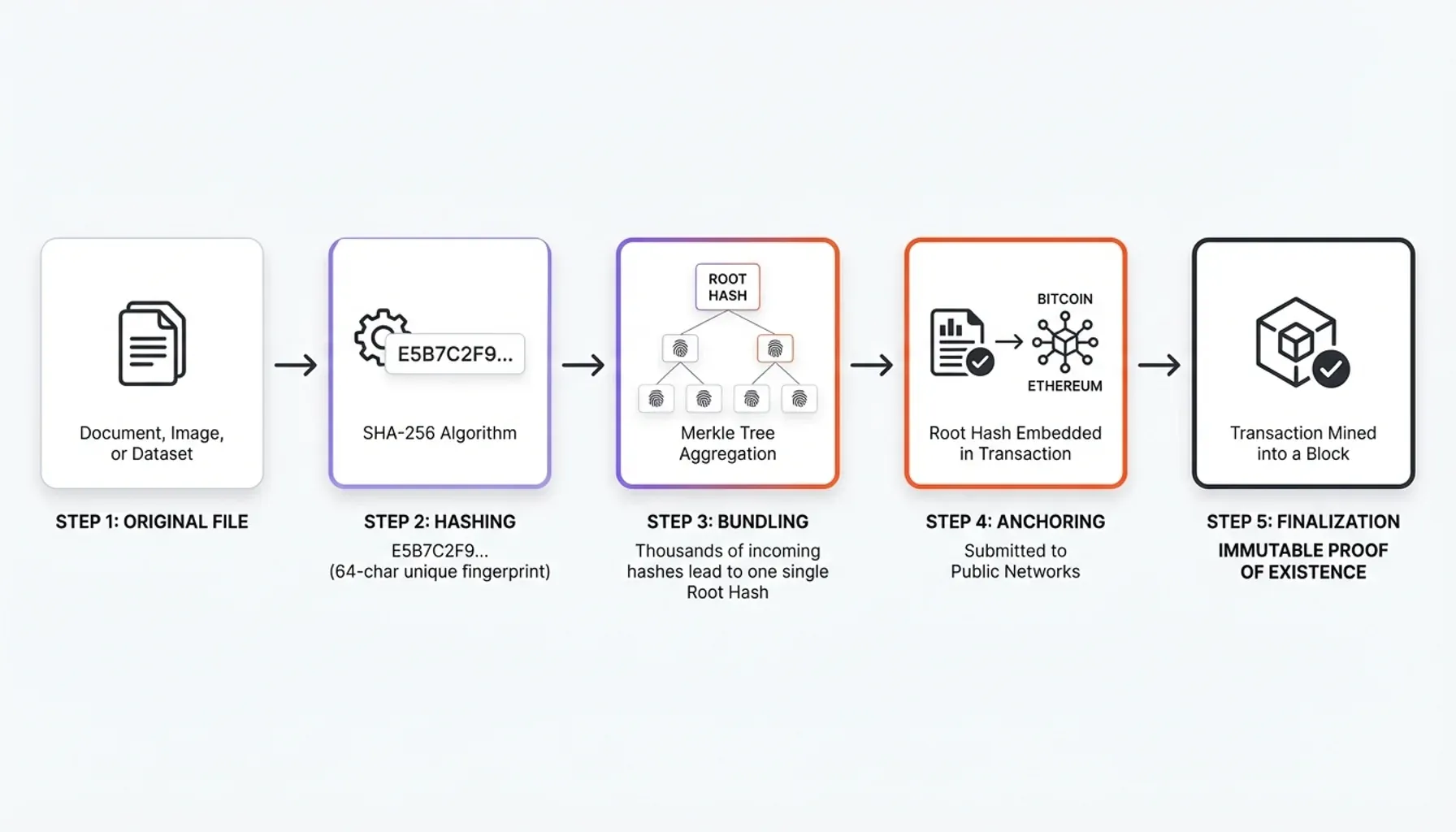
Once the hash is generated, the anchoring process begins. Processing millions of individual transactions directly on a public blockchain would be prohibitively expensive and slow. Advanced infrastructure solves this with Merkle trees, which bundle thousands of incoming hashes into a single aggregated root hash. That root hash then gets embedded into a standard transaction and submitted to public networks like Bitcoin or Ethereum.
When the network mines that transaction into a block, the proof of existence is finalized. Every file whose hash was part of that aggregated bundle now shares the cryptographic proof of that block's timestamp. Anyone can take the original file, generate its hash, and trace the cryptographic path back to the specific blockchain transaction — independently verifying authenticity without relying on the original timestamping provider.
Protocols and Standards: RFC 3161, OpenTimestamps, and Interoperability
Before examining why public blockchains make such powerful timekeepers, it is worth mapping the standards landscape — because interoperability determines whether your timestamps will still be verifiable in ten years.
RFC 3161 is the long-standing Internet Standard for Time-Stamp Protocol (TSP), published by the IETF. It defines how a client submits a hash to a Time-Stamp Authority (TSA), which returns a digitally signed timestamp token. RFC 3161 is widely supported in enterprise software, PDF signing workflows, and legal frameworks across the EU — it underpins much of the eIDAS qualified timestamp specification. In regulated environments that explicitly require a qualified electronic timestamp, RFC 3161 compliance is often non-negotiable.
The structural weakness, however, is that RFC 3161 tokens depend entirely on the TSA's PKI certificate chain. When that certificate expires — typically after one to three years — you must re-timestamp or apply a counter-signature to keep the proof valid. If the TSA goes out of business, every token it ever issued enters a legal grey zone. This is not a theoretical risk: several commercial TSAs have shut down over the past decade, leaving customers scrambling to migrate their archives.
OpenTimestamps is an open-source protocol, developed by Bitcoin developer Peter Todd, that standardizes how timestamps are created and verified against public blockchains. An OpenTimestamps proof is a compact .ots file containing the Merkle path connecting your document's hash to a specific Bitcoin block header. Verification requires no trusted third party — anyone with a Bitcoin node can independently confirm the proof. The protocol is free, the format is open, and the verification tooling is publicly auditable.
Where OpenTimestamps excels in openness and cost, it currently lacks the formal legal recognition that RFC 3161 carries in some jurisdictions. This is where a layered approach becomes valuable: anchor hashes to multiple public blockchains — Bitcoin, Ethereum, and others — while also generating structured proof documents that can be presented alongside RFC 3161-compatible certificates where legal frameworks demand them. You get vendor-independence from blockchain anchoring and the regulatory acceptance of established PKI standards in a single workflow.
Interoperability is the practical upshot. When evaluating a timestamping solution, ask three questions: Can the proof be verified without the vendor's software? Is the proof format documented and open? Does the solution support multiple blockchain anchors to hedge against any single network's long-term viability? A timestamp that locks you into a proprietary verification tool is only marginally better than a centralized server log — you have moved the single point of failure, not eliminated it.
Timestamp in Cryptocurrency: Block Times vs. Application-Level Timestamps
Understanding how time actually works inside a blockchain network is essential before trusting it as an evidentiary anchor — and the distinction between block-level timestamps and application-level timestamps is frequently misunderstood.
Block-level timestamps are set by the miner or validator who produces a block. In Bitcoin, the protocol requires only that a block's timestamp be greater than the median of the previous eleven blocks and no more than two hours ahead of the network-adjusted time. This means a Bitcoin block timestamp can legitimately drift by up to two hours from wall-clock time. Ethereum's proof-of-stake consensus tightened this considerably — validators must set timestamps within a narrow window relative to the previous slot — but some tolerance remains. The practical implication: a blockchain timestamp does not prove a document existed at 14:32:07 UTC on a specific date. It proves the document existed before the block was mined, with a precision bounded by the network's consensus rules.
Application-level timestamps, by contrast, are generated by the service submitting the transaction — not by the network itself. When a timestamping service batches thousands of hashes into a Merkle tree and submits the root hash in a transaction, the submission time is recorded by the service, while the confirmation time is recorded by the network. These two moments can differ by minutes or hours depending on network congestion and the fee strategy used. A well-designed timestamping service makes this distinction explicit in its proof documents, recording both the submission timestamp and the block confirmation timestamp so that auditors understand exactly what is being claimed.
For most legal and compliance use cases, this precision is entirely sufficient. Courts and regulators generally care about establishing that a document predates a specific event — a patent filing, a contract dispute, a regulatory deadline — not about pinning it to a specific second. The evidentiary value of a blockchain-anchored timestamp lies in its tamper-evidence and independence, not in sub-second precision.
Where precision matters more acutely — high-frequency trading audit trails, real-time IoT sensor logs, or forensic investigations — organizations should combine blockchain anchoring with a trusted time source such as an RFC 3161 TSA or a GPS-synchronized clock, recording both in the proof bundle. The blockchain anchor provides long-term tamper-evidence; the precise time source provides the granularity.
Security Assumptions and Limitations: 51% Attacks, Reorgs, and Finality
Blockchain timestamping is not unconditionally secure. Its guarantees depend on specific assumptions about the underlying network, and understanding those assumptions is what separates a robust implementation from a false sense of security.
51% attacks are the most cited threat. If a single entity gains majority control of a proof-of-work network's hash rate, it can mine an alternative chain faster than the honest chain — a process called a reorg (chain reorganization). A deep enough reorg can erase recently confirmed transactions, including timestamp anchors. On Bitcoin, executing a 51% attack requires sustained expenditure in the tens of billions of dollars in hardware and electricity, making it economically irrational against the world's largest proof-of-work network. On smaller networks, the calculus is very different: several minor chains have suffered successful 51% attacks in recent years, with reorgs reaching dozens of blocks deep. This is a concrete reason why anchoring to multiple independent networks — Bitcoin and Ethereum, for example — provides meaningfully stronger security than anchoring to a single chain.
Finality is the related concept. A transaction confirmed in one block is not immediately permanent. The probability that a block will be orphaned decreases exponentially with each subsequent block built on top of it. Bitcoin practitioners typically treat six confirmations as effectively final for high-value transactions; Ethereum's proof-of-stake protocol introduces checkpointing that achieves economic finality after roughly twelve minutes. For timestamping purposes, this means a proof generated seconds after a transaction is mined carries less security weight than one generated after several confirmations. Responsible timestamping services wait for sufficient confirmations before issuing a finalized proof document.
Timestamp manipulation by miners is a subtler risk. As noted above, Bitcoin's protocol allows miners to set block timestamps within a two-hour window. A colluding miner could, in principle, set a block timestamp slightly in the past to make a document appear older than it is. In practice, this attack is constrained by the median-time-past rule and the fact that other nodes will reject blocks with implausible timestamps. But it does mean that blockchain timestamps carry an inherent uncertainty window, not a precise atomic-clock reading.
The honest-network assumption underlies all of this. A blockchain timestamp is only as trustworthy as the network's continued operation under honest-majority conditions. For Bitcoin and Ethereum, this assumption has held for over a decade under adversarial conditions, and the economic incentives strongly favor continued honest operation. For newer or smaller networks, that track record does not yet exist.
The practical takeaway: anchor to established, high-hash-rate networks; wait for confirmed finality before treating a proof as legally binding; use multi-chain anchoring to eliminate single-network risk; and document the confirmation depth in your proof records so that auditors can assess the security level themselves.
Why Cryptocurrency Networks Make Such Powerful Timekeepers
Private databases can be manipulated. Public cryptocurrency networks operate at a scale of decentralization that makes retroactive alteration practically impossible. Anchoring data to these networks leverages massive computational power and economic incentives to act as a near-indestructible, universal clock.
The strength of distributed ledger technology lies in its consensus model. The Bitcoin network runs on tens of thousands of independent nodes distributed across the globe. Unlike a centralized server where a single compromised administrator can rewrite history, altering a public blockchain requires simultaneously overpowering the majority of those independent participants — at a cost that, as detailed above, runs into the tens of billions of dollars on established networks.
Global synchronization means the timeline is universally recognized. Because the ledger is public and continuously verified by independent nodes, the sequence of blocks establishes an undeniable chronological order of events that no single party controls.
Most importantly for enterprise adoption, anchoring data to public blockchains delivers genuine vendor independence. If a traditional software provider shuts down, the proprietary timestamps it issued may become unverifiable. A blockchain timestamp anchored to a decentralized ledger remains valid and verifiable indefinitely — your long-term archiving and compliance strategy is never held hostage by a single vendor's lifecycle.
The Business Case: Data Integrity and Digital Sovereignty
For C-level executives, CTOs, and VPs of Engineering, technology is only as valuable as the business risk it mitigates. In an era of rampant digital fraud and aggressive regulatory scrutiny, proving data integrity is no longer an optional IT feature — it is a critical component of corporate governance and digital sovereignty.
The primary business value of a blockchain timestamp is eliminating "he-said-she-said" scenarios in B2B transactions and legal disputes. When two parties sign a digital contract, exchange technical specifications, or finalize a financial ledger, an immutable audit trail prevents either party from retroactively claiming the document was altered. Converting standard system logs — which bad actors can easily delete or modify — into permanent, cryptographically sealed mathematical proofs gives organizations an indisputable record of truth.
Protecting intellectual property is another critical use case. R&D cycles often span years before a formal patent is filed. During that vulnerable window, companies must protect trade secrets while retaining the ability to prove exactly when an innovation was conceptualized. By routinely hashing and anchoring R&D documents, schematics, and source code, companies build a verifiable timeline of creation. This strategic documentation of innovation lets organizations defend against patent trolls or IP theft without ever publicly disclosing the sensitive information itself.
Tamper-evident infrastructure also directly impacts the bottom line. Mathematically provable data integrity reduces litigation risk. When digital evidence carries a blockchain timestamp, document authenticity can be instantly and independently verified — cutting both the cost and duration of legal discovery. Demonstrating adherence to strict information security standards through immutable archiving can also lower cyber liability insurance premiums, as underwriters increasingly demand robust, tamper-proof audit trails to mitigate institutional risk.
Real-World Use Cases: From Video Evidence to ERP Archiving
The theoretical security of distributed ledger technology translates into powerful, industry-specific applications where trust and verifiable timelines are mission-critical.
One of the most pressing applications today is authenticating digital media. With the rapid proliferation of generative AI and deepfake technology, the authenticity of video and image files is constantly in question — particularly in law enforcement, insurance claims, and logistics. Applying blockchain timestamping to counter deepfake dashcam video evidence lets organizations automatically hash video files the moment they are recorded. If footage is submitted as evidence in a liability claim, the claims adjuster or legal team can immediately verify whether it has been manipulated. If the current hash does not match the blockchain-anchored hash, the evidence is flagged as tampered — full stop.
In supply chain transparency, international logistics rely on complex handoffs between manufacturers, freight forwarders, customs officials, and distributors. A tamper-evident audit trail ensures that shipping manifests, quality control certificates, and temperature logs are permanently recorded at each stage of the journey. That sequence of events becomes mathematically provable, preventing any single party from altering records to avoid liability for damaged or delayed goods.
For enterprise software — particularly ERP vendors — integrating blockchain seals solves significant compliance hurdles. In regions like the DACH market, strict legal frameworks govern the electronic retention of financial records. A cloud-agnostic archiving layer that automatically seals every invoice and ledger entry with AES-256 encryption and a blockchain timestamp can deliver out-of-the-box compliance for GoBD in Germany and GeBüV in Switzerland. This architecture ensures that even system administrators cannot modify financial documents without detection, meeting the standards set by electronic identification and trust services regulation.
Courts and regulatory bodies are increasingly recognizing the validity of mathematically provable timestamps. Because the underlying cryptography is standardized and public blockchains are universally accessible, a blockchain timestamp provides stronger evidentiary weight than traditional centralized logs.
Blockchain vs. Traditional TSA: A Technical Comparison
When evaluating data integrity solutions, enterprise architects typically compare blockchain-based methods against traditional Time-Stamp Authorities operating under RFC 3161. While RFC 3161 has been a workhorse standard for years — relying on Public Key Infrastructure (PKI) — it carries structural limitations that decentralized anchoring resolves directly.
A traditional TSA relies on a centralized trusted third party. The TSA signs the hash of a document using its private key, and the recipient verifies it using the TSA's public key. If the TSA's private key is compromised, or if the TSA ceases operations and its certificate expires or is revoked, the long-term validity of every timestamp it ever issued is thrown into jeopardy. Several commercial TSAs have shut down over the past decade, leaving customers with archives full of tokens they can no longer independently verify. That is vendor lock-in with a very long tail.
A blockchain-anchored timestamp, by contrast, is natively independent. The cryptographic proof requires no ongoing relationship with any provider to verify. The hash is permanently embedded in public ledgers. As long as those networks exist — and open-source verification tools remain available — the timestamp remains valid.
Cost-efficiency and scalability also favor the blockchain approach. Traditional TSAs often charge per certificate, making it prohibitively expensive to timestamp millions of granular actions: individual database rows, API calls, or IoT sensor pings. Merkle tree aggregation bundles millions of hashes into a single transaction, letting enterprises secure vast amounts of data at a fraction of the cost.
Modern APIs make this an invisible layer. Developers integrate tamper-evident security without disrupting existing workflows. Whether deploying on AWS, Azure, or on-premise, the API receives hashes in the background and returns cryptographic proofs — no friction for the end user, no complex PKI certificate management to maintain.
For organizations that need both worlds — blockchain permanence and RFC 3161 legal recognition — a hybrid approach is the practical answer. Generate an RFC 3161 token for immediate regulatory compliance, anchor the same hash to Bitcoin and Ethereum for long-term vendor-independent verification, and store both proofs together in your archive. You are covered today and in twenty years.
Putting It Into Practice: A Scenario
Consider a mid-sized pharmaceutical company — call it Verimedix — that has just completed a three-year R&D cycle on a novel drug delivery mechanism. Their legal team is preparing a provisional patent application, but a competitor has already filed a suspiciously similar claim. The question before the court will be simple and brutal: who can prove they got there first?
Verimedix's engineering team had integrated a timestamping API into their document management system eighteen months earlier, almost as an afterthought during a broader security audit. Every time a researcher saved a new version of a protocol document, the system automatically computed its SHA-256 hash and submitted it to the API. The API batched that hash with thousands of others into a Merkle tree, computed the root hash, and embedded it in a Bitcoin transaction. Within the hour, the transaction was confirmed. The researcher never saw any of this — it ran silently in the background.
When the legal dispute materialized, Verimedix's counsel pulled the proof records for forty-seven key documents. Each record contained the original document hash, the Merkle path connecting it to the Bitcoin transaction, the block height, and the block timestamp. An independent forensic expert — engaged by neither party — downloaded the Bitcoin blockchain, located each transaction, and recomputed the Merkle paths from scratch. Every proof verified. The documents existed, in their exact current form, months before the competitor's filing date.
The competitor's counsel challenged the timestamps. Could Verimedix have backdated them? The expert explained the economics: to rewrite the relevant Bitcoin blocks would require a sustained 51% attack on the largest proof-of-work network in the world, at a cost of billions of dollars, sustained over days. The challenge was withdrawn.
The case settled favorably within six weeks.
That outcome did not happen because Verimedix had an expensive legal strategy. It happened because an engineer had spent two days integrating a hashing API into an existing workflow, and because the proof that integration produced was mathematically independent of any single authority — including Verimedix itself.
The implementation path that produced this result follows a consistent logic. First, identify your highest-risk data assets: IP, financial ledgers, compliance logs, and any records that could become evidence. Second, decouple your trust model from centralized authorities by anchoring to established, high-hash-rate networks and waiting for confirmed finality before treating a proof as binding. Third, integrate automated hashing via API into existing workflows so that timestamping is invisible to end users and cannot be bypassed. Fourth, determine which standards — RFC 3161, OpenTimestamps, or both — your regulatory environment requires, and choose a solution that supports them without locking you into a single vendor's certificate chain. Fifth, store proof documents alongside the original files in your archive, so that verification remains possible decades from now without any dependency on the service that generated them.
The math does not care who is asking. That is the point.
Future-Proofing Your Data Strategy
As digital ecosystems grow more complex, a reactive approach to data security is no longer viable. The rapid advancement of artificial intelligence is blurring the lines between authentic human creation and machine-generated content. Proving that content was human-generated — or establishing the exact moment a proprietary algorithm produced a result — requires proactive, early timestamping. Secure the data at the moment of inception, and you build a verifiable foundation of digital truth that no subsequent manipulation can undermine.
Looking ahead, the evolution of hashing algorithms continues to outpace emerging threats. While quantum computing poses theoretical risks to certain public-key cryptographies, the core SHA-256 hashing used in data fingerprinting is widely considered to be quantum-resistant, ensuring that the mathematical proofs you generate today will remain secure against the supercomputers of tomorrow.
The question of data integrity is not limited to Earth-bound systems either. As distributed infrastructure extends into space, the same principles of decentralized, tamper-evident record-keeping apply — a challenge explored in depth in how blockchain maintains trust across interplanetary distances.
By adopting a tamper-evident, decentralized approach to digital proof, you do not just protect your past records. You secure your future digital legacy — and you make sure that the next time someone tries to roll back a system clock, the math says otherwise.
Thomas Hepp
Co-Founder
Thomas Hepp is the founder of OriginStamp and creator of the OriginStamp timestamp, which has set the standard for tamper-proof blockchain timestamps since 2013. As one of the earliest innovators in the field, he combines deep technical expertise with a pragmatic focus on solving real business problems, and is a recognized voice in blockchain security, AI analytics, and data-driven decision support. His work has earned multiple international awards, including a top Best Project recognition from ETH Zurich and the Swiss Confederation. He publishes regularly on blockchain, AI, and digital innovation.