
Proof of Existence: Securing Digital Integrity via Blockchain
Dec 19, 2025

Thomas Hepp
Dec 19, 2025

Picture this: a pharmaceutical contractor in Germany, 2017, quietly editing batch-release records days after the products had already shipped. The falsified timestamps sailed through every internal audit. The fraud only surfaced during a cross-border regulatory inspection that compared paper logs against independent shipping manifests. By then, compromised batches had reached pharmacies across three countries. The company paid €4.2 million in fines and lost its manufacturing license for two years.
That wasn't a freak incident. It was a preview. A single keystroke can alter a financial record, modify critical sensor data, or backdate a legal contract — and in most organizations, nothing catches it. For decades, businesses relied on physical signatures, trusted notaries, and internal system administrators to guarantee record authenticity. As digital transformation accelerates, those centralized mechanisms are cracking. Trusting a human or a single database administrator creates a single point of failure — one that can compromise your entire compliance posture overnight.
The Evolution of Trust: Defining Proof of Existence
You've probably signed a PDF and assumed that was enough. It isn't. A digital signature confirms who signed a document, but it doesn't prove what the document contained at the moment of signing — or whether someone quietly altered it since. That gap is exactly where fraud, IP theft, and compliance failures live.
Proof of Existence on the Blockchain closes that gap by shifting verification away from trusting a central authority and toward trusting immutable mathematics. It guarantees that a specific digital document existed in an exact state at a precise moment in time — without depending on the platform that generated the proof.
Historically, proving a document existed at a certain time required a physical notary stamp or a digital certificate from a centralized Time Stamp Authority (TSA). The critical flaw? Centralized authorities can be compromised, shut down, or manipulated by insiders. Decentralized timestamping eliminates these risks by replacing vulnerable human oversight with mathematical certainty.
Trusting the math beats trusting a service provider every time. When your organization uses decentralized mathematical proof, verification becomes instantaneous, borderless, and completely independent of any vendor's operational status. Services like OriginStamp illustrate how this works in practice: a file is hashed, and that hash is anchored to a public blockchain, creating a tamper-evident record that no single party — including the service provider — can alter or revoke. This approach, backed by peer-reviewed research in distributed systems, is reshaping how enterprises handle compliance, intellectual property, and legal documentation.
The Mechanics: From SHA-256 Hashes to Blockchain Anchors
Think of it like a fingerprint scanner for data — except this one cannot be bribed, forged, or shut down by a court order. Every document, video, or line of code you feed into the system produces a unique digital fingerprint. Change a single comma in a contract or a single pixel in an image, and the fingerprint changes completely. You can't reverse-engineer the original file from that fingerprint, which means your sensitive data never leaves your servers.
That fingerprint comes from a cryptographic hash function called SHA-256. Feed any file through the algorithm and it produces a fixed-length string of 64 characters. The original data cannot be reconstructed from this hash, so sensitive corporate information stays on your internal servers. The hash captures the data's exact state without exposing its contents — a design that aligns with NIST's cryptographic standards and guidelines for data security.
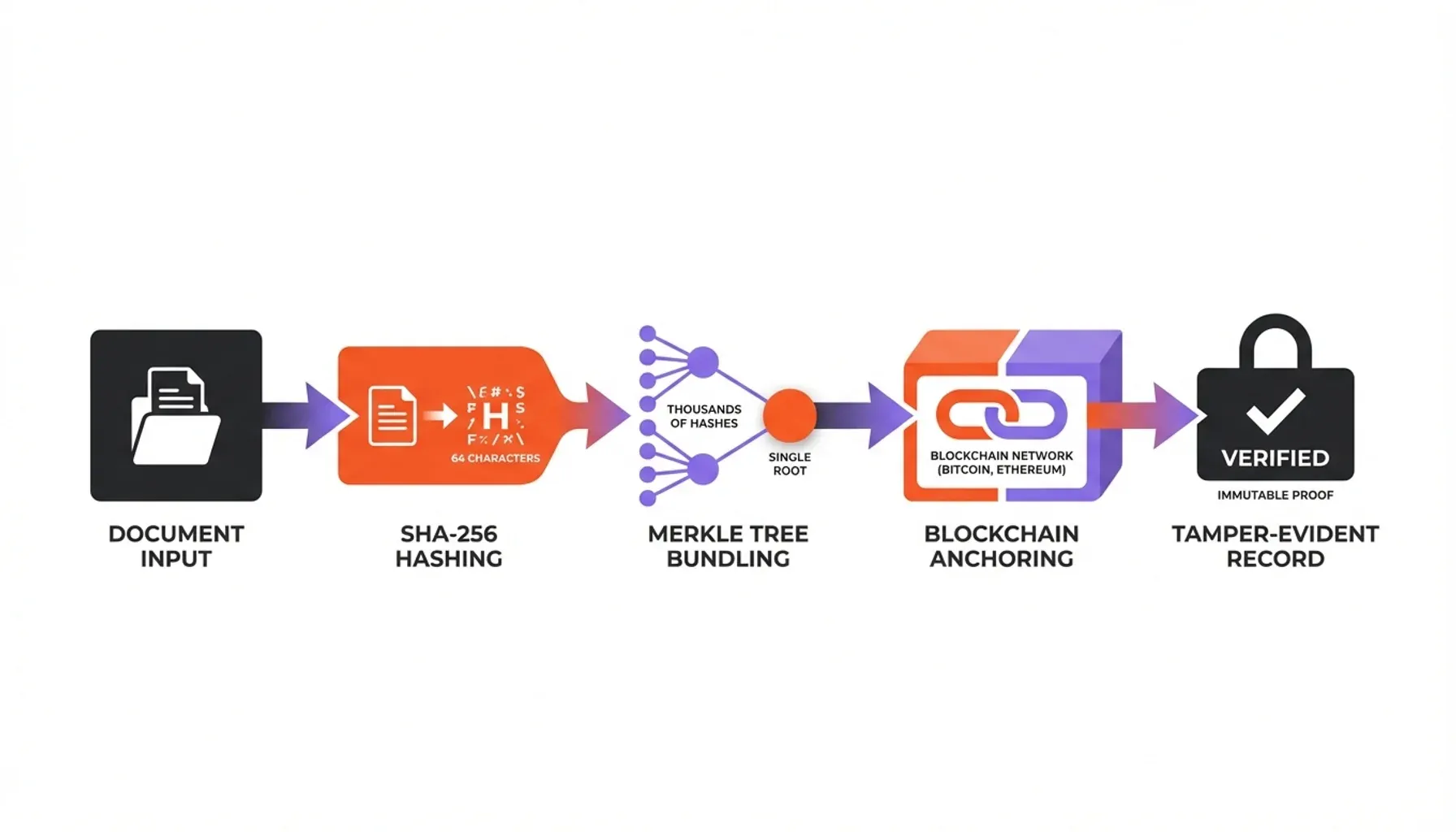
Once the hash is generated, anchoring begins. To make your digital fingerprint immutable, it must be permanently recorded on a decentralized ledger. As explained in Blockchain Technology Explained: What is Blockchain?, a distributed ledger secures data across a global network of computers — no single entity controls it. In practice, many anchoring services bundle thousands of incoming hashes into a single cryptographic root using a Merkle tree structure, then submit it as one transaction to networks like Bitcoin or Ethereum.
Public networks serve a specific purpose here: security through massive computational distribution. A private ledger can still be manipulated by the consortium that owns it, which defeats the entire point of independent proof. When your hash is anchored to Bitcoin, the combined computational power of the entire network secures it.
This establishes what researchers call "immutable time." Each block in the chain links mathematically to the one before it. Altering a past record would require rewriting the entire blockchain history — a computational impossibility. A blockchain timestamp cannot be backdated, modified, or deleted by anyone, including the original author, the system administrator, or the anchoring service itself.
Beyond the Hype: Real-World Use Cases for Proof of Existence
The theoretical elegance of cryptographic hashing translates into powerful applications wherever data integrity is mission-critical. Across industries, tamper-evident proof resolves complex disputes and secures digital assets against emerging technological threats.
Intellectual Property Protection
Innovators, designers, and software engineers constantly face the same dilemma: how do you prove you originated an idea without publicly disclosing it before a patent is filed? Timestamping your design files, source code, or blueprints establishes an indisputable record of prior art. This gives you a legally robust defense against IP theft or patent trolls — maintaining complete operational secrecy while aligning with WIPO's digital evidence frameworks for intellectual property disputes.
Legal Evidence and Deepfake Threats
AI-generated content has made digital media inherently suspect, and securing raw data at the source is now a necessity. The way blockchain timestamping defeats deepfake tampering in dashcam footage illustrates the principle clearly: a hash of the video file is generated the millisecond it is recorded. If the footage is later presented in court, the hash of the submitted video is compared against the blockchain anchor. A match gives the court mathematical certainty that the footage is authentic and unaltered — no expert witness required. The same logic applies to bodycam footage, financial screen recordings, and any digital evidence where chain of custody matters.
Supply Chain Integrity
Global logistics networks generate massive volumes of certifications, origin documents, and compliance records — and fraudulent certifications lead directly to regulatory fines and reputational damage. An immutable audit trail for every compliance document lets your stakeholders verify the origin and handling of products in real time. Once a safety certification is issued and anchored, distributed ledger tracking ensures it cannot be quietly revoked or modified by a compromised vendor. This matters most in food safety and pharmaceutical logistics, where falsified cold-chain records have caused documented public health incidents.
Clinical Research and Pharmaceutical Compliance
Protecting clinical trial data and laboratory notes from retrospective manipulation is a strict regulatory requirement. Researchers anchor raw data and methodologies continuously, guaranteeing non-repudiation. Your organization can prove to auditors and regulatory bodies that trial results were not cherry-picked or altered after the fact — a capability increasingly demanded by FDA data integrity guidance and equivalent international frameworks such as EMA's GCP guidelines. The German pharmaceutical case described at the opening would have been detectable — and preventable — with this infrastructure in place.
IoT and Industrial Sensor Data
As manufacturing and infrastructure systems generate continuous streams of sensor data, the integrity of those readings carries real legal and safety weight. A tampered pressure log or falsified emissions reading can mask equipment failure or environmental violations. Anchoring your sensor outputs in real time creates an auditable record that regulators, insurers, and courts can independently verify — without relying on your own systems as the sole source of truth.
Enterprise-Grade Integrity: Compliance Archiving at Scale
The core technology of blockchain timestamping is highly versatile, but enterprise adoption requires solutions that integrate with existing regulatory frameworks. Several platforms now bridge the gap between cryptographic proof and enterprise software, transforming proof of existence into a scalable compliance engine for ERP vendors and large-scale architectures.
Blockchain anchoring can power legally compliant archiving. In regions with stringent data retention laws — Germany's GoBD and Switzerland's KRM-certified GeBüV framework, for example — your organization must store financial and operational records in a tamper-proof manner. Automated anchoring addresses this directly. Every invoice, receipt, and ledger entry generated by your ERP system is automatically hashed and sealed, ensuring the entire archive meets the standards of electronic records management recognized by international auditors.

A robust enterprise implementation combines AES-256 encryption with blockchain certificates. Encryption makes unauthorized access impossible; the simultaneous blockchain anchor guarantees the file's structural integrity. These two controls address different threat vectors and should always be deployed together.
This architecture also neutralizes one of the most persistent vulnerabilities in enterprise IT: the rogue system administrator. In traditional database environments, users with administrative privileges can alter, delete, or backdate records without leaving an obvious trace. With encryption and blockchain anchoring in place, even a privileged insider cannot modify an archived document without detection. Any alteration breaks the cryptographic hash, instantly flagging the tampering event and preserving the integrity of the broader archive.
For ERP vendors managing large customer bases, building this compliance infrastructure from scratch requires years of development and significant capital expenditure. White-label anchoring solutions let ERP providers embed this integrity layer directly into their existing software — giving end users a compliant archiving system under the ERP vendor's own branding, without the heavy lifting of independent development.
The Technical Advantage: Why Public Blockchains Matter
The architectural decisions behind a proof of existence implementation determine its long-term viability. A common point of confusion for enterprise decision-makers is the distinction between public and private blockchains. For true data integrity and non-repudiation, public blockchains hold a clear technical advantage.
The primary advantage is absolute independence. When your organization secures a digital asset, the proof must outlive the company that facilitated it. If a vendor using a private, proprietary database ceases operations, the verification infrastructure disappears with it. By anchoring data to globally distributed networks like Bitcoin and Ethereum, your immutable cryptographic timestamp becomes completely vendor-agnostic. The proof lives permanently on the public ledger, verifiable by anyone with an internet connection — regardless of whether any specific service provider continues to operate decades from now.
Decentralization also eliminates the single point of failure inherent in traditional systems. A centralized server can be hacked, hit with a DDoS attack, or physically destroyed. A public blockchain is maintained by tens of thousands of independent nodes distributed globally. To compromise a Bitcoin-anchored timestamp, an attacker would have to simultaneously overpower the majority of the network's hash rate — economically and computationally unfeasible.
Despite the security of public blockchains, direct interaction can be cost-prohibitive due to fluctuating transaction fees. The Merkle tree approach addresses this: millions of individual document hashes are bundled into a single root hash, then anchored in one transaction. Your organization can secure massive datasets — thousands of daily invoices, high-frequency IoT sensor logs — at a predictable cost, without paying per-document network fees.
Underpinning all of this is SHA-256's mathematical resistance to collisions. A collision occurs when two different files produce the exact same hash. SHA-256 offers 2²⁵⁶ possible combinations — a number so astronomically large that finding two identical hashes for different datasets is considered computationally impossible within any practical timeframe. Every digital fingerprint is entirely unique and undeniably linked to its specific source file. For a broader perspective on how these trust architectures extend beyond conventional applications, the same principles applied to interplanetary data integrity show just how far this technology can reach.
Best Practices and Common Pitfalls
Deploying proof of existence correctly requires more than calling an API. The decisions you make around file preparation, key management, and long-term verification determine whether your timestamps hold up under scrutiny — in a courtroom, a regulatory audit, or a dispute with a counterparty five years from now.
Salting
A hash alone can be vulnerable to preimage attacks when the input data is predictable. If an adversary knows that your archived document is likely one of a small set of possible values — a standard contract template, for instance — they can hash each candidate and match it against your anchor. Salting solves this: before hashing, you append a unique random value (the salt) to the document. The resulting hash is unpredictable even when the underlying content is not. Store your salts securely and separately from the hashes themselves. Losing a salt doesn't compromise the archive, but it does prevent you from re-verifying that specific document later.
File Normalization
Identical content can produce different hashes depending on how a file is saved. A Word document re-exported as a PDF, a spreadsheet with a different line-ending convention, or an image re-compressed at the same quality setting will all generate different fingerprints. Before you anchor anything, establish a strict normalization protocol: define canonical file formats for each document type, strip volatile metadata (author fields, last-modified timestamps, printer settings), and enforce consistent encoding. If your process allows the same logical document to exist in multiple technical representations, your verification chain will break the first time someone opens and re-saves the file.
Metadata Handling
Metadata is a frequent source of silent hash mismatches. Operating systems, office suites, and document management platforms routinely embed creation dates, editor names, revision counts, and device identifiers into files — often without any visible indication. When you hash a file that contains this embedded metadata, you're anchoring that specific snapshot, including all hidden fields. That's intentional if you want to detect any modification whatsoever. But it becomes a problem if routine system processes — automatic backups, format migrations, or software upgrades — alter metadata without touching the actual content. Decide upfront whether your hash should cover the full file byte-for-byte or a normalized content-only extract, document that decision, and apply it consistently across your entire archive.
Key Management
Blockchain anchoring proves that a hash existed at a point in time. It does not, by itself, prove who submitted it. For your timestamps to carry legal weight, you need a reliable chain of custody linking your organization to the anchoring event. This typically means signing the hash with a private key before submission. Treat those signing keys with the same discipline you apply to code-signing certificates or HSM-protected credentials: rotate them on a defined schedule, store them in hardware security modules where possible, maintain offline backups, and document every key lifecycle event. If your signing key is compromised, an adversary could submit fraudulent hashes under your identity. If it's lost, you may be unable to prove authorship of legitimate archives.
Long-Term Verification
Cryptographic standards don't last forever. SHA-256 is considered secure today, but the history of cryptography is a history of algorithms that were once considered unbreakable. Your verification strategy needs to account for this. First, keep the original files — a hash is only useful if you still have the document it fingerprints. Second, maintain complete anchoring records: the transaction ID, the block number, the Merkle proof, and the timestamp. Third, monitor NIST's post-quantum cryptography standardization process; if SHA-256 is ever deprecated, you'll need a migration path that re-anchors critical archives under a stronger algorithm before the old one is considered broken. Organizations that anchor today and assume the proof is self-maintaining will find themselves unable to verify decade-old records precisely when those records matter most.
Strategic Implementation: Integrating Proof of Existence into Your Workflow
Transitioning from traditional data management to mathematically provable digital integrity doesn't require a complete overhaul of your existing IT infrastructure. An API-first approach lets you deploy enterprise-grade blockchain security with minimal friction.
Your developers integrate anchoring APIs into existing document management systems, ERPs, or custom applications using standard RESTful endpoints. Hashing and anchoring run in the background. Your original files stay on local servers or preferred cloud storage — only the lightweight cryptographic hashes are transmitted for anchoring. This ensures strict adherence to data privacy regulations like GDPR, since no personally identifiable information ever touches the blockchain.
This automated integration transforms compliance from a manual burden into an invisible process. Every document creation and data modification is automatically logged, hashed, and sealed. When your auditors walk in at 9am on a Tuesday and ask for proof of compliance, verifiable blockchain certificates are ready instantly — cutting the time and cost of regulatory audits significantly.
Scalability matters as your data volumes grow. As industries move toward Industry 4.0, data from automated systems, manufacturing lines, and connected devices is expanding rapidly. Well-designed anchoring architectures handle thousands of hashes per second without bottlenecks, ensuring that even data-intensive IoT applications can secure sensor logs in real time without latency penalties.
Consider what the alternative looks like: a mid-sized manufacturer running 50,000 sensor events per day through a traditional audit log faces weeks of forensic reconstruction after a single disputed reading. With real-time anchoring in place, that same dispute resolves in minutes — the blockchain record either matches or it doesn't. Organizations that reach that operational baseline first will be the ones setting the evidentiary standard that regulators and courts begin to expect from everyone else.
The infrastructure for absolute digital truth already exists. The strategic imperative is simply to use it — before the next backdated record becomes a headline.
Thomas Hepp
Co-Founder
Thomas Hepp is the founder of OriginStamp and creator of the OriginStamp timestamp, which has set the standard for tamper-proof blockchain timestamps since 2013. As one of the earliest innovators in the field, he combines deep technical expertise with a pragmatic focus on solving real business problems, and is a recognized voice in blockchain security, AI analytics, and data-driven decision support. His work has earned multiple international awards, including a top Best Project recognition from ETH Zurich and the Swiss Confederation. He publishes regularly on blockchain, AI, and digital innovation.