How Blockchain Trust and Timestamps Build Customer Confidence
Mar 12, 2026

Thomas Hepp
Mar 12, 2026

The Crisis of Trust in the Digital Age
Trust used to be a handshake. Then it became a contract. Today, it needs to be a mathematical proof.
The digital economy runs on data, and data has a credibility problem. Deepfake technology is now sophisticated enough to fabricate video evidence convincingly. Data breaches expose millions of records every year. Centralized databases can be quietly altered by anyone with sufficient access privileges. In every one of these scenarios, the organization holding the data simply says: "Trust us."
That proposition is failing. Global trust in institutions and technology platforms has declined sharply across industries, not because companies are more dishonest, but because the tools for deception have outpaced the tools for verification. Executives who built their data governance strategy on administrative controls and internal promises now face a structural credibility gap that no policy document can close.
This is the defining challenge for CPOs, CTOs, and VPs responsible for data infrastructure: the gap between what an organization claims about its data and what it can prove. Regulatory bodies, enterprise customers, and legal counterparties are no longer satisfied with assertions. They want evidence that is independent, verifiable, and immune to post-hoc manipulation.
Blockchain trust bridges that gap, not by adding another layer of policy, but by making data integrity a mathematical property of the data itself. When you cryptographically anchor a document to a public blockchain, its authenticity stops being a matter of organizational reputation. It becomes a verifiable fact, provable by anyone, anywhere, without relying on the provider who created it.
That shift, from promises to proof, is the foundation of every serious data integrity strategy in 2025 and beyond.
Blockchain Trust: Moving from Promises to Proof
The mechanics of blockchain trust begin with a single operation: hashing.
Every document, file, or dataset converts into a SHA-256 hash, a unique 64-character cryptographic fingerprint derived mathematically from the file's content. Change a single character in the original document and the hash changes completely. This property makes the hash a reliable identity for the data at a specific point in time.
That hash then gets anchored to a public blockchain, Bitcoin, Ethereum, or both. Once written to the chain, nobody can alter, delete, or overwrite it. The blockchain's decentralized consensus mechanisms ensure that no single party, not the software vendor, not the cloud provider, not even the issuing organization, can retroactively modify what was recorded. The proof exists independently of any administrative relationship.
This is categorically different from a standard database log. A database administrator can alter a database timestamp. An internal audit log depends entirely on the integrity of the system that produced it. A blockchain timestamp, by contrast, is anchored across thousands of independent nodes on a public network. Invalidating it would require rewriting the entire chain, a computational impossibility that grows more secure with every block added.
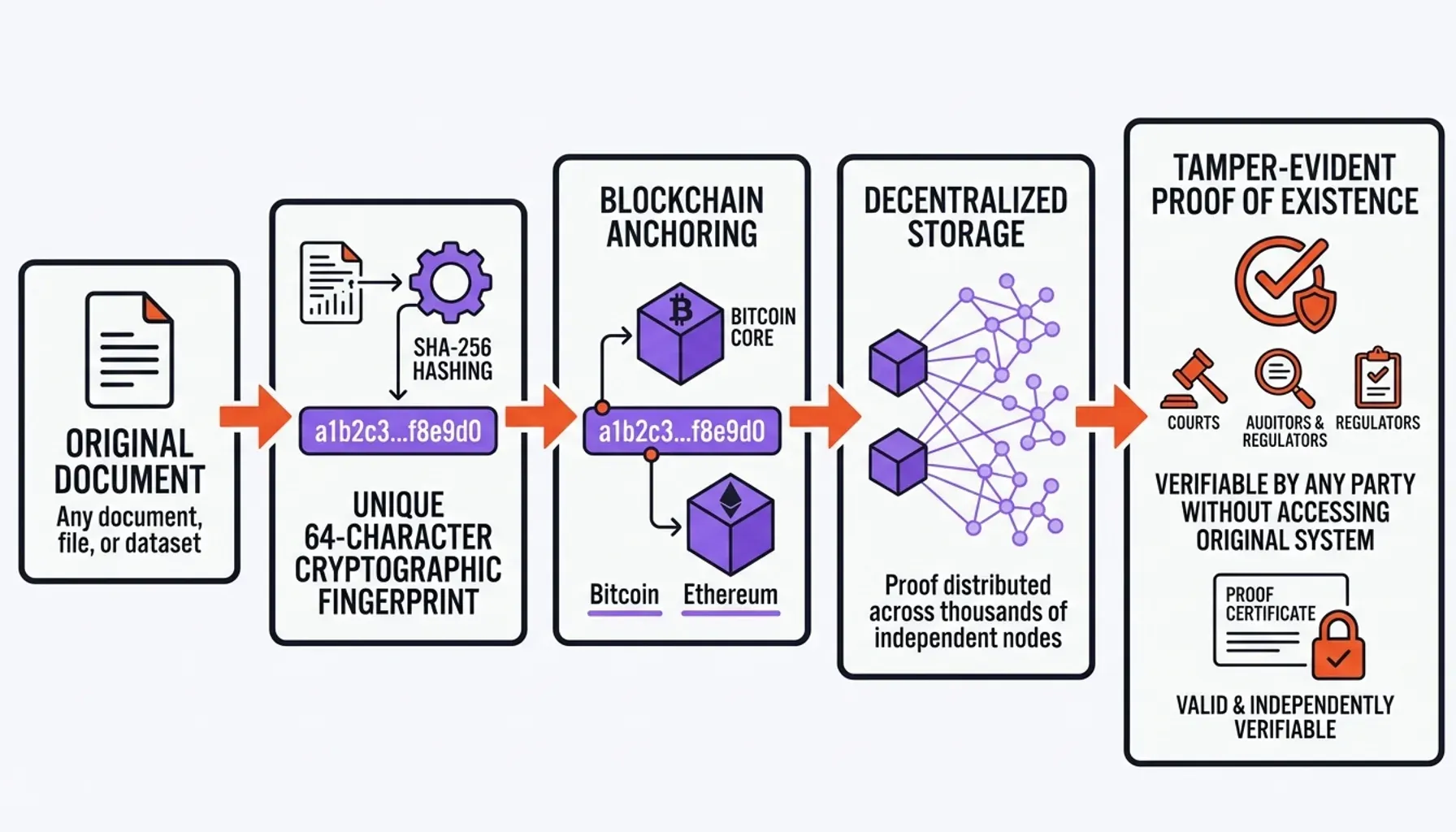
The distinction matters enormously in legal and regulatory contexts. A document with a blockchain timestamp carries tamper-evident proof of existence that any third party, a court, an auditor, a regulator, can verify without accessing the original system. The proof is self-contained, portable, and permanent.
OriginStamp has been building and refining this infrastructure since 2013. Twelve years of development, backed by peer-reviewed academic research, has produced a timestamping API that anchors data to both Bitcoin and Ethereum, creating redundant, decentralized proof that survives any single-chain failure. For developers and enterprise partners integrating this capability, the result is a data integrity layer that requires no ongoing maintenance and generates no administrative overhead.
The core insight is simple: when data integrity is a mathematical property rather than an organizational promise, the entire trust dynamic changes. Customers, regulators, and legal counterparties can verify authenticity independently. The provider's credibility becomes irrelevant to the proof itself. That is what genuine blockchain trust delivers.
For a deeper technical grounding, the Blockchain Timestamping Guide: Securing Digital Proof covers the full mechanics of hash anchoring and verification workflows.
Transparency vs. Privacy: You Don't Have to Choose
One of the most common objections I hear about blockchain-based transparency is this: "We can't put sensitive data on a public chain." It's a fair concern, and it reflects a genuine tension between auditability and confidentiality. But it's a false dilemma.
The resolution lies in what actually gets anchored. OriginStamp never writes raw data to the blockchain. It writes a cryptographic hash, a mathematical fingerprint that proves a document existed in a specific state at a specific time, without revealing any of its contents. The underlying document stays wherever you keep it: on-premise, in a private cloud, or behind access controls. The blockchain sees only the hash.
This design enables pseudonymity by default. A third-party auditor can verify that a document hasn't been altered since a given timestamp without ever seeing the document itself. The proof is public. The data is not.
For organizations handling particularly sensitive data, healthcare records, legal documents, financial contracts, this architecture can be extended further using zero-knowledge proofs (ZKPs). ZKPs allow one party to prove a statement is true (for example, "this clinical trial record was created before a specific date and has not been modified") without revealing the underlying data to the verifier. The cryptographic guarantee holds without any information disclosure.
Permissioned access layers add another dimension. In enterprise deployments, blockchain certificates can be issued with access controls that determine who can retrieve and verify the associated document. The immutability guarantee is universal, anyone can confirm the hash on-chain, but the document itself remains gated. This separation of proof from access is what makes blockchain-backed transparency compatible with GDPR, HIPAA, and Swiss data protection law simultaneously.
Encryption completes the picture. OriginVault's AES-256 data seal encrypts the document at the moment of archiving, binding it cryptographically to its original state. Even if an attacker gains access to the storage layer, the encrypted document is unreadable without the decryption key, and any attempt to modify it breaks the seal and invalidates the blockchain certificate.
The practical upshot: you can offer customers, regulators, and auditors full verifiability without exposing confidential content. Transparency and privacy aren't opposites. With the right cryptographic architecture, they reinforce each other.
Smart Contracts and Trust Automation
Blockchain timestamps establish when something happened and what it contained. Smart contracts take the next step: they automate what happens next, based on verifiable on-chain conditions.
A smart contract is a self-executing program deployed on a blockchain. Its logic is deterministic. Given the same inputs, it always produces the same outputs, and no party can alter its execution once deployed. This determinism is what makes smart contracts useful for trust automation: the outcome isn't subject to interpretation, negotiation, or administrative discretion. If condition A is met, action B executes. Full stop.
In practice, this enables powerful workflows. An ERP system could automatically release payment when a blockchain-anchored delivery certificate confirms goods arrived in the specified condition. A clinical trial platform could trigger regulatory submission when a complete, tamper-evident dataset reaches a predefined milestone. A supply chain system could flag a shipment for inspection the moment a quality certificate hash fails to match its blockchain record.
The Oracle Problem
Smart contracts can only act on data that exists on-chain. Real-world events, a shipment arriving, a temperature threshold being crossed, a regulatory deadline passing, exist off-chain. Oracles are the bridges that bring external data onto the blockchain so smart contracts can act on it.
Here's the thing. If the oracle is compromised or manipulated, the smart contract executes on false data, and executes correctly from the blockchain's perspective. The immutability guarantee applies to the execution, not to the accuracy of the input. This is why oracle design is one of the most actively researched problems in applied blockchain engineering, and why production deployments typically use decentralized oracle networks with cryptographic attestation rather than single-source feeds.
Composability Risks
Smart contracts can call other smart contracts. This composability is powerful, enabling complex, multi-party workflows to be assembled from modular components, but it also creates systemic risk. A vulnerability in one contract can propagate through every contract that depends on it. In the DeFi ecosystem, composability exploits have resulted in losses exceeding $3 billion across multiple incidents. For enterprise deployments, this argues for conservative composability: limit external contract dependencies, audit every integration point, and prefer battle-tested components over novel ones.
The broader principle is that smart contracts automate trust, but they don't eliminate the need for careful design. Determinism is a feature, not a substitute for sound architecture.
Security and Attack Vectors That Undermine Trust
Blockchain's security properties are real. They are not, however, unconditional. Understanding the attack vectors that can undermine blockchain-based trust is essential for any organization building on this infrastructure.
51% Attacks
Most companies get this wrong. A blockchain's immutability depends on its consensus mechanism. In proof-of-work networks, an attacker who controls more than 50% of the network's mining power can rewrite recent transaction history, a "51% attack." On Bitcoin, this is economically prohibitive: the cost of acquiring that much hash power exceeds any plausible gain. On smaller chains, it's a documented risk. Several smaller proof-of-work blockchains have suffered 51% attacks with confirmed double-spend transactions. This is one reason OriginStamp anchors to Bitcoin and Ethereum specifically, their network size makes this attack vector effectively impossible.
Sybil Attacks
A Sybil attack involves flooding a network with fake identities to gain disproportionate influence over consensus or data propagation. In permissioned blockchain networks, where nodes are known and credentialed, Sybil resistance is built into the access control layer. In public networks, proof-of-work and proof-of-stake mechanisms impose economic costs on identity creation that make large-scale Sybil attacks impractical. For enterprise deployments using public chains for anchoring, the relevant protection is the size and decentralization of the underlying network.
Miner Extractable Value (MEV)
MEV refers to the profit miners or validators can extract by reordering, inserting, or censoring transactions within a block. While MEV doesn't threaten the immutability of already-confirmed records, it can affect the ordering and timing of transactions, which matters for applications where the precise sequence of events is significant. For timestamping applications, the practical impact is minimal: what matters is that a hash was anchored before a specific block, not its position within that block.
Bridge Exploits
Cross-chain bridges, protocols that move assets or data between different blockchains, have been the single largest source of losses in blockchain security incidents, with billions lost to bridge exploits since 2021. For organizations anchoring to multiple chains (as OriginStamp does with Bitcoin and Ethereum), the relevant question is whether the bridge mechanism itself is in the trust path. OriginStamp's multi-chain anchoring creates independent proofs on each chain rather than bridging between them, avoiding bridge risk entirely while preserving redundancy.
The Practical Takeaway
None of these attack vectors invalidate blockchain-based trust for timestamping and data integrity applications, particularly when anchoring to large, established public networks. But they do underscore that security is a function of network choice, architecture, and implementation. "It's on the blockchain" is not a security argument. "It's anchored to Bitcoin with cryptographic proof, independently verifiable, and architecturally isolated from bridge risk" is.
Strengthening Customer Confidence Through Transparency
Customer confidence isn't built through marketing claims. It's built through the ability to verify.
When a B2B customer can independently confirm that a document, record, or dataset hasn't been altered since a specific moment in time, without asking the vendor to confirm it, the relationship fundamentally changes. The vendor stops asking for trust. They provide the tools to make trust unnecessary.
This is the psychological shift that blockchain-backed transparency enables. An immutable audit trail means every action taken on a document, creation, access, modification, archiving, is recorded in a log that nobody can quietly revise. Customers can inspect that trail at any time, on their own initiative. The record speaks for itself.
In intellectual property contexts, this capability is decisive. A content creator, software developer, or research team that timestamps their work at the moment of creation has mathematically provable evidence of prior art. If ownership is later disputed, the blockchain timestamp establishes precedence without relying on witness testimony or organizational records that could be challenged. The proof is independent and permanent.
For teams working with AI-generated content and digital assets, this layer of provenance is fast becoming a competitive requirement rather than a differentiator. As synthetic media proliferates, the ability to prove that a specific piece of content existed in a specific form at a specific time is the only reliable defense against authenticity disputes.
In the B2B SaaS market, data transparency is increasingly a procurement criterion. Enterprise buyers conduct security reviews, demand audit capabilities, and assess data governance maturity before signing contracts. Vendors who can demonstrate an immutable, independently verifiable audit trail aren't just meeting a compliance checkbox, they're reducing the perceived risk of the relationship. That reduction in perceived risk translates directly into shorter sales cycles, higher contract values, and stronger retention.
Blockchain trust, in this context, is not a technical feature. It is a commercial advantage.
Data Integrity as the Bedrock of Modern Archiving
Storage is not archiving. Storing a document means it exists somewhere. Archiving means it exists unchanged, with a provable record of its entire lifecycle.
The distinction is critical for any organization operating under regulatory oversight, which in 2025 includes virtually every enterprise handling financial records, healthcare data, or legally significant documents. Data integrity is not a feature of archiving. It is the definition of archiving.
Standard storage systems, cloud buckets, file servers, database tables, offer no inherent protection against modification. An authorized administrator can alter a record. A misconfigured system can overwrite data silently. A malicious actor with elevated privileges can edit documents without leaving a trace in the system's own logs. These are not theoretical risks. They are documented failure modes in regulated industries.
OriginVault addresses this at the architectural level through two complementary mechanisms. First, AES-256 encryption creates a data seal at the moment of archiving, a cryptographic lock that binds the document to its original state. Second, a blockchain certificate anchors that sealed document to a public chain, creating an external reference point entirely independent of the archiving system itself.
The result is protection against what security teams call an "admin-in-the-middle" scenario: even a system administrator with full database access cannot modify an archived document without breaking the cryptographic seal and invalidating the blockchain certificate. The tampering becomes immediately detectable, not by the organization's own monitoring tools, but by mathematical verification against an immutable external record.
This architecture satisfies ISO 27001 information security requirements for data integrity controls without requiring manual audit processes. Compliance evidence generates automatically, continuously, and in a format that auditors can verify independently. For organizations managing thousands or millions of documents, the operational significance of that automation is hard to overstate.
The broader principle, that blockchain provides a transformative foundation for trustworthy information systems, applies directly here. Data integrity is not maintained by policy. It is enforced by cryptography.
Real-World Use Cases: Where Proof Matters Most
Legal Evidence
Video and sensor data are increasingly central to legal proceedings, and increasingly vulnerable to manipulation. Dashcam footage, surveillance recordings, and digital photographs can all be edited with commercially available tools. Without a timestamp anchored at the moment of capture, the authenticity of any digital recording is challengeable.
Blockchain timestamping eliminates that vulnerability. A hash anchored to Bitcoin or Ethereum at the moment a file is created provides court-admissible proof against deepfake tampering that the content has not been altered since that timestamp. The proof doesn't depend on the credibility of the party presenting it. It depends on the mathematical properties of the blockchain, which no opposing counsel can credibly contest.
Supply Chain
Global supply chains depend on the integrity of certifications, inspection records, and milestone documentation. A falsified quality certificate can send defective components into medical devices or aerospace systems. Blockchain timestamps applied to each certification at the moment of issuance create an immutable chain of custody that any downstream party can verify without contacting the original issuer.
Healthcare
Patient record integrity under Good Clinical Practice standards is a legal requirement in every regulated healthcare market. Clinical trial data, diagnostic records, and treatment histories must be preserved exactly as created. Any modification must be logged, attributed, and justified. Blockchain-backed archiving enforces this requirement automatically, reducing the compliance burden on clinical operations teams while giving auditors independently verifiable evidence.
Financial Services
SEC Rule 17a-4 and its European equivalents mandate that broker-dealers retain records in a non-rewritable, non-erasable format for specified periods. Blockchain timestamping satisfies the technical requirements of these mandates while generating audit evidence that regulators can verify without relying on the firm's own reporting. For financial institutions managing large document volumes, automated proof generation is operationally essential.
Compliance Without Complexity: OriginVault for ERPs
Turning Compliance Into a Revenue Stream
For ERP vendors serving the DACH region and broader European market, regulatory compliance is simultaneously a customer requirement and a development burden. GoBD in Germany and GeBueV in Switzerland mandate specific archiving standards, immutability, audit trails, retention periods, and retrieval capabilities, that take years to build correctly from scratch.
OriginVault eliminates that development burden entirely. As a white-label, cloud-agnostic archiving engine, it integrates into existing ERP platforms without requiring end customers to interact with any OriginStamp branding or infrastructure. The compliance layer is invisible. The ERP vendor's brand stays front and center.
The commercial model is straightforward: ERP vendors with 10,000+ end customers can offer GoBD and GeBueV-compliant archiving as a premium feature, generating recurring revenue from a capability that required zero internal development. OriginVault is certified for GeBueV compliance under the Swiss standard, providing a credentialed compliance foundation that satisfies Swiss regulatory requirements out of the box.
The digital sovereignty dimension adds further commercial value. Swiss-based infrastructure, operating under Swiss data protection law, is a meaningful differentiator for European enterprise customers who are increasingly cautious about data residency and jurisdictional exposure. For ERP vendors competing in regulated industries, the ability to offer Swiss-hosted, blockchain-sealed archiving is a procurement advantage that competitors without equivalent infrastructure cannot easily replicate.
The economic case is direct: rather than allocating engineering resources to a multi-year compliance build, ERP vendors can redirect that capacity toward core product development while delivering a compliance capability that exceeds what most internal teams would produce.
The Future of Trust: AI and Strategic Environment Analysis
The next frontier of blockchain trust is not document archiving. It is decision intelligence.
As organizations deploy AI systems to support strategic decisions, in defense, energy, critical infrastructure, and financial services, the integrity of the data feeding those systems becomes existential. A compromised training dataset produces compromised recommendations. An altered input produces an undetectable error in the output. Without a verifiable chain of custody for AI inputs and decision trails, the reliability of AI-driven decisions under emerging regulatory frameworks cannot be independently confirmed.
Blockchain timestamping provides the integrity layer that AI governance requires. When every dataset, model version, and decision output is anchored to an immutable record at the moment of creation, the audit trail for any AI decision becomes mathematically verifiable. Regulators, counterparties, and oversight bodies can confirm not just what decision was made, but what data produced it, and whether that data was altered between ingestion and analysis.
OriginRadar, currently in proof-of-concept development for 2026, applies this principle to strategic environment analysis for defense and energy sectors. The objective is not to replace human judgment but to ensure that the situational intelligence informing that judgment is provably accurate, free from manipulation, injection, or retroactive revision.
For C-level executives navigating environments where information integrity is itself a strategic asset, the combination of blockchain-backed data provenance and AI-powered analysis represents a qualitative shift in decision-making confidence. Facts become mathematically indisputable. Strategic clarity becomes a function of infrastructure, not intuition.
This is also where the implications of trust at civilizational scale come into focus. The same principles that make blockchain timestamps reliable for a single document make them foundational for any system where independent verification must survive across time, distance, or institutional boundaries.
Building a Future Where Facts Are Verifiable
The erosion of digital trust is not a cultural problem. It is a technical one, and it has a technical solution.
Blockchain timestamps, cryptographic data seals, and immutable audit trails transform data integrity from an organizational promise into a mathematical property. Customers gain the ability to verify independently. Regulators receive audit evidence they can trust. Legal counterparties encounter proof that no opposing argument can invalidate.
For ERP vendors, this infrastructure is a revenue opportunity. For enterprises managing regulated data, it is a compliance foundation. For organizations operating at the intersection of AI and critical decision-making, it is a strategic necessity.
The technology exists. The standards are established. Twelve years of peer-reviewed development have produced infrastructure that is production-ready, commercially proven, and deployable today.
The question is not whether your data needs to be trustworthy. The question is whether you can prove it.
Contact OriginStamp to explore how blockchain timestamping and OriginVault can make your data integrity mathematically demonstrable, for your customers, your regulators, and your legal counterparties.
Thomas Hepp
Co-Founder
Thomas Hepp is the founder of OriginStamp and creator of the OriginStamp timestamp, which has set the standard for tamper-proof blockchain timestamps since 2013. As one of the earliest innovators in the field, he combines deep technical expertise with a pragmatic focus on solving real business problems, and is a recognized voice in blockchain security, AI analytics, and data-driven decision support. His work has earned multiple international awards, including a top Best Project recognition from ETH Zurich and the Swiss Confederation. He publishes regularly on blockchain, AI, and digital innovation.