
Independent Timestamps for the Machine Economy
Jun 11, 2026

Thomas Hepp
Jun 11, 2026

The Rise of the Machine Economy: When Agents Become Consumers
Trillions of dollars in economic activity will soon flow through systems where no human ever clicks "confirm." Autonomous AI agents are already negotiating API contracts, purchasing compute cycles, and settling micropayments, in milliseconds, at scale, without a human in the loop. This is the machine economy: a dense network of autonomous economic agents, IoT devices, AI systems, and software bots, transacting directly with each other, governed by code, and measured in nanoseconds.
To be precise about what we mean: the machine economy is an emerging economic paradigm in which machines, not humans, are the primary actors initiating, executing, and settling transactions. Its core principles are autonomy (agents act without human approval on each decision), programmability (economic rules are encoded in software), and verifiability (outcomes must be provable to third parties). These principles are not aspirational. They are already embedded in deployed systems managing cloud infrastructure, energy grids, and logistics networks.
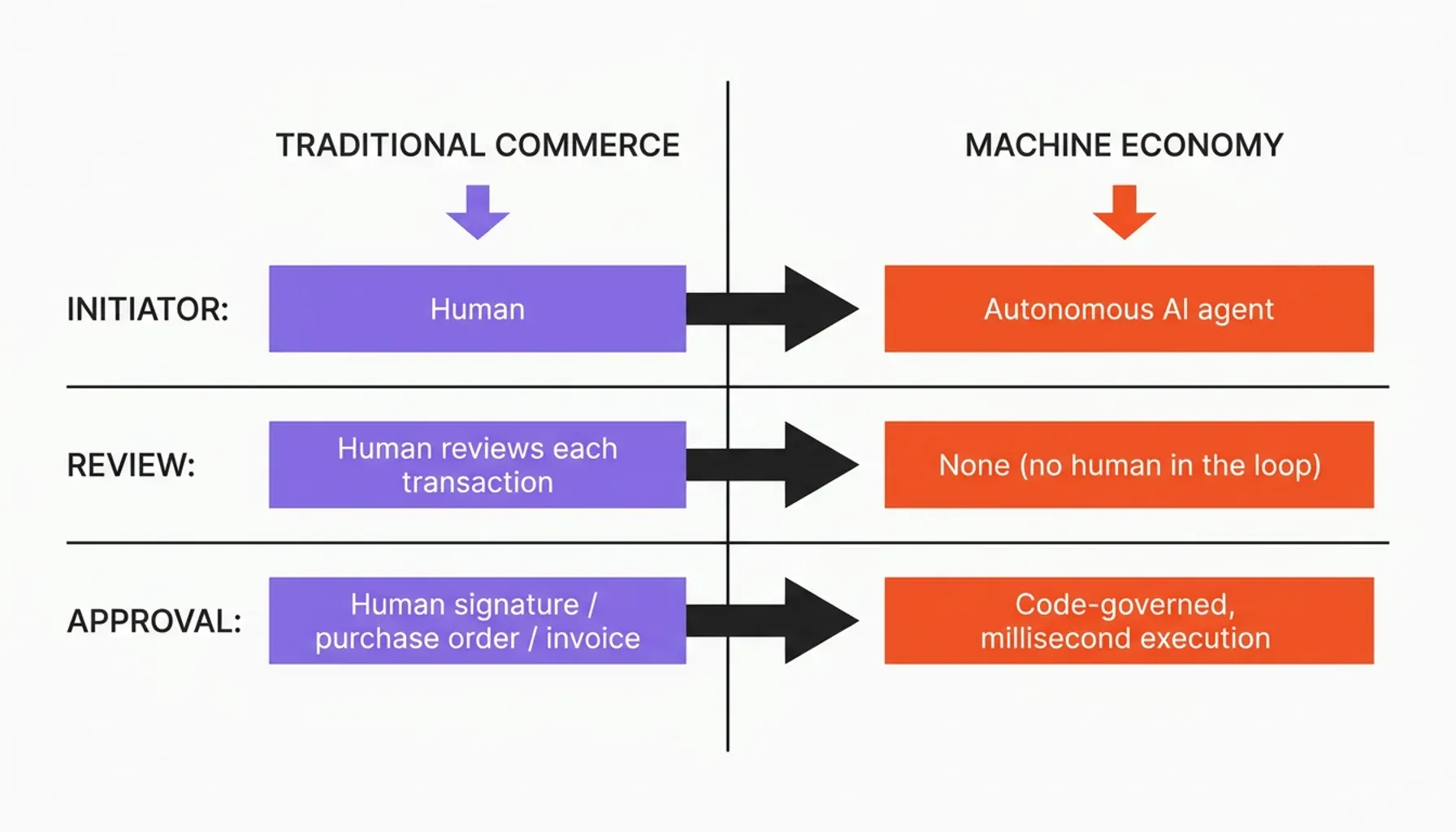
The shift is structural. Traditional commerce assumes a human initiates, reviews, and approves each transaction. The machine economy inverts that model entirely. An AI agent managing cloud infrastructure might execute thousands of micro-purchases per second: GPU cycles, bandwidth, sensor data, API calls, each one a discrete economic event. No invoice. No purchase order. No human signature.
This creates a problem that conventional payment rails were never designed to solve. Credit card networks, ACH transfers, and even most blockchain payment protocols assume low-frequency, high-value transactions. They are not built for high-frequency machine-to-machine micropayments where the cost of reconciliation often exceeds the value of the transaction itself.
But the deeper challenge is not speed or cost. It is accountability. When an autonomous agent pays for a data feed and that data turns out to be corrupted, who proves what was delivered, and when? When two competing agent networks dispute a settlement, what counts as evidence? When a regulator audits a trillion machine-generated transactions, what does the audit trail look like?
The machine economy cannot scale on trust alone. It needs something more durable: mathematical proof.
How IoT Devices, AI Agents, and Autonomous Systems Participate in Economic Activity
Before we get into the accountability problem, it helps to understand exactly who, or what, is doing the transacting.
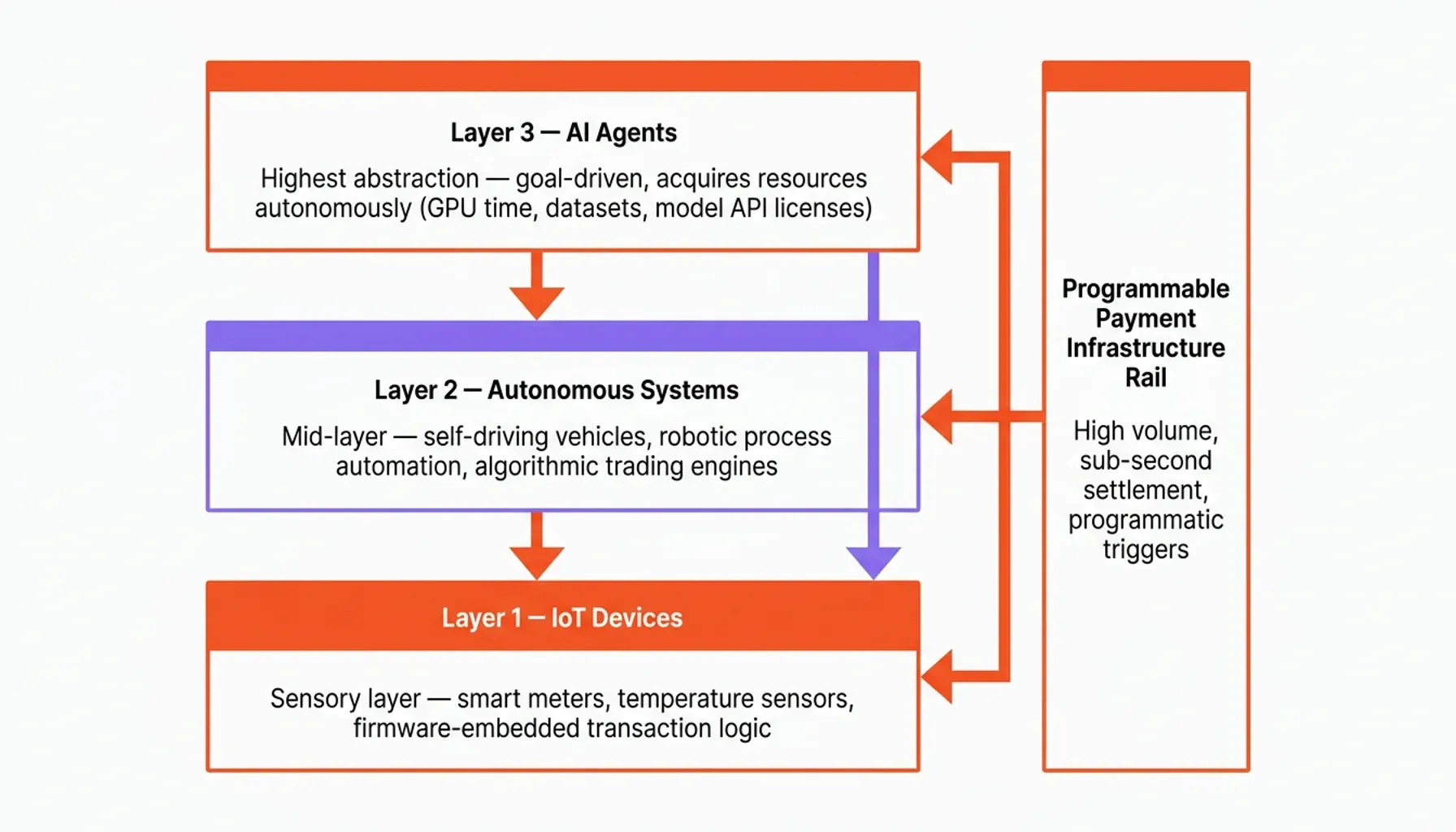
IoT devices are the sensory layer of the machine economy. A smart meter reads energy consumption and triggers a micropayment to a grid operator. A temperature sensor in a cold-chain shipment logs a reading and pays for a data verification service. These devices generate economic events continuously, often without any software agent orchestrating them. The transaction logic is embedded in firmware.
AI agents operate at a higher level of abstraction. They receive goals, decompose them into subtasks, and acquire the resources needed to complete those tasks, autonomously. An AI agent managing inference workloads might purchase GPU time from a compute broker, pay for a proprietary dataset, and settle a licensing fee for a model API, all within a single job execution. Each of these is a real economic transaction, settled in real time.
Autonomous systems, including self-driving vehicles, robotic process automation, and algorithmic trading engines, sit between these two layers. They combine sensor inputs with decision logic to execute actions that have direct economic consequences: routing a delivery, executing a trade, adjusting a manufacturing parameter.
What unites all three is programmable payment infrastructure. Machine-to-machine (M2M) payments require payment rails that can handle high transaction volumes, sub-second settlement, and programmatic triggers. Stablecoins on blockchain networks, payment channels like the Lightning Network, and emerging ISO 20022-compliant messaging standards are converging to fill this gap. The Federal Reserve's FedNow instant payment service represents the traditional finance sector's response to the same pressure: the need for programmable, real-time settlement at scale.
Here's the thing. M2M payment infrastructure is only half the problem. The other half is proving what was exchanged. A payment channel can confirm that value moved from Agent A to Agent B. It cannot confirm what Agent B delivered in return, or whether that delivery met the agreed specification. That evidentiary gap is where independent timestamps become essential.
The Visibility Gap: Why Digital Receipts Aren't Enough
Internal logs are the default answer to the audit problem. Every payment processor, API gateway, and agent framework generates them. But in decentralized agent environments, internal logs are structurally inadequate, and in contested situations, they are essentially useless.
The core problem is custody. A log maintained by the same system that executed the transaction is not independent evidence. It is a self-reported receipt. Any party with administrative access can alter it, and no external observer can verify it has not been changed. In a world where centralized logging creates a single point of failure for compliance, this is not a theoretical risk. It is a design flaw.
The "He Said, Bot Said" dilemma is already emerging in real deployments. Agent A pays Agent B for a data payload. Agent B's logs show delivery. Agent A's logs show corrupted data. Both logs were generated by the respective parties. Neither is independently verifiable. There is no neutral witness to the state of the data at the moment of exchange.
This is not a dispute resolution problem. It is a visibility problem. The machine economy generates events at a rate and granularity that no human auditor can monitor in real time. By the time a discrepancy surfaces, in a monthly reconciliation, a compliance audit, or a regulatory inquiry, the original state of the data may be unrecoverable.
Competing agent networks compound this further. When Agent Network A and Agent Network B are operated by different organizations with different infrastructure stacks, their logs are not just unverified. They are structurally incompatible. There is no shared ground truth.
What the machine economy requires is not better logging. It requires a neutral, third-party witness: a system that can confirm the state of any piece of data at a specific point in time, without relying on either party's infrastructure, and without storing the data itself. That witness needs to be mathematically trustworthy, not just contractually trustworthy.
If you want to understand just how wide this gap is, AI agent audit trails versus application logs lays it out clearly: what logs record and what courts or regulators will accept as proof are two very different things. The machine economy will collide with that gap at scale.
Independent Timestamps: The Mathematical Receipt
The solution is not a new type of database. It is a different category of proof entirely.
A cryptographic hash is a mathematical fingerprint. Feed any digital file, whether a data payload, a transaction record, a sensor reading, or an API response, into a SHA-256 hashing function, and you get a fixed-length string that is unique to that exact input. Change a single bit in the original file, and the hash changes completely. This property, known as collision resistance, makes the hash an immutable identifier for a specific state of data at a specific moment.
Anchor that hash to a public blockchain, Bitcoin or Ethereum, and you have something qualitatively different from a log entry. You have a tamper-evident proof of existence anchored to an immutable ledger that is:
- Independent: The proof lives on a public ledger that neither party controls.
- Permanent: Bitcoin blocks cannot be retroactively altered without rewriting the entire chain, a computational impossibility.
- Verifiable by anyone: Any third party can recompute the hash and check the blockchain record without asking either party for permission.
- Private: The original data never touches the blockchain. Only its fingerprint does.
This is what an independent timestamp delivers. It does not replace the transaction. It does not store the payload. It creates an unforgeable record that a specific piece of data existed in a specific form at a specific point in time, decoupled from the service provider, the payment rail, and both parties to the transaction.
For the machine economy, this changes the accountability calculus entirely. An AI agent that timestamps every data payload it delivers, before and after transmission, creates a mathematical receipt independent of its own infrastructure. If the recipient claims the data was corrupted, the hash tells the truth. If the sender claims timely delivery, the blockchain timestamp confirms or refutes it.
This moves the standard from "trust me" to "verify the math." It is the difference between a witness statement and a fingerprint at a crime scene. OriginStamp's blockchain timestamping service operationalizes exactly this: anchoring SHA-256 hashes to Bitcoin and Ethereum to create proof that is mathematically provable and administratively impossible to forge.
The NIST guidelines on cryptographic key management establish that binding a hash to a trusted time source is foundational to non-repudiation, the legal and technical standard that prevents parties from denying the authenticity of a transaction. Independent blockchain timestamps meet this standard without requiring either party to trust the other's infrastructure.
Bridging the Gap with Blockchain Timestamping
Understanding the mechanics matters here, because the architecture determines the trust properties.
When OriginStamp anchors a hash to Bitcoin, it does not write the hash directly into a Bitcoin transaction in isolation. It aggregates multiple hashes into a Merkle tree, a hierarchical data structure where each parent node is the hash of its children, and anchors the root of that tree in a single Bitcoin transaction. This means thousands of agent interactions can be proven with a single blockchain entry, while each individual hash retains its independent verifiability.
The result is a permanent audit trail that lives outside any single organization's control. A regulator auditing a machine economy platform does not need to request log files from the operator. They can independently verify the blockchain record. A counterparty disputing a transaction does not need to trust the other party's database. They can recompute the hash and check the public ledger.
Critically, this architecture separates the proof layer from the payment rail. The timestamp is not embedded in the payment transaction. It is independent of it. This is a feature, not a limitation. It means the integrity proof works regardless of which payment protocol the agents use, whether stablecoins, payment channels, or traditional settlement networks. Fintech interoperability is preserved because the integrity layer is protocol-agnostic.
This independence also addresses a specific risk in multi-agent systems: the compromise of the payment infrastructure itself. If a payment rail is hacked or manipulated, the blockchain timestamp of the original transaction payload remains intact. The proof of what was agreed, delivered, and paid for exists outside the compromised system.
For autonomous payment flows that require verifiable agent authorization, this separation is essential. The authorization record, what the agent was instructed to do, when, and by whom, must be verifiable independently of the payment execution. Blockchain timestamps provide exactly that separation.
The Bitcoin whitepaper's description of a timestamp server establishes the foundational logic: a distributed system that proves the existence of data at a specific time by including its hash in a chain of proof-of-work blocks. Ethereum extends this with programmable state proofs, enabling more complex verification conditions. Together, they form a universal, decentralized clock that no single actor controls.
Use Cases: From Compute Arbitrage to Smart Grids
The machine economy is not a future abstraction. Specific industries are already generating the transaction volumes that make independent timestamping operationally necessary.
Compute-on-demand markets: AI agents managing inference workloads purchase GPU cycles from compute brokers in real time. The agent submits a job, receives output, and settles payment, all autonomously. The critical question: did the compute provider deliver the output it claims? A timestamped hash of the input job and the returned output creates a verifiable record of what was delivered. If the output is disputed, whether due to the wrong model version, degraded quality, or incomplete results, the hash comparison is determinative.
Supply chain telemetry: Autonomous vehicles and drones operating in logistics networks exchange sensor data for stablecoin micropayments. A drone delivering a package generates a continuous stream of telemetry: GPS coordinates, temperature readings, chain-of-custody confirmations. Each data packet, timestamped and hashed at the point of generation, creates an immutable provenance record for supply chain integrity that no party in the chain can retroactively alter.
Decentralized energy markets: IoT-enabled smart meters in local energy grids execute peer-to-peer energy trades at the millisecond level. A rooftop solar installation sells excess capacity to a neighbor's EV charger. The transaction settles automatically. The timestamp proves the energy was available, offered, and consumed at the claimed time, which is essential for grid balancing, regulatory reporting under FERC guidelines, and dispute resolution.
Regulated machine industries: In healthcare, financial services, and critical infrastructure, machine-generated decisions will increasingly require post-facto audit trails. An AI agent that adjusts insulin dosing, reallocates capital, or controls a grid relay must leave a verifiable record of what data it acted on, and when. The timestamp is the foundation of that record.
In each case, the timestamp does not replace the transaction logic. It provides the evidentiary layer that makes the transaction auditable, by regulators, counterparties, and the agents themselves.
Scalability and Standards: The Road to 2030
Most companies get this wrong. The objection that every micro-transaction requires its own blockchain entry, making costs and latency prohibitive, misunderstands how production-grade timestamping actually works.
The Merkle tree aggregation approach described earlier addresses the volume problem directly. A single Bitcoin transaction can anchor the integrity proof for millions of agent interactions. Each individual hash remains independently verifiable against the Merkle root. The cost of the blockchain entry is shared across all anchored hashes, reducing the per-transaction cost to fractions of a cent.
Layer 2 solutions and rollup architectures extend this further. By batching state transitions off-chain and periodically committing compressed proofs to the base layer, it becomes feasible to handle millions of agent requests per second while maintaining the security guarantees of the underlying blockchain. Latency improves as Layer 2 infrastructure matures.
The standards landscape is catching up. ISO/TC 307, the international technical committee on blockchain and distributed ledger technologies, is developing frameworks for proof-of-transaction protocols that could become the basis for machine economy interoperability standards. The direction is clear: independent, verifiable proof of transaction state will be a baseline requirement, not a premium feature.
Honest limitations remain. Gas costs on Ethereum's base layer fluctuate with network congestion. Bitcoin's block time averages ten minutes, which is adequate for batch anchoring but not for real-time verification. The tooling for integrating blockchain timestamping into existing agent frameworks is still maturing. These are engineering constraints, not architectural dead ends.
For multi-agent systems that need verifiable trust between agents, the trajectory is toward standardized proof protocols that any agent can generate and any counterparty can verify, without requiring a shared trust anchor or a common infrastructure provider. Independent timestamps are the building block that makes this possible.
Building a Foundation of Fact
The machine economy will not fail because agents are too slow or payments are too expensive. It will fail, or be severely constrained, if it cannot produce credible evidence of what happened.
Regulators will demand audit trails. Counterparties will dispute settlements. Insurance underwriters will require proof of delivery. Courts will need to evaluate machine-generated evidence. None of these requirements can be met by self-reported logs from the parties involved. All of them can be met by independent, cryptographically verifiable timestamps anchored to public blockchains.
The strategic advantage for fintechs, ERP vendors, and infrastructure providers is not abstract. Organizations that build independent integrity layers into their agent architectures today will be the ones capable of operating in regulated machine economy environments tomorrow. The compliance burden of retrofitting auditability into a system designed without it is orders of magnitude higher than building it in from the start.
The deeper implication here is enabling, not just defensive. When every agent interaction carries a mathematically provable record of its state at the moment of execution, more complex and higher-value autonomous behaviors become possible. Multi-step agent workflows, cross-organizational machine contracts, and autonomous financial instruments all depend on a shared foundation of verifiable fact. You cannot build that foundation on assertions.
One practical place to see this play out is in chargeback and dispute scenarios. Agentic commerce is already creating a new chargeback evidence crisis that self-reported logs simply cannot resolve. The machine economy needs a better answer, and independent timestamps are it.
The machine economy is being built now. The question is whether it is being built on assertions or on proof.
Explore how cryptographic proof of existence works for digital data and what it takes to make every machine transaction independently verifiable.
Thomas Hepp
Co-Founder
Thomas Hepp is the founder of OriginStamp and creator of the OriginStamp timestamp, which has set the standard for tamper-proof blockchain timestamps since 2013. As one of the earliest innovators in the field, he combines deep technical expertise with a pragmatic focus on solving real business problems, and is a recognized voice in blockchain security, AI analytics, and data-driven decision support. His work has earned multiple international awards, including a top Best Project recognition from ETH Zurich and the Swiss Confederation. He publishes regularly on blockchain, AI, and digital innovation.