
Proving AI Agent Authorization in Autonomous Payments
Jun 11, 2026

Thomas Hepp
Jun 11, 2026

The Rise of Agentic Commerce: When Machines Pay Machines
A software agent books a freight slot, negotiates a price, and completes a wire transfer with no human approving a single step. This is not a future scenario. It is happening in production environments today, and the legal and financial infrastructure to govern it is still being written.
The shift from human-in-the-loop approvals to fully autonomous agent-to-agent payments represents one of the most consequential architectural changes in enterprise software. Where traditional automation required a human to authorize each transaction, agentic systems delegate that authority to an AI, permanently, programmatically, and at scale.
The economic logic is compelling. Micro-payment rails and automated procurement can eliminate entire layers of manual overhead. A logistics agent that can autonomously bid on spot freight rates, approve invoices, and release payments compresses a multi-day process into seconds. The machine-to-machine economy is projected to generate trillions in transaction volume as agentic systems proliferate across supply chains, financial services, and enterprise procurement.
But the central challenge is not technical. It is legal and epistemic. When an AI agent exceeds its spending mandate due to a logic error, a manipulated prompt, or a misinterpreted instruction, who is responsible? The enterprise that deployed it? The model vendor? The API provider that processed the payment?
Traditional logging systems are not built to answer that question. Append-only databases, server-side event logs, and platform-generated audit records all share the same fatal flaw: they are controlled by the same party whose actions are under scrutiny. That is not accountability. That is self-reporting.
Establishing trustworthy authorization records for autonomous transactions requires something fundamentally different, a proof layer that no single administrator can alter after the fact.
Emerging Standards for Agent Mandates and Intents
Most companies get this wrong. The industry has recognized the accountability gap and is moving, unevenly, toward formal protocol standards that define how agents should declare, communicate, and record their spending authority.
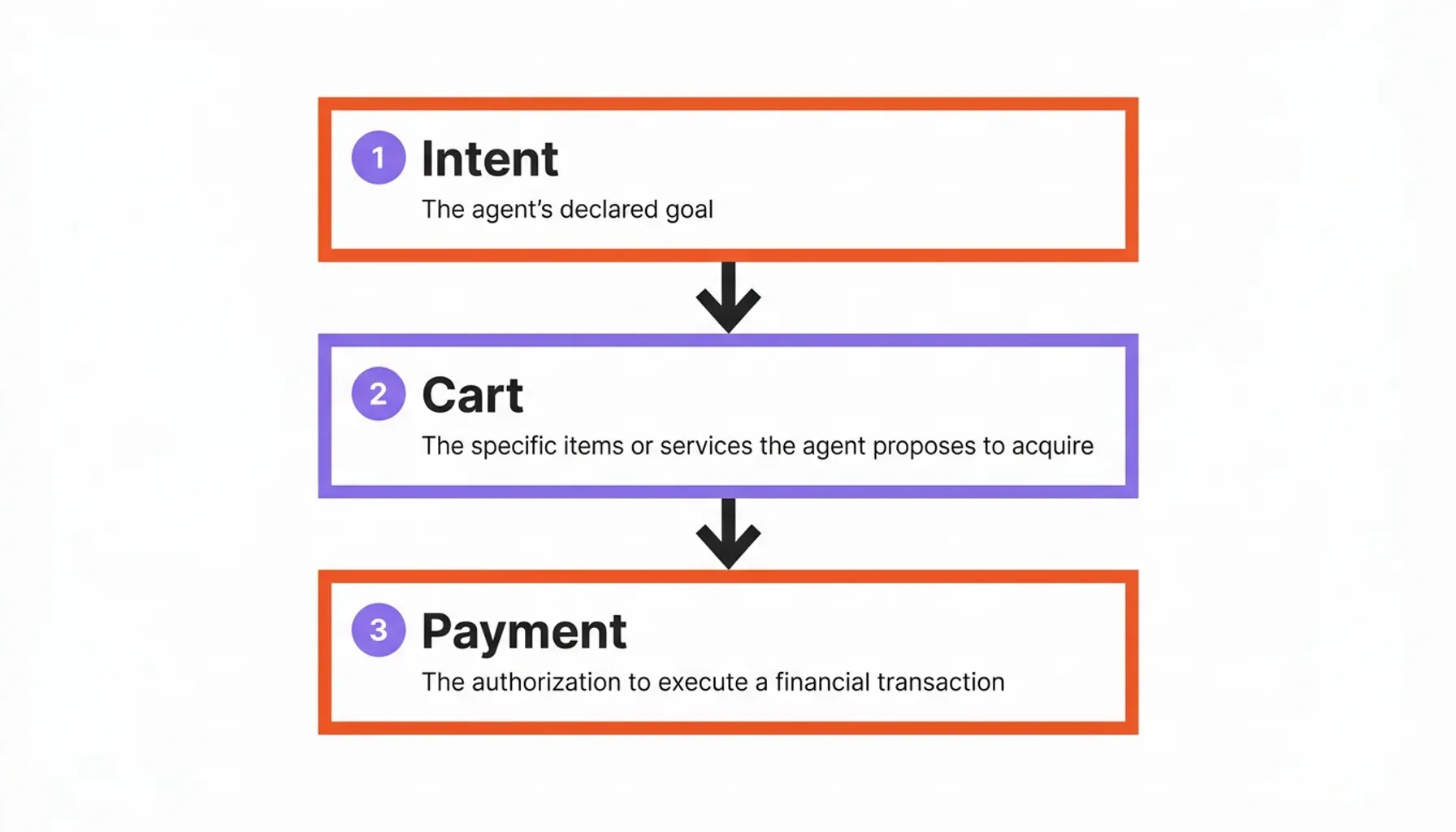
Google's Agentic Payment Protocol (AP2) is among the most structured frameworks currently in development. AP2 organizes agent spending authority into three distinct mandate types: Intent (the agent's declared goal), Cart (the specific items or services the agent proposes to acquire), and Payment (the authorization to execute a financial transaction). Each layer is designed to be cryptographically verifiable, so a downstream system can confirm not just that a payment occurred, but that it was sanctioned at each prior step.
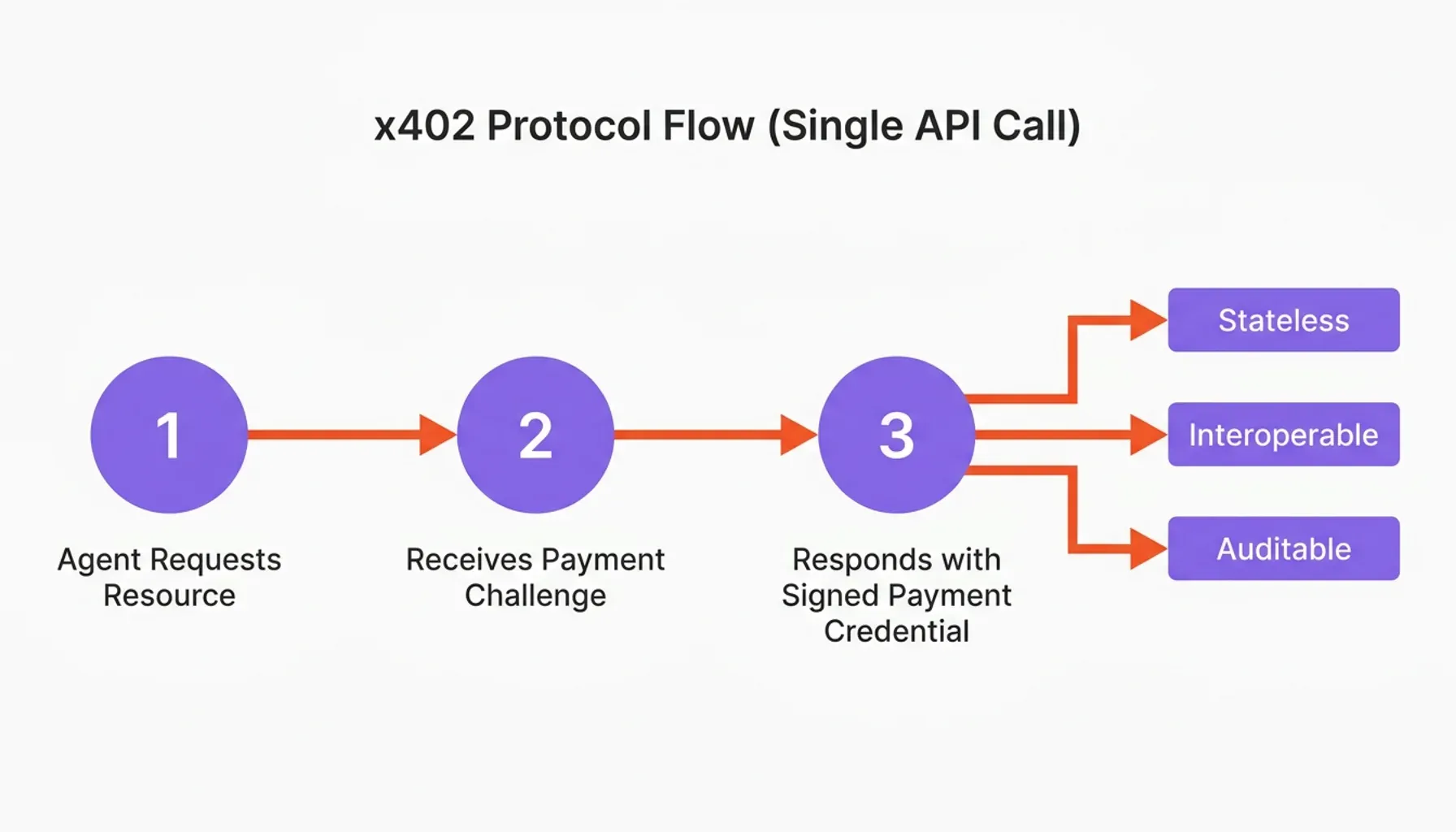
The x402 protocol, built on the HTTP 402 "Payment Required" status code, takes a complementary approach, enabling machine-to-machine micropayments directly within API calls. An agent requests a resource, receives a payment challenge, and responds with a signed payment credential. The entire exchange is designed to be stateless, interoperable, and auditable.
The agentic commerce protocol space more broadly is being shaped by contributions from W3C working groups, IETF drafts, and IEEE research on autonomous transaction standards. These efforts share a common vocabulary: agents must be able to prove non-repudiation, the cryptographic guarantee that a message or transaction was sent by a specific party, at a specific time, and has not been altered since.
Non-repudiation in AI contexts is more complex than in traditional digital signatures. A human signs a document. An agent executes a mandate that was itself generated by another AI, based on instructions from a human, filtered through a model that may have been fine-tuned by a third party. The chain of accountability is longer, and every link is a potential point of dispute.
The fragmentation problem is real. No single protocol has achieved dominant adoption, and the risk of vendor lock-in is significant. An enterprise that builds its agent authorization layer entirely on Google's AP2 framework is betting that Google's protocol becomes the standard. One that builds on x402 is making a different bet. The more prudent architectural choice is to treat the protocol layer as interchangeable and invest instead in the integrity layer that sits beneath all of them, the cryptographic record that proves what was authorized, when, and by whom, regardless of which protocol carried the instruction.
This is precisely where AI governance auditing with blockchain becomes operationally relevant, not as a theoretical safeguard but as a practical infrastructure requirement.
The Accountability Gap: The Problem with Platform-Owned Logs
Every major cloud platform offers logging. AWS CloudTrail, Azure Monitor, Google Cloud Audit Logs, these are mature, well-documented services. They are also entirely controlled by the platform provider. And in a dispute about whether an AI agent was authorized to make a specific payment, that matters enormously.
Here's the thing. The Admin Paradox is straightforward: any log that can be written by an administrator can, in principle, be modified or deleted by that same administrator. This is not a hypothetical risk. It is the structural reality of centralized logging infrastructure. When a financial dispute arises between two enterprises whose agents transacted with each other, neither party's internal logs constitute independent evidence.
The legal implications of "He Said, AI Said" disputes are already emerging in enterprise contracts. Agency law, the legal doctrine governing when one party can bind another through an authorized representative, was not designed for software agents operating at machine speed. Courts and regulators are beginning to ask a question that existing infrastructure cannot cleanly answer: Was this specific transaction within the agent's authorized mandate at the moment it was executed?
Consider a concrete scenario. A procurement agent is deployed with a mandate to purchase cloud computing resources up to $10,000 per month. A prompt injection attack, one of the most critical vulnerabilities in LLM-based systems, causes the agent to misinterpret its spending ceiling. It commits to $340,000 in reserved instances over a 12-month term. The vendor's system processed a valid payment credential. The enterprise's internal logs show the agent acted within what the system believed was its mandate.
Who has the authoritative record of what the mandate actually said at the time the agent was initialized? If that record lives in a database controlled by either party, it is not authoritative. It is a claim.
The requirement for independent verification is not a compliance checkbox. It is the technical prerequisite for agent-to-agent commerce to function at scale in environments where financial and legal accountability are real. A third party must be able to validate a mandate without trusting the agent's creator, the platform provider, or any other interested party.
Anchoring Truth: Blockchain Timestamps as the Integrity Layer
The solution to the Admin Paradox is mathematical, not administrative. Instead of asking parties to trust their own logs, the integrity layer must produce proof that is verifiable by anyone, controlled by no one, and impossible to retroactively alter.
This is what cryptographic blockchain timestamping delivers. When an agent mandate is created, defining the agent's scope, spending limits, authorized counterparties, and validity window, that mandate document is converted into a SHA-256 cryptographic hash. This hash is a unique 64-character fingerprint of the document. Change a single character in the mandate, and the hash changes entirely.
That hash is then anchored to a public blockchain, Bitcoin or Ethereum, where it becomes part of an immutable, globally distributed ledger. The blockchain provides a decentralized Clock of Record: a timestamp that no single entity controls and that cannot be altered without invalidating the entire chain of subsequent blocks.
The result is a proof with three properties that matter for autonomous transaction security:
- Existence: The mandate existed in exactly this form at this specific point in time.
- Content integrity: Any subsequent modification to the mandate is mathematically detectable.
- Timing: The authorization preceded the transaction, establishing that the agent acted within a mandate that was in place before the payment occurred.
This shifts the evidentiary standard from administrative trust to mathematical proof. Instead of "our logs show the agent was authorized," the claim becomes "here is a cryptographic proof, anchored on Bitcoin block #903,441, that this mandate existed in this exact form at 14:23:07 UTC, four minutes before the transaction was executed." Any party with internet access can verify that proof independently, without trusting OriginStamp, the enterprise, or any other intermediary.
NIST guidance on computer security log management explicitly identifies the integrity and authenticity of log records as a core requirement for security-relevant systems. Blockchain anchoring satisfies that requirement in a way that no centralized logging system can.
For high-stakes autonomous transactions, this is not an optional enhancement to the AI audit trail. It is the foundation. Peer-reviewed research on blockchain-based audit trails consistently demonstrates that cryptographic anchoring provides non-repudiation guarantees that centralized systems structurally cannot replicate.
Technical Architecture of a Non-Repudiable Audit Trail
Building a production-grade authorization proof system for agent-to-agent payments requires five discrete steps. Each step is independently auditable, and the system is designed so that sensitive transaction data never leaves the local environment.
Step 1, Mandate Generation When an agent is initialized, its mandate document is generated in a structured format (JSON-LD or equivalent) that captures: the agent's identity, the authorizing human or system principal, spending limits, permitted counterparties, validity window, and any conditional constraints. This document is the authoritative record of what the agent is permitted to do.
Step 2, Cryptographic Hashing The mandate document is hashed locally using SHA-256. The hash, not the document itself, is what leaves the enterprise environment. This is the critical privacy-preserving property: the blockchain never sees the mandate's contents, only its fingerprint. Sensitive commercial terms, supplier identities, and pricing data remain entirely within the enterprise's control.
Step 3, Blockchain Anchoring The hash is submitted to a timestamping service that anchors it to Bitcoin and Ethereum. The resulting blockchain certificate records the hash, the block height, and the timestamp. This certificate is stored alongside the original mandate document in the enterprise's records system. OriginStamp's tamper-proof blockchain timestamp infrastructure handles this anchoring process, producing certificates that reference specific blocks on public chains.
Step 4, Transaction Execution with Proof Reference When the agent executes a payment, the transaction record includes a reference to the mandate's blockchain certificate. Any downstream system, a counterparty's ERP, an auditor's review tool, a regulatory compliance platform, can independently verify that the mandate existed, was unaltered, and was in force at the time of the transaction.
Step 5, Aggregation for High-Frequency Micro-Transactions For agents executing hundreds or thousands of micro-transactions per hour, anchoring each transaction individually is impractical. A Merkle tree aggregation approach solves this: multiple transaction hashes are combined into a single root hash, which is anchored in one blockchain transaction. Each individual transaction can still be independently verified against the root. This is the same scaling approach used in Layer 2 blockchain architectures and is well-suited to high-frequency agentic commerce environments.
Integration with ERP and accounting systems is straightforward via API. The blockchain certificate becomes a metadata field attached to each purchase order or payment record, enabling automated reconciliation and audit-ready reporting without manual intervention.
The Next 36 Months: Preparing for Agentic Compliance
Regulation follows economic risk. As agent-to-agent payments move from experimental pilots to mission-critical procurement infrastructure, regulatory frameworks will impose requirements that today's architectures are not built to satisfy.
The EU AI Act already mandates logging and traceability for high-risk AI systems. Financial transactions executed autonomously by AI agents will almost certainly fall within high-risk classifications as enforcement guidance matures. The Act's requirements for human oversight and auditability translate directly into a technical requirement for tamper-evident, independently verifiable records, precisely what blockchain-anchored audit trails provide. For a detailed analysis of what non-compliance costs, see the real impact of EU AI Act penalties.
US regulatory movement is parallel. Executive orders on AI governance and emerging SEC guidance on algorithmic trading both point toward mandatory audit trail requirements for autonomous financial systems. The direction is clear even where the specific rules are not yet final.
For CTOs building agentic systems today, the strategic advice is direct: build audit-ready architectures before the mandate, not after. Retrofitting immutable logging into a production agent system is significantly more expensive and disruptive than designing for it from the start. The enterprises that establish a foundational integrity layer now will be positioned to onboard new agentic protocols, AP2, x402, or whatever standard emerges, without rebuilding their compliance infrastructure each time.
The transition from proof-of-concept to mission-critical is already underway in financial services, logistics, and enterprise procurement. The organizations that treat AI content provenance and data integrity as infrastructure, not as an afterthought, will be the ones that can scale autonomous commerce without accumulating unquantifiable legal and financial exposure.
The prerequisite for safe, scalable agent-to-agent payments is not a better protocol. It is a proof layer that makes every authorization mathematically verifiable, permanently, by anyone.
Conclusion
Agentic commerce is not a trend to monitor. It is an architectural shift to prepare for. The economic efficiency of autonomous machine-to-machine transactions is real, and adoption will accelerate regardless of whether the governance infrastructure is ready.
The accountability gap is equally real. Platform-owned logs, self-reported audit trails, and administrative trust cannot satisfy the evidentiary standard that autonomous financial transactions require. When an AI agent commits enterprise capital, the authorization record must be provable by mathematics, not by the word of the party whose system generated it.
Blockchain timestamping closes that gap. It converts agent mandates into tamper-evident, independently verifiable proofs that establish existence, content, and timing with cryptographic certainty. It does this without exposing sensitive data, without requiring trust in any intermediary, and without depending on any single vendor's continued cooperation.
The architecture is available today. The regulatory requirement is arriving. The enterprises that build their agentic systems on a foundation of cryptographic proof will be the ones that scale without legal exposure and the ones that can demonstrate compliance on demand, to any auditor, in any jurisdiction.
Explore how OriginStamp's blockchain timestamping infrastructure can serve as the integrity layer for your autonomous agent architecture.
Thomas Hepp
Co-Founder
Thomas Hepp is the founder of OriginStamp and creator of the OriginStamp timestamp, which has set the standard for tamper-proof blockchain timestamps since 2013. As one of the earliest innovators in the field, he combines deep technical expertise with a pragmatic focus on solving real business problems, and is a recognized voice in blockchain security, AI analytics, and data-driven decision support. His work has earned multiple international awards, including a top Best Project recognition from ETH Zurich and the Swiss Confederation. He publishes regularly on blockchain, AI, and digital innovation.