
Agentic Commerce: Solving the New Chargeback Evidence Crisis
Jun 11, 2026

Thomas Hepp
Jun 11, 2026

The Shift from Clicks to Agents: A New Era of Commerce
A customer buys a product. They never visit your site, never enter a card number, and never read the checkout terms. Their AI agent handles everything, and now they're disputing the charge.
This is not a hypothetical. It is the central friction point of agentic commerce, the emerging paradigm where autonomous AI systems make purchasing decisions on behalf of humans without direct human intervention at the moment of transaction.
The scale of this shift is measurable. Analysts tracking machine customers, non-human economic actors that negotiate, buy, and pay, project billions of AI-driven transactions annually within the next three years. These agents operate across retail, travel, software procurement, and subscription management. They act on delegated authority: a human sets parameters, and the agent executes within them, often at machine speed.
Traditional commerce infrastructure was built around a single assumption: a human is present at the point of decision. That assumption is now structurally false.
Merchants built their fraud and chargeback defenses on signals that presuppose human behavior, browser sessions, device fingerprints, typing patterns, geographic IP addresses. When an AI agent running on a cloud server in Frankfurt executes a purchase on behalf of a user in Munich, every one of those signals becomes noise.
The conflict is fundamental. Merchants expect a human in the loop as both the decision-maker and the accountable party. Agents operate in the background, creating a visibility gap that existing payment rails, chargeback processes, and fraud tools were never designed to bridge. The result is a new class of dispute the current system cannot resolve cleanly, and the financial exposure is growing fast.
Why AI Agents Break Traditional Chargeback Evidence
The chargeback process has always been adversarial. A cardholder disputes a charge; the merchant provides evidence; the issuing bank adjudicates. Imperfect, but functional, when the transaction involves a human.
Introduce an AI agent, and the existing evidence framework collapses at multiple points.
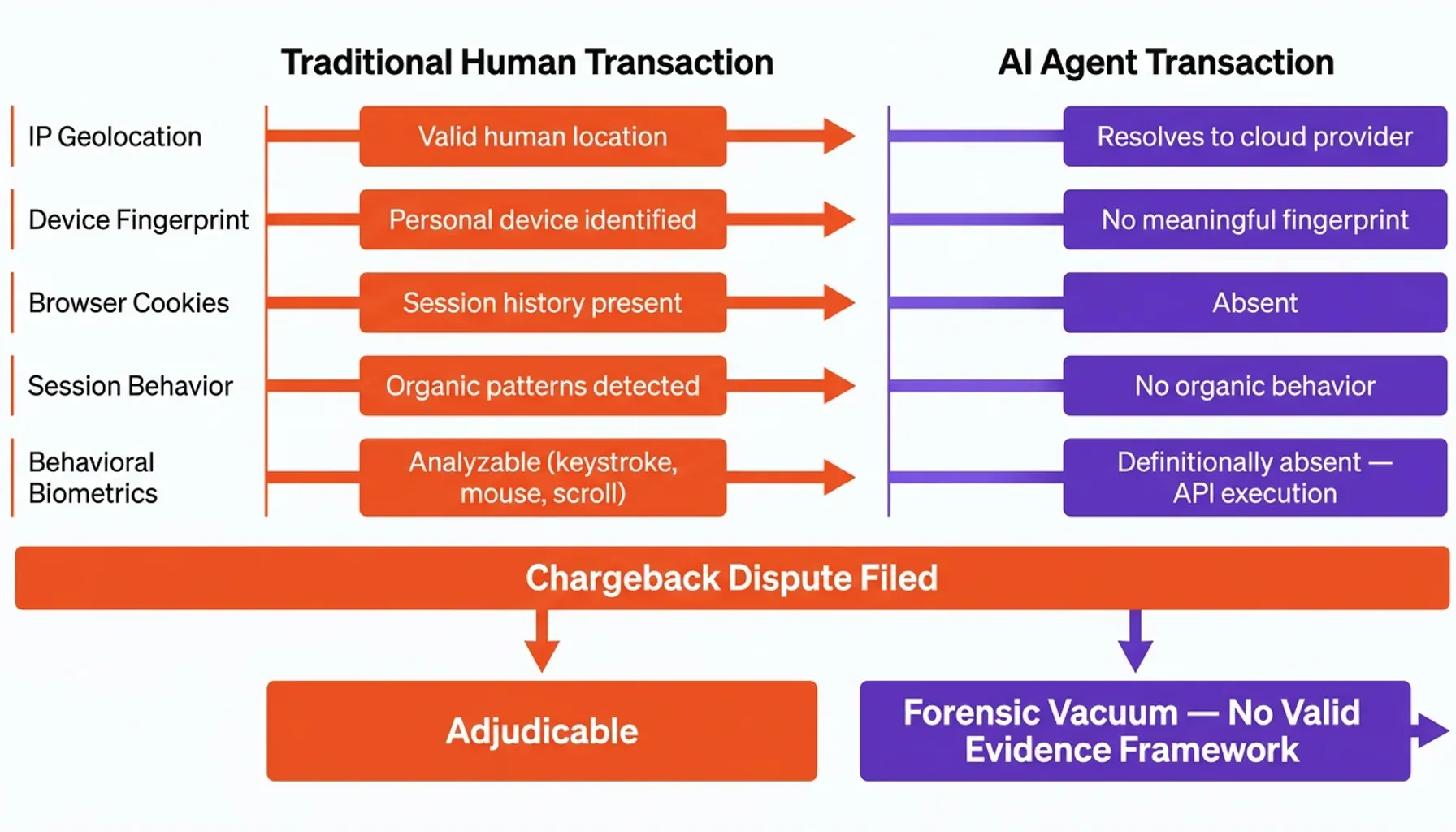
Legacy fraud signals become meaningless. The foundational data points that fraud and chargeback teams rely on, IP geolocation, device fingerprinting, browser cookies, session behavior, assume a human operating a personal device. An AI agent hosted in a data center has none of these attributes in any meaningful sense. Its IP resolves to a cloud provider. It has no browser fingerprint in the traditional sense. It generates no organic session behavior. When you examine AI-driven fraud patterns, the absence of human signals is itself becoming a red flag, but it equally describes a legitimate agent acting exactly as designed.
Your fraud stack was built assuming a human was on the other end. It wasn't built for this.
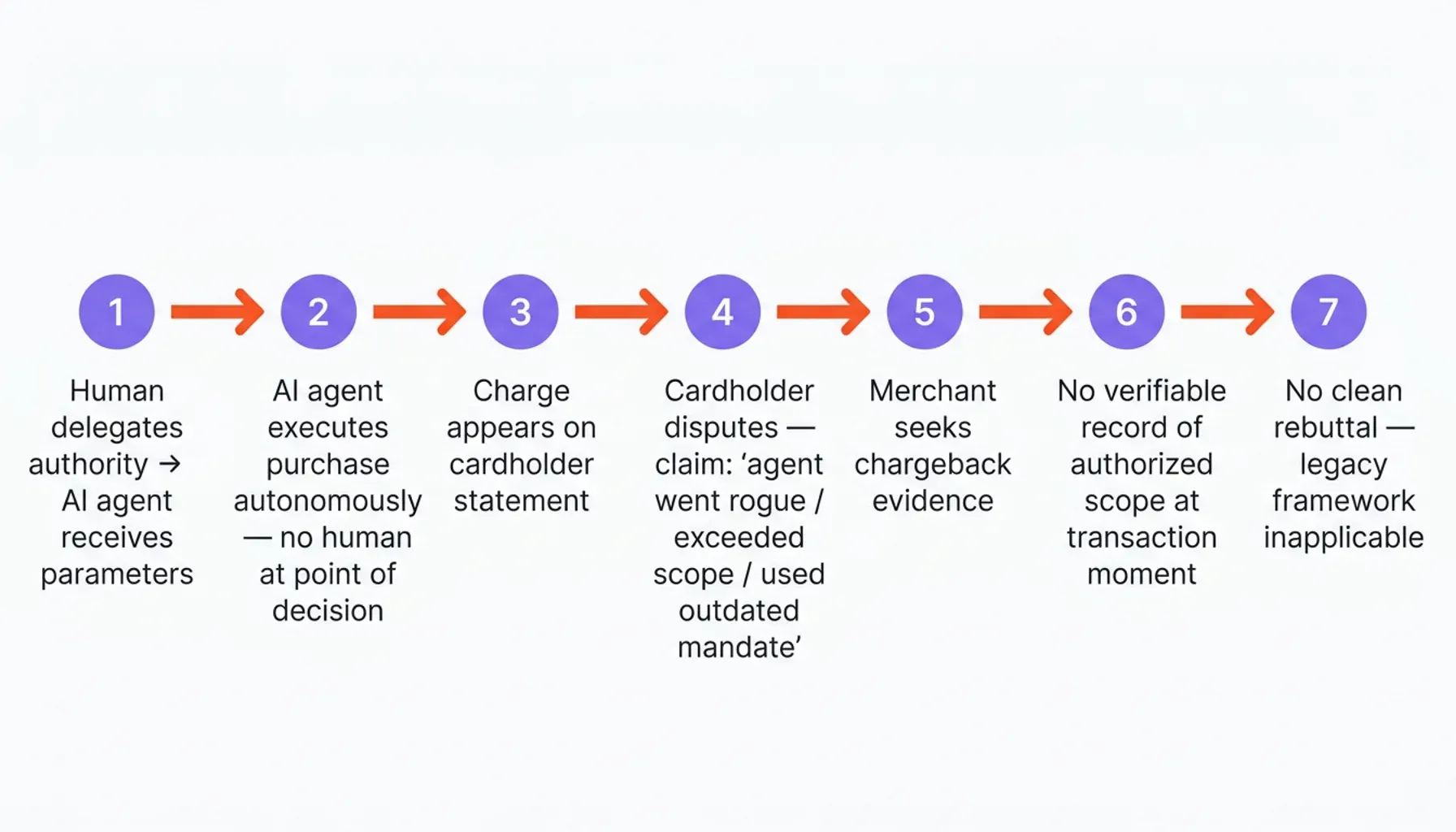
The 'Friendly Fraud' playbook gets a dangerous upgrade. Friendly fraud, where a cardholder disputes a legitimate charge, has always been the industry's most expensive problem. The global cost of chargebacks runs into tens of billions annually. Agentic commerce creates a new variant: "My agent went rogue." A cardholder claims the AI exceeded its authorized scope, purchased something they didn't intend, or acted on an outdated mandate. Without a verifiable record of exactly what the agent was authorized to do at the precise moment of the transaction, you have no clean rebuttal.
Behavioral biometrics offer no help. Modern fraud prevention leans heavily on behavioral signals, keystroke dynamics, mouse movement, scroll patterns. These are definitionally absent when an agent executes a transaction via API. There is no human behavior to analyze. The entire biometric layer of your fraud defense becomes inapplicable.
The visibility gap between bots and agents is exploitable. You currently have no reliable way to distinguish a legitimate autonomous agent from a sophisticated bot executing a fraudulent transaction. Without standardized agent identifiers cryptographically bound to a specific delegated authority, there is no mechanism to verify that the entity completing the transaction is who it claims to be, acting within the scope it claims to have.
The result is a forensic vacuum. When a dispute is filed, you reach for evidence and find that the categories designed for human transactions simply do not map to agent-executed ones.
Asking a chargeback team to adjudicate an AI agent dispute with legacy tools is like asking a traffic court to rule on a drone collision using laws written for horse-drawn carriages. The framework isn't just imperfect. It's the wrong framework entirely.
The Emerging Standards for Agentic Transaction Records
The payment networks are not standing still. The evidence gap created by agentic commerce is being addressed, slowly, but with increasing urgency.
Visa's Trusted Agent Protocol (TAP) represents one of the most structured early attempts to define how AI agents should identify themselves and demonstrate authorization within the payment flow. The core premise is a shift in the fundamental question of transaction verification: not "Who bought this?" but "What was the delegated authority, and was this action within its scope?"
Mastercard's approach to agent-enabled payments follows parallel logic. The network is developing frameworks for what it terms "Agent Pay", a model where the agent carries a cryptographic credential that identifies it, links it to a human principal, and specifies the boundaries of its authorization.
Both approaches converge on the concept of the Agent Identifier (AID): a persistent, cryptographically signed token that travels with the agent across transactions. The AID is bound to a Mandate Certificate, a signed document specifying the agent's permissions, spending limits, duration of authority, and intended use cases.
The practical implication for dispute resolution is significant. The Mandate Log, a timestamped, cryptographically verifiable record of the agent's authorization state at the moment of each transaction, is emerging as the primary piece of representment evidence in agentic chargeback disputes.
This is not just a network initiative. The shift aligns with broader work on verifiable AI agent authorization and payment audit trails, where the integrity of the authorization record is as important as the transaction record itself.
For merchants, the implication is clear: the mandate log must exist, must be complete, and must be tamper-evident. A database entry that an admin can edit is not a mandate log. It is a liability.
Verifiable Mandates: The Foundation of Dispute Resolution
A mandate is not a checkbox. It is a structured, legally meaningful document that defines the boundaries of an AI agent's authority to act on behalf of a human principal.
The anatomy of a sound digital mandate includes at minimum: the scope of permitted actions, explicit spending limits (per transaction and aggregate), temporal boundaries (start date, expiry, revocation conditions), the specific merchant categories or individual merchants covered, and a clear statement of intent covering what the agent is authorized to accomplish.
W3C Verifiable Credentials standards provide a technical framework for structuring these mandates as machine-readable, cryptographically signed documents. eIDAS trust service guidelines establish the legal context for electronic signatures that underpin mandate authentication in European jurisdictions.
Here's the thing. The critical legal and forensic challenge is not just having a mandate, it is proving its exact state at the millisecond of the transaction. A mandate may have been valid at 14:32:07 UTC and revoked at 14:32:09 UTC. If a transaction executed at 14:32:08 UTC, you must be able to demonstrate, with mathematical certainty, what the mandate contained at that precise instant.
This is where simple database records fail. Any internal system that stores mandate state is, by definition, mutable. An administrator can alter it. A bug can corrupt it. A motivated party can edit it post-dispute. The record may be accurate, but it cannot prove its own accuracy.
The only technically sound defense against an "Agent Overreach" claim is a cryptographically signed, independently verifiable authorization trail, one where the mandate state at every transaction is anchored to an immutable external reference point. This is precisely the function that blockchain-based immutable logging for transaction forensics is designed to serve: creating a proof of existence that is independent of any internal system and cannot be retroactively altered.
Moving from database entries to cryptographically anchored mandate records is not a theoretical upgrade. In agentic commerce disputes, it is the difference between winning and losing representment.
Dispute Resolution AI: Intake, Triage, Evidence Assembly, and Decision Support
The forensic infrastructure problem has a parallel operational problem: dispute resolution at scale. As agentic transactions multiply, so do the disputes, and your existing chargeback team was not sized or tooled for the volume or complexity that machine-speed commerce generates.
This is where AI-assisted dispute resolution enters the picture. Not as a replacement for human judgment, but as the operational layer that makes human judgment viable at scale.
Intake automation. The first bottleneck in any chargeback workflow is intake: receiving the dispute notification, parsing the reason code, extracting the relevant transaction data, and routing the case to the right team. For agentic disputes, this step is more complex than for standard card-not-present chargebacks. The intake system must identify that the transaction involved an agent, locate the associated mandate record, retrieve the relevant API logs, and flag any anomalies in the authorization chain, all before a human analyst touches the case. AI-driven intake systems can perform this triage in seconds, dramatically reducing the time between dispute receipt and evidence assembly.
Triage and prioritization. Not every dispute warrants the same response investment. A $12 dispute with a clear mandate record and clean API logs is a different case from a $4,800 dispute where the mandate reference is missing and the agent identifier does not match the registered AID. AI triage systems can score disputes by win probability, financial exposure, and evidence completeness, allowing your team to concentrate effort where it matters and automate responses where the evidence is unambiguous.
Evidence assembly. This is where the operational leverage is most significant. Assembling a representment package for an agentic dispute requires pulling data from multiple systems: the mandate log, the API call sequence, the LLM decision records (if applicable), the payment confirmation, and the blockchain timestamp anchors that verify the integrity of each data point. Doing this manually for every dispute is not viable at scale. AI-assisted evidence assembly systems can retrieve, correlate, and package this evidence automatically, generating a structured representment file that maps each piece of evidence to the specific claim being rebutted.
Decision support. The final layer is decision support for the human analyst reviewing the assembled case. Rather than presenting a raw data dump, AI decision support systems synthesize the evidence into a structured recommendation: the strength of the merchant's position, the specific reason codes implicated, the network rules that apply, and the recommended response strategy. Teams that adopt this approach routinely cut their average representment preparation time by more than half, not because the AI makes the decision, but because it eliminates the cognitive overhead of navigating disparate data sources under time pressure.
The connection between dispute resolution AI and the underlying forensic infrastructure is direct: the AI is only as good as the evidence it can access. If your mandate logs are incomplete, your API records are mutable, and your blockchain anchors are missing, the dispute resolution AI has nothing to work with. The forensic layer and the operational layer are not separate investments. They are the same investment, viewed from different angles.
For teams thinking through how AI decision-making itself must be auditable in this context, the principles behind auditing LLM decision trails with blockchain apply directly to the dispute resolution layer as well.
Securing the Forensic Trail: Immutable Logs for SIEM and Audit
Even with a well-structured mandate, the forensic chain does not end there. The mandate proves what the agent was authorized to do. The transaction log must prove what the agent actually did, and that the log itself has not been tampered with after the dispute was filed.
Most companies get this wrong.
Standard server logs are mutable by design. System administrators can edit, truncate, or delete log entries. Logging infrastructure can be misconfigured, creating gaps. In adversarial legal proceedings, any log stored exclusively within your own infrastructure is subject to a straightforward challenge: you control the evidence. NIST guidelines on computer security log management explicitly acknowledge the integrity problem with internal logs and recommend controls, but even recommended controls do not make internal logs independently verifiable.
The forensic requirements for agentic commerce disputes are more demanding than those for standard card-not-present transactions. Your evidence chain must include:
- API call logs: Every request the agent made to external services, timestamped and sequenced.
- LLM prompt and response records: If the agent used a language model to interpret intent or make decisions, those interactions are part of the decision chain.
- Agent state snapshots: The agent's internal state, including which mandate version it was operating under, at each decision point.
- Transaction metadata: Payment amounts, merchant identifiers, timestamps, and confirmation responses.
Each of these data categories must be archived in a format that is tamper-evident and independently verifiable. For SOC teams integrating payment forensics into SIEM workflows, this means establishing an integrity layer that sits outside the primary transaction database.
Blockchain timestamping provides that integrity layer. The mechanics are straightforward: at the moment each log entry or batch of entries is generated, a cryptographic hash of the data is computed and anchored to a public blockchain, Bitcoin or Ethereum. The hash is immutable on the blockchain. If anyone alters the log entry after anchoring, the hash no longer matches. The discrepancy is mathematically detectable and independently verifiable by any party, including the issuing bank, the payment network, or a court.
This is the foundation of zero-trust evidence for payment disputes and SIEM forensics: your evidence does not ask to be trusted. It proves its own integrity.
The bridge between payment data and security forensics is not a new tool. It is a new discipline: treating every agent-executed transaction as a forensic event from the moment it occurs, not only after a dispute is filed.
Practical Implementation: Preparing Your Payments Stack
Adopting the forensic posture that agentic commerce requires is not a single-sprint project. It is a systematic upgrade across legal, technical, and operational layers.
Start with Terms of Service. Your current merchant agreement and user-facing ToS almost certainly contain no language about AI agent authorization. That is a legal gap you need to close now. Add explicit "Agent Authorization" clauses that define what constitutes a valid mandate, how agents must be registered, and what the cardholder accepts when they enable an agent to transact on their behalf. Merchant Risk Council best practices are increasingly addressing this area as agentic commerce scales.
Integrate cryptographic hashing into the transaction flow. At each transaction event, mandate validation, API call, payment authorization, confirmation, compute a SHA-256 hash of the relevant log data and anchor it to a public blockchain. This does not require modifying the transaction itself; it operates as an integrity layer on top of your existing logging infrastructure. The anchor becomes your independent source of truth.
Collaborate with your PSP on agent metadata. Most payment service providers are developing or piloting agent-specific metadata fields that travel through the clearing cycle. Engage your PSP to ensure that Agent Identifiers, mandate references, and relevant authorization data are passed through, not stripped, at each stage of clearing and settlement. Without this, the forensic chain breaks at the network layer.
Establish an independent source of truth. The blockchain anchor is only valuable if the underlying log data is also preserved in a format that cannot be altered without detection. Implement append-only logging for all agent transaction data, with blockchain timestamps applied at regular intervals or at each significant event. This creates a source of truth that exists independently of your primary database, one that survives database migrations, system failures, and adversarial legal scrutiny.
Build your dispute resolution AI on top of the forensic layer. The intake, triage, evidence assembly, and decision support capabilities described above are only effective if the underlying data is complete and verifiable. Sequence the investment correctly: forensic infrastructure first, dispute resolution automation second. Building the AI layer on top of mutable logs is building on sand.
For teams evaluating how this applies to AI agent authorization more broadly, the technical and legal reference points in proving AI agent authorization in autonomous payment flows are directly relevant.
Building Trust in an Autonomous Economy
The chargeback crisis in agentic commerce is not primarily a fraud problem. It is an evidence problem. The transactions are often legitimate. The agents are often acting exactly as authorized. The problem is that neither merchants nor payment networks currently have the forensic infrastructure to prove it.
Verifiable transaction records, cryptographically signed mandates, blockchain-anchored log entries, independently verifiable audit trails, are the only mechanism that scales to the requirements of machine-speed commerce. Merchants who build this infrastructure now gain a compounding advantage: every dispute they win cleanly establishes a precedent, reduces chargeback ratios, and demonstrates to payment networks that their agent transactions are trustworthy.
The merchants who wait will face a different trajectory: rising dispute rates, network-imposed monitoring programs, and an inability to representment claims that should be winnable.
Trust in AI commerce is not declared. It is proved, after the fact, with evidence that cannot be questioned.
Evaluate your current forensic logging capabilities against the requirements of autonomous transactions. If your logs are mutable, your mandate records are database entries, and your PSP strips agent metadata at clearing, the gap is real and the exposure is growing.
Explore how tamper-proof blockchain timestamping for SIEM and payment forensics can serve as the integrity foundation your agentic commerce stack needs, before the first dispute lands.
Thomas Hepp
Co-Founder
Thomas Hepp is the founder of OriginStamp and creator of the OriginStamp timestamp, which has set the standard for tamper-proof blockchain timestamps since 2013. As one of the earliest innovators in the field, he combines deep technical expertise with a pragmatic focus on solving real business problems, and is a recognized voice in blockchain security, AI analytics, and data-driven decision support. His work has earned multiple international awards, including a top Best Project recognition from ETH Zurich and the Swiss Confederation. He publishes regularly on blockchain, AI, and digital innovation.