
Proving a Leaked Document Is Real: Verifiable Proof for NGOs
Jun 11, 2026

Thomas Hepp
Jun 11, 2026

When a Leaked Document Is Called a Fake: The Verification Problem No Journalist Can Afford to Ignore
A whistleblower hands you evidence of systematic fraud. You verify the source. You protect their identity. You publish. Within 48 hours, the accused party releases a statement: the documents are fabricated, altered after the fact, planted by political opponents. Your newsroom is now on the defensive, and without cryptographic proof of the document's original state, you have no mathematical counter-argument.
This is not a hypothetical. It is the operational reality facing investigative journalists, human rights NGOs, and accountability organizations worldwide. The question is no longer whether your source is credible. The question is whether you can prove the document you received is identical to the one you published, and that it existed, in that exact form, before any accusation of tampering was made.
This article explains how blockchain timestamping closes that gap, without compromising source identity, and without requiring trust in any central authority.
The Verification Gap: When Source Protection Isn't Enough
Secure submission infrastructure has matured significantly. Platforms built for anonymous document submission give sources a protected channel to deliver sensitive material without exposing their identity. That is a critical first layer. But it addresses only the transmission problem, not the integrity problem that begins the moment a document enters your editorial environment.
Once a file lands in your newsroom's hands, a new set of risks emerges. The document can be accidentally modified during editing. It can be intentionally altered by a bad actor with access to internal systems. Most dangerously, the accused party can simply claim it was altered, whether it was or not. This is the "gaslighting" attack: disputing document authenticity not through evidence, but through assertion.
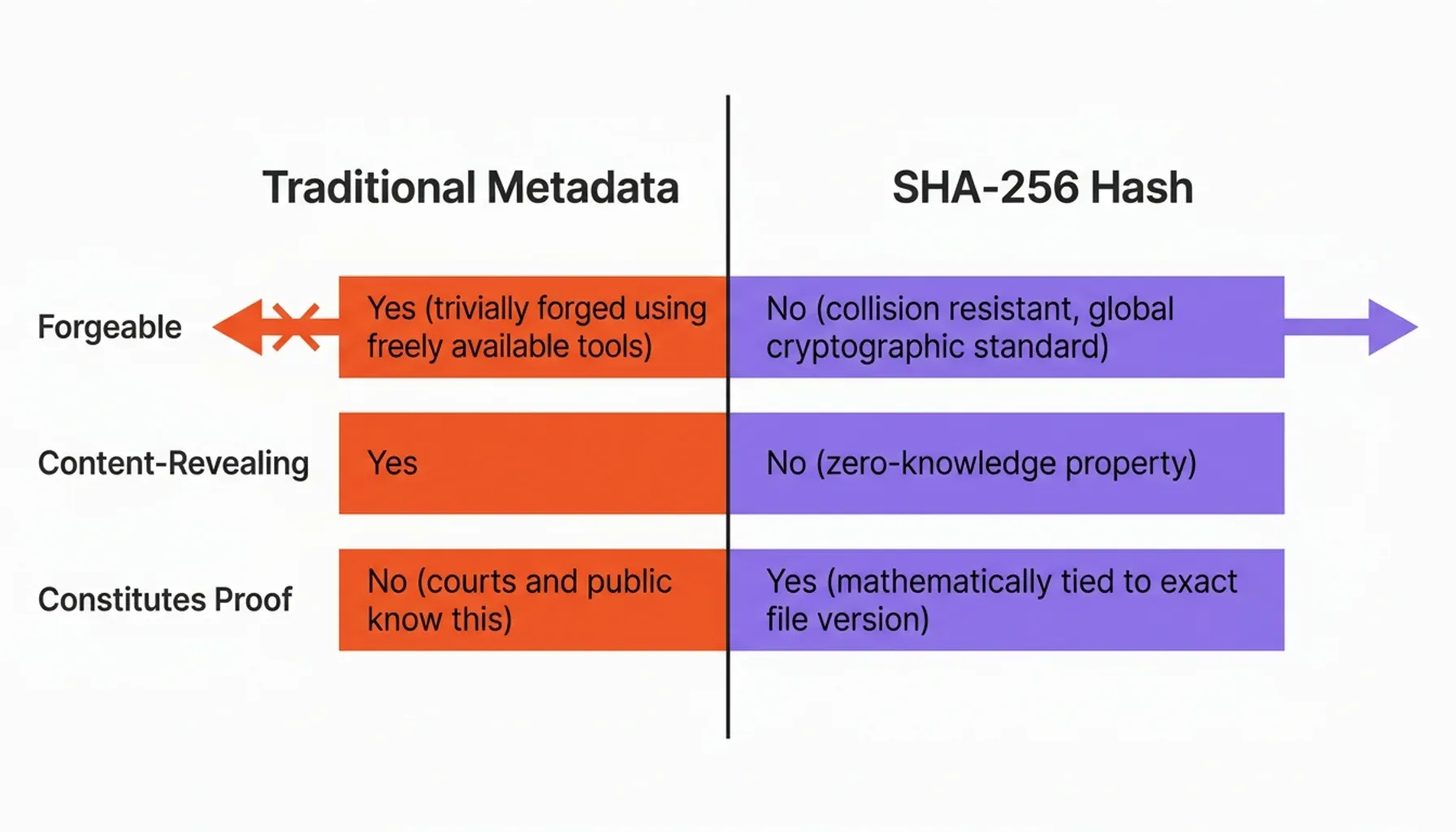
Traditional metadata offers no real defense here. Creation dates, author fields, embedded timestamps: file metadata is trivially forged using freely available tools. A determined adversary can backdate a document, strip its original properties, and replace them with whatever narrative serves their defense. Courts and the public know this. Metadata alone does not constitute proof.
The ICIJ's operational security guidelines draw an important ethical line: source anonymity is always the first priority. No verification layer should ever risk exposing a source's identity. Blockchain timestamping respects this boundary completely. The hash, the cryptographic fingerprint of a document, contains zero information about the document's content or origin. You prove the document's integrity without revealing anything about who provided it.
The Cryptographic Fingerprint: Hashing Explained for Investigators
At the core of document integrity verification is a concept borrowed from cryptography: the hash function. Specifically, SHA-256, the same algorithm that secures Bitcoin transactions and underpins global financial infrastructure.
Here is what it does in plain terms. You feed a document, any document regardless of size, into a SHA-256 algorithm. The output is a fixed-length string of 64 characters. That string is the document's unique digital fingerprint. Change a single comma in a 500-page PDF and the resulting hash is completely different. Not slightly different: entirely unrecognizable from the original. This property is called collision resistance, and it is what makes SHA-256 the global standard for data integrity verification.
The critical advantage for investigative journalism is what the hash does not reveal. It contains no information about the document's content, its author, its source, or its subject matter. A hash of a leaked corporate fraud spreadsheet looks identical in structure to a hash of a blank text file. This is the zero-knowledge property: you can prove you possess a specific file, and that it has not been altered, without uploading the file itself to any external system.
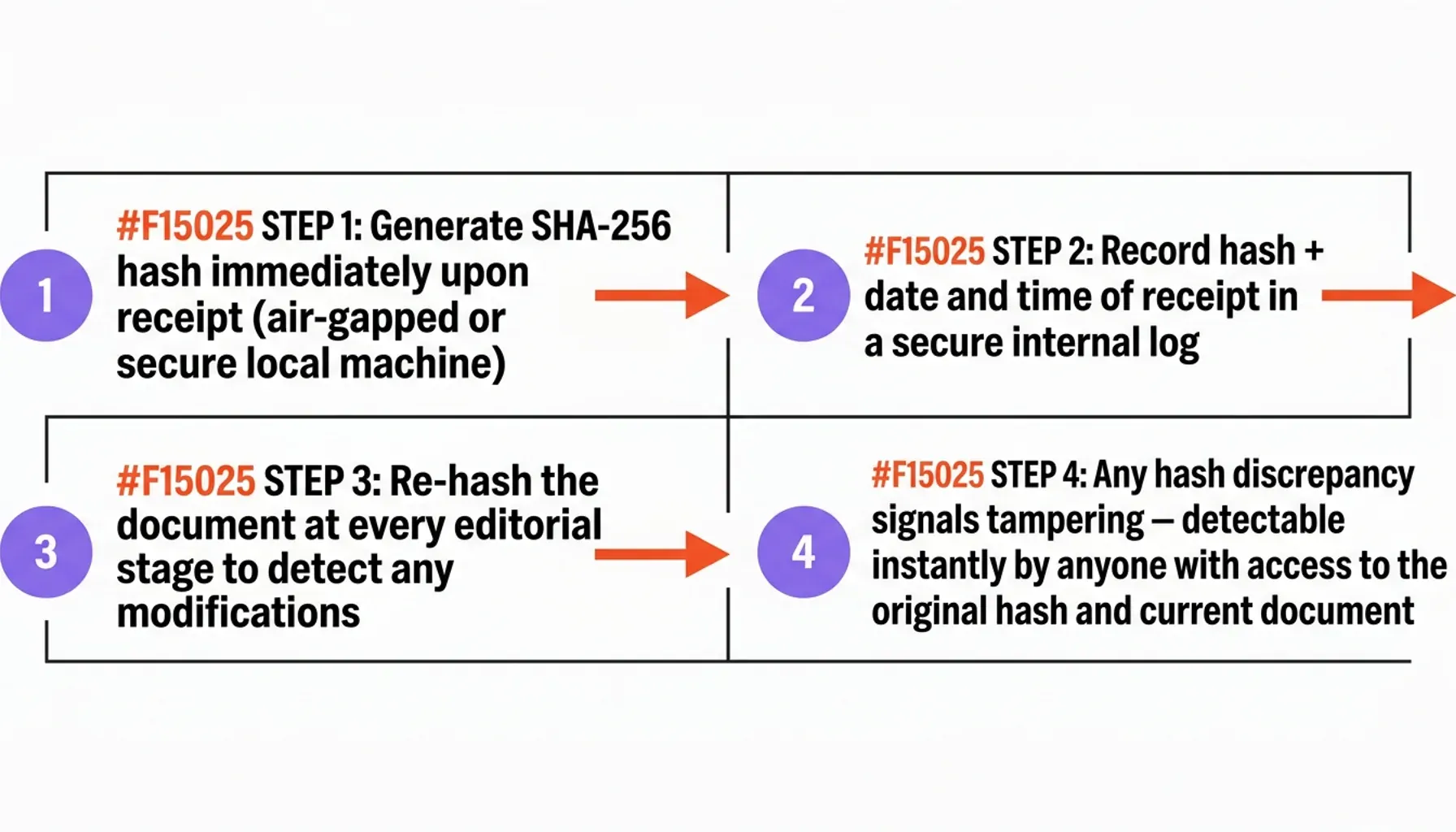
This matters enormously for operational security. When an NGO or newsroom generates a SHA-256 hash locally, before the document enters any collaborative content management system or cloud storage, they create a reference point that is mathematically tied to that exact version of the file. Any subsequent modification, intentional or accidental, produces a different hash. The discrepancy is detectable instantly by anyone with access to the original hash and the current document.
Practical workflow for editorial teams:
- Generate the SHA-256 hash of the received document immediately upon receipt, on an air-gapped or secure local machine
- Record the hash alongside the date and time of receipt in a secure internal log
- Re-hash the document at every editorial stage to detect any modifications
- Submit only the hash, never the document, to a blockchain timestamping service
This workflow adds minutes to the editorial process. The protection it provides can last decades.
Anchoring Truth: Creating a Tamper-Proof Record of Existence
A hash stored in a spreadsheet proves nothing on its own. Anyone can create a hash today and claim it was generated last Tuesday. The integrity of the hash is only as strong as the trustworthiness of the system recording it, and that is precisely where traditional internal logging fails under adversarial scrutiny.
Blockchain changes this equation fundamentally. When a hash is anchored to a public blockchain, Bitcoin or Ethereum, it becomes part of a decentralized, immutable ledger that no single entity controls. The blockchain records the hash and the precise timestamp at which it was submitted. That record cannot be altered, deleted, or backdated. It exists independently of the organization that created it, the journalist who submitted it, and the technology provider that facilitated the process.
OriginStamp's blockchain timestamping service anchors document hashes to both Bitcoin and Ethereum simultaneously, creating redundant proof across two independent public ledgers. The result is a certificate that any third party, a court, a secondary newsroom, an independent fact-checker, can verify without contacting OriginStamp, without trusting the NGO, and without any access to the original document.
This shifts the evidentiary standard from assertion to mathematics. Instead of "Trust us, we received this document on Tuesday," the statement becomes: "The Bitcoin blockchain recorded this document's fingerprint at block height X, at timestamp Y. Verify it yourself." That is a fundamentally different position to defend.
One distinction must be stated clearly: a blockchain timestamp proves that a specific file existed in a specific state at a specific point in time. It does not prove that the file's contents are accurate. A timestamp on a fabricated document proves only that the fabrication existed at that moment. The timestamp is an integrity tool, not a truth-detection tool. Research on blockchain-based timestamping consistently frames this distinction, and responsible use of the technology requires communicating it clearly to audiences and legal teams alike.
Decentralization is what makes this proof durable. If OriginStamp ceased to exist tomorrow, the proof would remain valid on the blockchain indefinitely. If the NGO's servers were destroyed, the proof would remain. The verification infrastructure is the public blockchain itself, maintained by thousands of independent nodes across the globe, with no single point of failure.
Maintaining the Chain of Custody in Digital Investigations
Most companies get this wrong. Chain of custody is treated as a legal formality rather than an operational discipline, and in digital investigations that gap is where evidence dies.
Chain of custody has deep roots in physical evidence handling. A document passed between investigators, lawyers, and courts must be accompanied by a continuous, unbroken record of who held it, when, and in what condition. Break that chain and the evidence loses its legal standing.
Digital chain of custody has historically been the weakest link in investigative journalism. Files are copied, emailed, downloaded, edited, and re-uploaded across multiple systems. Each transfer is a potential point of contamination, and without a mathematical record of the file's state at each point, proving that the published version matches the received version is nearly impossible.
Blockchain timestamps function as a mathematical evidence seal at each stage of this chain. Timestamp the document upon receipt. Timestamp the working copy before editorial review. Timestamp the final version before publication. Each timestamp creates an immutable marker in the public ledger. If any version differs from any other, the hashes will not match, and the discrepancy is detectable by anyone, anywhere, at any time.
This approach is comparable to a traditional notary service in function, but superior in three critical ways. It operates in seconds rather than days. It is accessible globally without geographic or institutional constraints. And the resulting proof is verifiable by any party independently, without requiring the notary's cooperation or continued existence.
For organizations working on cross-border investigations, the kind coordinated by multi-outlet consortia, this is particularly valuable. A tamper-evident digital audit trail allows partner newsrooms in different jurisdictions to independently verify that the version of a document they received matches the version originally timestamped, without any communication with the originating organization. The math does the verification.
Providing a Verification Package to legal teams has become best practice for high-stakes investigations. This package includes:
- The SHA-256 hash of the original document
- The blockchain transaction ID confirming the timestamp
- Instructions for independent verification using any public blockchain explorer
- A hash comparison log showing document state at each editorial stage
Any competent legal team can audit this package without specialized tools. That is the point.
Strategic Transparency: Defending Against Information Warfare
State actors and well-resourced corporate defendants have developed sophisticated playbooks for discrediting leaked documents. Two tactics are particularly common and particularly difficult to counter without cryptographic proof.
The first is selective leaking: releasing a modified or incomplete version of the same document to a friendly outlet, then using the discrepancy between the two versions to claim that the original investigative report was based on fabricated material. Without a timestamp proving which version existed first, the public is left to choose between competing claims.
The second is retroactive tampering claims: after publication, asserting that documents were altered between receipt and publication, that the newsroom itself introduced inaccuracies, either through incompetence or malice. This tactic exploits the fact that most newsrooms cannot prove the negative.
A public blockchain timestamp is a preemptive defense against both attacks. The hash anchored to the blockchain before publication proves the document's state at that moment. If a modified version surfaces later, the hashes will not match, and the blockchain record establishes which version existed first. This is the same principle applied to deepfake dashcam video evidence, where timestamping video files before they can be disputed has become a recognized forensic practice.
Consider two concrete scenarios. A human rights organization documents evidence of extrajudicial detention through internal government communications. The government later claims the documents are fabricated. A blockchain timestamp created upon receipt, before any internal review, proves the document existed in that exact form before the organization's editorial process began, making post-hoc fabrication by the organization logically impossible.
Second scenario: a financial journalist receives a spreadsheet showing systematic tax evasion. The corporation's legal team argues the data was manipulated. The timestamp proves the spreadsheet existed in that form before the story was filed. The burden of proof shifts.
The psychological impact of verifiable proof extends beyond individual cases. When audiences understand that a newsroom's evidence is mathematically sealed, not just editorially verified, the institutional credibility of investigative journalism increases. Trust in digital media is under sustained pressure. Cryptographic proof of document integrity is one of the few tools that operates above the level of assertion.
The Path Forward: Maturing Standards for Digital Evidence
Here's the thing. Blockchain timestamping is not a replacement for rigorous fact-checking, source verification, or editorial judgment. It is a complementary layer that addresses a specific, narrow, and critically important problem: proving that a document existed in a specific state at a specific point in time.
The distinction matters because the technology is sometimes oversold. A timestamp does not validate the accuracy of a whistleblower's claims. It does not authenticate a source's identity. It does not replace the investigative work required to corroborate a document's contents through independent evidence. What it does, with mathematical certainty, is eliminate one of the most common and damaging attacks on investigative reporting: the claim that documents were altered.
Cross-border infrastructure raises a legitimate concern for organizations operating under different legal regimes. Data sovereignty, the principle that data and its associated proofs remain under the jurisdiction of a trustworthy, stable legal framework, is not a bureaucratic abstraction. It is a practical requirement for organizations whose work puts them in conflict with powerful governments. Swiss-based infrastructure, operating under Swiss data protection law, provides a jurisdiction that many governments and international courts recognize as neutral and reliable.
Long-term digital preservation is the final frontier. A blockchain timestamp created today must remain verifiable in 20 or 50 years. Public blockchains, particularly Bitcoin with its 15-year track record, provide a reasonable basis for long-term confidence. The hash anchored today will be readable by any future system capable of querying the Bitcoin ledger. That is a durability guarantee no proprietary archiving system can match.
For NGOs and investigative newsrooms building institutional capacity, the practical steps are straightforward. Establish a hashing protocol as a standard operating procedure for document receipt. Integrate blockchain timestamping into the editorial workflow at defined checkpoints. Build a Verification Package into every major investigation's documentation. Train legal teams to interpret and present cryptographic proof in the contexts where it will matter most.
The organizations that do this work now will be positioned to defend their reporting with mathematical certainty, not just editorial credibility, when the inevitable challenges arrive.
When document integrity is treated as an infrastructure problem rather than an editorial one, the solutions become both more durable and more defensible. Cryptographic proof does not ask anyone to trust the journalist, the NGO, or the platform. It asks them to trust the math.
If your organization handles sensitive documents that may face authenticity challenges, explore how OriginStamp's tamper-proof blockchain timestamping works in practice and understand what verifiable proof of existence means for the investigations that matter most.
Thomas Hepp
Co-Founder
Thomas Hepp is the founder of OriginStamp and creator of the OriginStamp timestamp, which has set the standard for tamper-proof blockchain timestamps since 2013. As one of the earliest innovators in the field, he combines deep technical expertise with a pragmatic focus on solving real business problems, and is a recognized voice in blockchain security, AI analytics, and data-driven decision support. His work has earned multiple international awards, including a top Best Project recognition from ETH Zurich and the Swiss Confederation. He publishes regularly on blockchain, AI, and digital innovation.