
Agentic Commerce Standards: x402, AP2, and Payment Protocols
Jun 11, 2026

Thomas Hepp
Jun 11, 2026

The Machine Economy Runs on Protocols, But Which Ones?
By 2027, autonomous AI agents are projected to represent a significant share of all commercial transactions. Not assisted by humans. Not supervised in real time. Just agents, APIs, and money moving at machine speed.
That reality exposes a fundamental gap: the global payment infrastructure was built for humans. Credit cards require 2FA. Bank transfers need manual approval. Chargebacks assume a person is disputing a charge. None of that works when a GPT-4o-powered procurement agent is executing 400 API calls per hour across a dozen vendors.
The result is an arms race of Agentic Commerce Protocols, technical standards that let AI agents negotiate, authorize, and settle payments without human intervention. Coinbase built x402. Google developed AP2. OpenAI and Stripe are co-developing what they call the Agentic Commerce Protocol (ACP). Visa and Mastercard are retrofitting their tokenization infrastructure for the same purpose.
Each approach makes different architectural bets. Some are crypto-native. Others extend existing card rails. All of them are solving for the same core problem: how do machines pay each other, reliably and at scale?
This article breaks down each protocol, compares their trade-offs, and identifies the layer that every single one of them is missing.
The Rise of the Machine Economy: Why Agentic Commerce Needs Standards
Machines Are Already Buying Things
The machine customer has moved from theoretical to operational. Autonomous agents now book cloud compute, purchase API credits, renew SaaS subscriptions, and execute data transactions with zero human involvement.
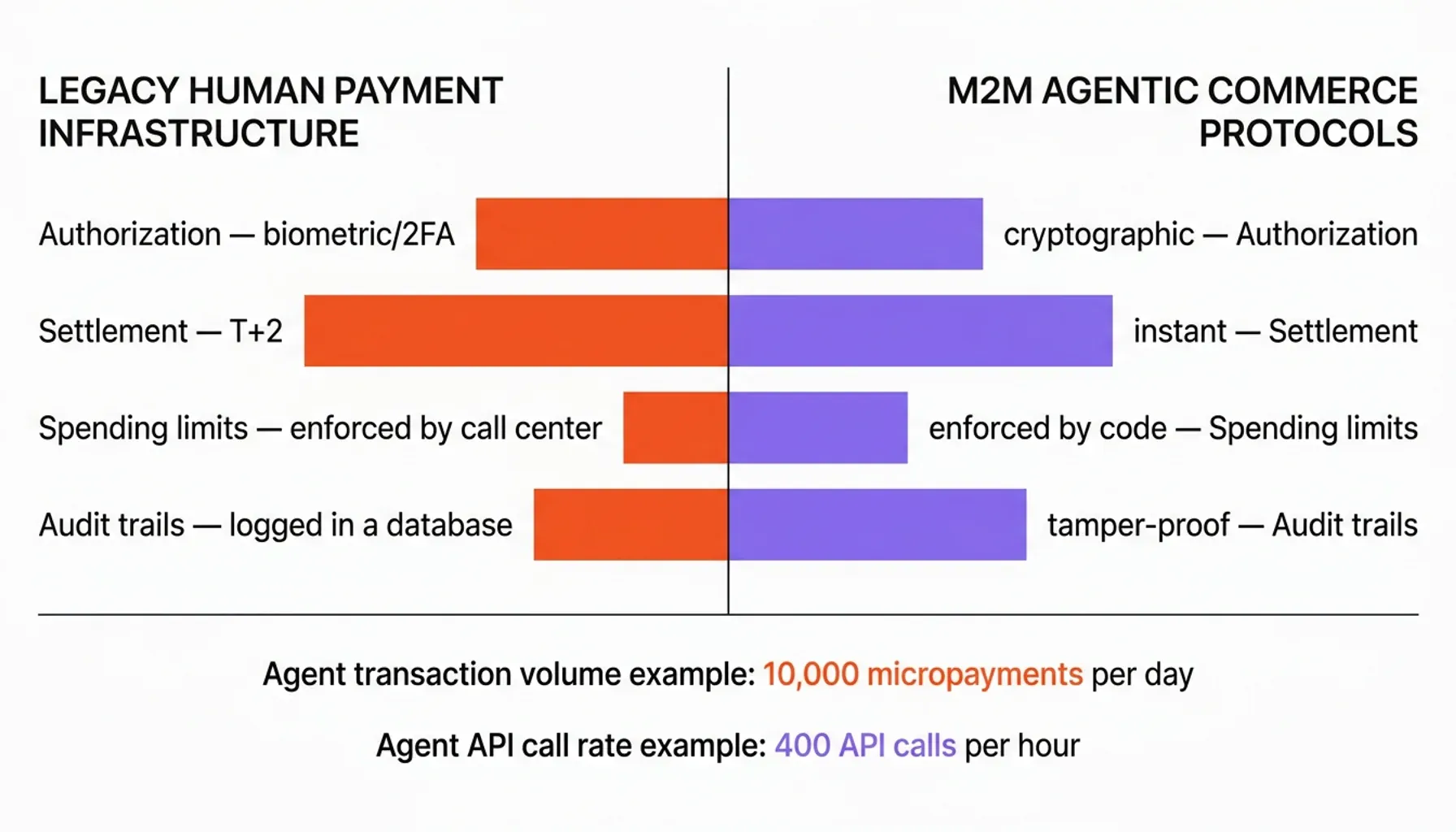
The friction point is legacy payment infrastructure. Credit card networks were designed around a human cardholder who can respond to a one-time password, recognize a fraudulent charge, and initiate a dispute. In high-frequency agent environments, these assumptions collapse entirely. An agent executing 10,000 micropayments per day cannot pause for 2FA. A machine cannot recognize "unusual activity" on its own account.
The shift from Human-to-Machine (H2M) to Machine-to-Machine (M2M) commerce demands a new class of financial protocol, one where:
- Authorization is cryptographic, not biometric
- Settlement is instant, not T+2
- Spending limits are enforced by code, not by a call center
- Audit trails are tamper-proof, not just logged in a database
The emerging landscape features four competing visions of how to achieve this. They differ in their approach to decentralization, their reliance on existing financial infrastructure, and their assumptions about who bears accountability when an agent makes a mistake.
What unites them is the recognition that the OpenAI-Stripe partnership and similar integrations have moved agentic commerce from an academic concept to a production requirement, and that the industry needs standards before it needs regulators.
Coinbase x402: Solving the HTTP 402 Micropayment Gap
Resurrecting a 30-Year-Old Status Code
The HTTP 402 status code was defined in 1999 as "Payment Required" and then left unused for three decades because there was no practical micropayment infrastructure to back it. Coinbase's x402 protocol is the first serious attempt to operationalize it.
The mechanism is elegant in its simplicity:
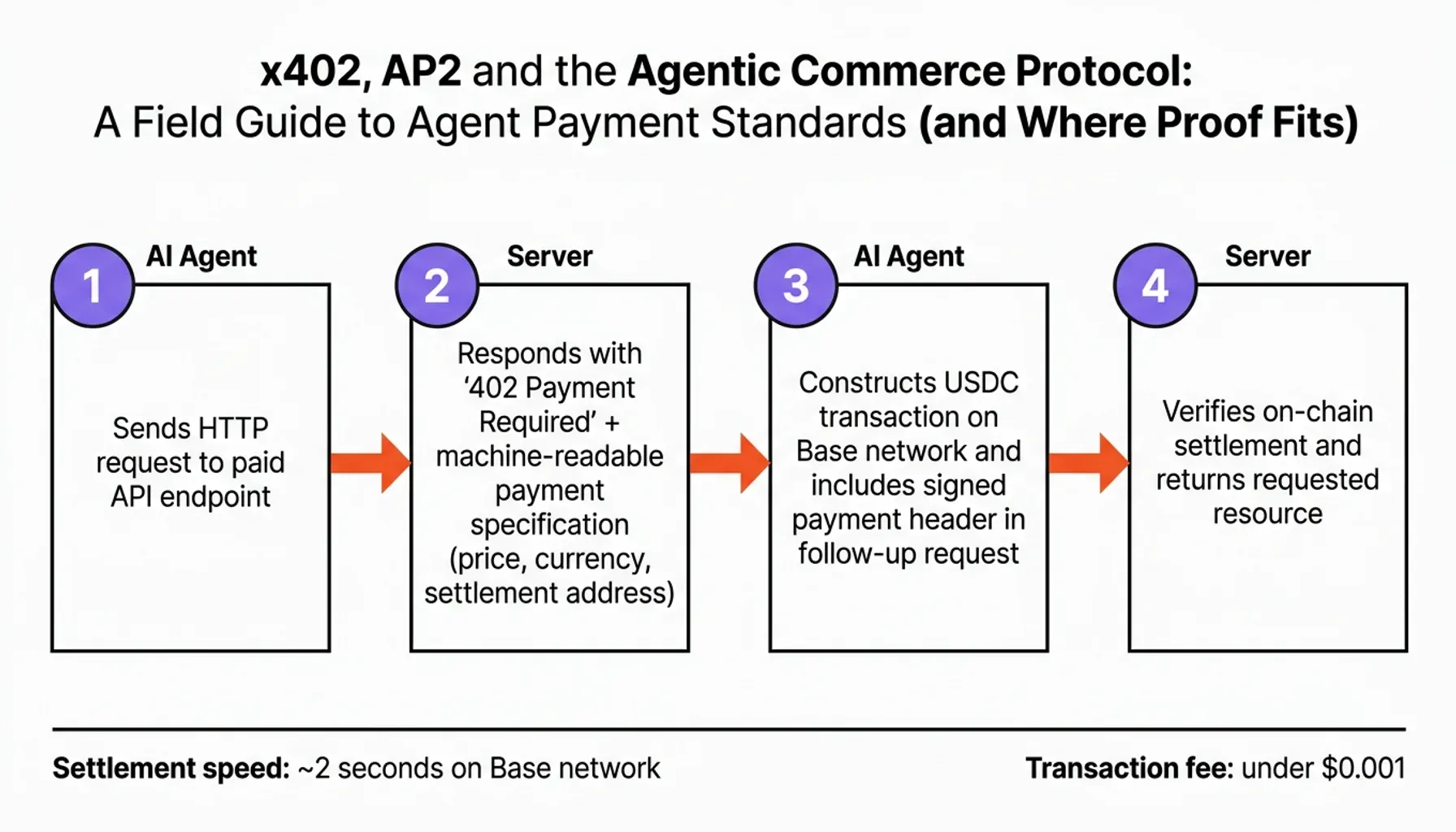
- An AI agent sends an HTTP request to a paid API endpoint
- The server responds with
402 Payment Requiredplus a machine-readable payment specification (price, currency, settlement address) - The agent reads the spec, constructs a USDC transaction on the Base network, and includes a signed payment header in a follow-up request
- The server verifies the on-chain settlement and returns the requested resource
No intermediary. No waiting for a payment processor to confirm. No chargebacks. Settlement occurs in seconds on Base, Coinbase's Ethereum Layer 2 network, at a fraction of a cent per transaction.
Why this matters for agentic commerce specifically:
- Latency: Base finalizes transactions in ~2 seconds, compatible with API response time expectations
- Cost: Fees on Base are typically under $0.001, making true micropayments economically viable for the first time
- Programmability: Agents can negotiate price, verify the payment specification cryptographically, and settle, all within a single request cycle
The protocol also handles the "handshake" problem: agents from different vendors, built on different LLMs, can interact with any x402-compliant endpoint without pre-negotiated contracts or API keys.
The trade-offs are real, though. x402 requires crypto-native infrastructure on both sides of the transaction. The merchant must accept USDC. The agent must have a funded on-chain wallet. For enterprises operating in regulated environments, this introduces custody risk, accounting complexity, and potential regulatory exposure depending on jurisdiction.
For developers building on OriginStamp's blockchain timestamping infrastructure or similar cryptographic services, x402 represents a natural fit, both sides of the transaction already operate in a blockchain-native environment. For a traditional ERP vendor, the integration lift is substantial.
Google's AP2: The Mandate Scheme for Web-Scale AI
Bridging Web2 Payments and Autonomous Agents
Google's Agent-to-Payment Protocol (AP2) takes a fundamentally different architectural position. Rather than building on public blockchain infrastructure, AP2 extends Google Pay's existing tokenization and mandate framework to support browser-based and cloud-based AI agents.
The core concept is the payment mandate: a pre-authorized spending permission that a human grants to an agent at setup time. The mandate specifies:
- Maximum transaction value per event
- Cumulative spending cap over a defined period
- Category restrictions (e.g., "only SaaS subscriptions, no physical goods")
- Revocation conditions
When an agent needs to make a purchase, it presents its mandate token to the merchant's AP2-compliant endpoint. The merchant verifies the token against Google's payment infrastructure, confirms the transaction falls within mandate parameters, and settles through existing card rails.
The security model is deliberately conservative. Rather than giving agents direct access to payment credentials, AP2 uses tokenized "intent", the agent never touches actual card data. Spending power is granularly scoped. Revocation is instant. This mirrors how W3C Web Payments Working Group standards approach delegated payment authority.
AP2's strategic advantage is adoption friction, or rather the lack of it. Merchants already accept Google Pay. The AP2 mandate layer sits on top of existing infrastructure, meaning a merchant needs minimal integration work to become AP2-compatible. For Google's ecosystem, Chrome, Android, Google Workspace, this creates a natural distribution channel for agent-enabled commerce.
The limitation is the opposite of x402's. AP2 is deeply tied to Google's infrastructure. It is not an open protocol. Settlement still runs through card networks, meaning T+2 clearing, interchange fees, and the full dispute resolution machinery of traditional finance, which may be a feature or a bug depending on your perspective.
The Agentic Commerce Protocol (ACP): OpenAI and Stripe's Vision
Making Agents First-Class Merchants
Most companies get this wrong. They treat agent payments as a bolt-on to existing checkout flows. The OpenAI-Stripe Agentic Commerce Protocol takes the opposite view, attempting to create a universal language for agent payments that works across LLM providers, payment processors, and merchant categories.
ACP positions Stripe as the financial "checkout" layer for any agent-initiated transaction, regardless of which AI model is executing the purchase. The key innovation is dynamic authorization: rather than pre-defining a static mandate, ACP evaluates each agent request against a user's predefined budget policy in real time.
The authorization flow works as follows:
- An agent identifies a purchase opportunity and constructs a structured transaction request
- The ACP layer evaluates the request against the user's policy (budget, category, merchant trust score)
- If the request passes policy checks, Stripe executes the transaction and returns a confirmation to the agent
- The agent receives a cryptographically signed receipt and continues its workflow
The "Merchant of Record" problem is where ACP makes its most significant contribution. In traditional e-commerce, the merchant of record is clearly defined. In agentic commerce, it is ambiguous: if an agent purchases a service on your behalf, who is liable for the transaction? Who handles disputes? ACP assigns this responsibility explicitly to the platform operator, the entity that deployed the agent, rather than leaving it undefined.
This matters enormously for audit-proof agent logs. If an agent makes an unauthorized purchase, there must be a clear chain of accountability: which policy was active, which agent version executed the request, and what the agent was instructed to do. ACP generates structured receipts designed to support that accountability chain.
Interoperability is the stated long-term goal. Stripe's public position is that ACP should become an open standard, allowing any agent to interact with any ACP-compliant merchant without vendor lock-in. Whether that vision survives competitive pressure from Google and Coinbase remains to be seen.
Institutional Guardrails: Visa's Trusted Agent and Mastercard's Agentic Tokens
TradFi Enters the Agent Economy
While crypto-native protocols debate decentralization and tech giants build proprietary mandate systems, Visa and Mastercard are doing what they have always done: adapting existing infrastructure to new transaction patterns.
Visa's Trusted Agent Protocol links agent authorization to biometric-verified keys. The premise is straightforward: every agent must be cryptographically tied to a verified human identity. When an agent initiates a transaction, Visa's network checks that the underlying human principal has explicitly authorized this class of agent action. The biometric link creates a non-repudiable chain of authority, legally significant in dispute resolution.
Mastercard's Agentic Tokens repurpose the card network's existing tokenization infrastructure. Each AI agent receives a unique, revocable token, functionally similar to a virtual card number, that can be scoped to specific merchants, spending categories, and time windows. The token can be revoked instantly if the agent behaves unexpectedly.
Both approaches offer something x402 and AP2 do not: consumer protection infrastructure that already exists at global scale. Chargebacks, fraud detection, dispute resolution, these are mature capabilities that took decades to build. The TradFi approach plugs agents into that infrastructure rather than rebuilding it from scratch.
The trade-off is the "walled garden" problem. Visa and Mastercard tokens operate within their respective networks. An agent with a Mastercard Agentic Token cannot natively interact with an x402 endpoint. Interoperability across protocol families remains unsolved.
For a deeper look at how agentic commerce creates new chargeback challenges, the gap between network-level settlement and proof of what was actually agreed upon becomes particularly acute.
The Missing Layer: Why Settlement Is Not Proof of Interaction
Paying for Something Is Not the Same as Proving It Happened
Here's the thing. Every protocol described above solves the same problem: how does money move from agent to merchant? None of them solve a different, equally critical problem: how do you prove, after the fact, what was agreed upon, delivered, and accepted?
This is the post-transaction integrity gap.
A payment confirmation proves that a specific amount of USDC moved from wallet A to wallet B at a specific time. It does not prove:
- What data or service was delivered in exchange
- What version of a contract or terms of service was active at the time
- What the agent was instructed to do versus what it actually did
- Whether the delivered content was modified after delivery
Internal system logs are insufficient for this purpose. Logs stored in a provider's database can be altered by an administrator, deleted in a system failure, or simply not retained long enough for a legal dispute that surfaces 18 months later. The ephemeral nature of agent interaction logs makes them legally fragile without independent verification.
The solution is a mathematical, third-party proof of existence: a cryptographic blockchain timestamp that anchors the hash of an agent interaction record to a public blockchain at a specific moment in time. This creates proof that a specific document, contract, or data payload existed in a specific form at a specific time, that the record has not been altered since that moment, and that the proof is independent of any single provider or administrator.
This is not a theoretical capability. OriginStamp's blockchain timestamping service has been anchoring cryptographic fingerprints to Bitcoin and Ethereum since 2013, creating tamper-evident proof of existence that is mathematically verifiable by any third party, with no dependency on OriginStamp's continued operation.
For agentic commerce specifically, this means decoupling payment from integrity. The payment protocol handles money movement. The timestamp protocol handles proof of what happened. Both are necessary. Neither is sufficient alone.
The accountability gap in AI agent systems is precisely this: organizations deploy agents, agents make decisions, money moves, and when something goes wrong, there is no tamper-proof record of what the agent was authorized to do, what it actually did, and what was delivered. That gap is not a payment protocol problem. It is a data integrity problem.
Conclusion: Building a Trustworthy Agentic Future
Protocol Choice Is Architecture. Integrity Is Non-Negotiable.
The Agentic Commerce Protocol landscape is not converging on a single winner, and it probably should not. x402 is the right choice for crypto-native, decentralized agent ecosystems where low fees and open infrastructure matter most. AP2 suits browser-based agents operating within Google's ecosystem with minimal merchant integration friction. ACP is the pragmatic choice for enterprises that need dynamic authorization and clear merchant-of-record accountability. Visa and Mastercard's tokenization approaches provide the consumer protection infrastructure that regulated industries require.
Your choice of protocol is an architectural decision that reflects your decentralization requirements, your regulatory environment, and your tolerance for infrastructure complexity.
But protocol choice does not resolve the integrity question. Every agentic commerce deployment, regardless of which payment standard it uses, needs a tamper-proof record of what agents were authorized to do, what they actually did, and what was delivered. That record must be mathematically verifiable by parties who were not involved in creating it.
The convergence of AI and blockchain is not a marketing narrative. It is a logical necessity. When machines make decisions that move money, the audit trail cannot be stored in the machine's own memory. It must be anchored to something immutable: a public blockchain timestamp that no administrator can alter and no system failure can erase.
Shifting from "trusting the provider" to "verifying the math" is the operational definition of trustworthy agentic commerce. The payment protocols handle the transaction. OriginStamp's blockchain timestamping infrastructure handles the proof, ensuring that every agent interaction, contract, and data exchange has a cryptographic fingerprint that survives disputes, audits, and time.
Thomas Hepp
Co-Founder
Thomas Hepp is the founder of OriginStamp and creator of the OriginStamp timestamp, which has set the standard for tamper-proof blockchain timestamps since 2013. As one of the earliest innovators in the field, he combines deep technical expertise with a pragmatic focus on solving real business problems, and is a recognized voice in blockchain security, AI analytics, and data-driven decision support. His work has earned multiple international awards, including a top Best Project recognition from ETH Zurich and the Swiss Confederation. He publishes regularly on blockchain, AI, and digital innovation.