
AI Agent Observability vs. Verifiable Records: The Proof Gap
Jun 11, 2026

Thomas Hepp
Jun 11, 2026

When Watching Isn't Enough: The Proof Gap in AI Agent Observability
Every engineering team deploying autonomous agents believes they have visibility. They have dashboards, traces, logs, and alerts. What most of them don't have is proof, and in regulated industries, that distinction separates a compliant system from a liability.
AI agent observability has matured rapidly. But observability answers the wrong question for the wrong audience. It tells engineers why something happened. It does not tell regulators, auditors, or courts what happened, with mathematical certainty, independently verifiable, and immune to post-hoc alteration.
This is the Proof Gap. As autonomous agents move into finance, healthcare, energy, and defense, closing it is no longer optional.
What Is AI Agent Observability, and Why Does It Matter?
AI agent observability is the discipline of instrumenting autonomous systems to capture sufficient telemetry for engineers to understand, debug, and improve agent behavior. Unlike traditional software observability, which monitors deterministic code paths, agent observability must track probabilistic reasoning, dynamic tool selection, and multi-step decision chains that no developer explicitly programmed.
The four core telemetry signals in any mature observability stack are:
- Logs: Discrete, timestamped records of events, including tool calls, API responses, errors, and state transitions
- Traces: End-to-end records of a single agent "run," linking each reasoning step, prompt, and tool invocation into a causal chain
- Metrics: Aggregated quantitative measurements, covering latency distributions, token consumption, error rates, and guardrail trigger frequency
- Events: Structured signals emitted when significant conditions occur, such as a policy evaluation, a human-in-the-loop handoff, or an anomaly detection
Beyond these four signals, agent observability must capture agent state: the working memory, retrieved context, active goals, and intermediate reasoning that determine why an agent chose a particular action at a particular moment. Without state capture, a trace shows what the agent did but not why it did it.
Tracking agent reasoning requires recording the full prompt sent to the model, including system instructions, retrieved documents, and conversation history, alongside the raw model output before any post-processing. Tool usage tracking must capture not just which tool was called, but the exact parameters passed, the response received, and how that response influenced subsequent reasoning steps. Model output logging must preserve the original completion, including any chain-of-thought reasoning, before downstream filtering or formatting is applied.
This granularity is what makes modern LLM observability platforms, such as Langfuse, genuinely valuable for engineering teams. They surface the internal mechanics of agent behavior in ways that traditional APM tools cannot.
But telemetry is not evidence. That distinction is exactly where the Proof Gap begins.
The Rise of Autonomous Agents and the Illusion of Oversight
The shift from conversational LLMs to autonomous AI agents with tool-calling capabilities has fundamentally changed the risk profile of AI systems. A chatbot generates text. An agent executes actions: it calls APIs, modifies databases, triggers payments, and makes decisions that cascade through real-world infrastructure.
Standard monitoring stacks, ELK, CloudWatch, Datadog, were designed for software systems where the developer controls the logic. They capture telemetry. They help engineers debug. They were not designed to satisfy a burden of proof in a regulated environment.
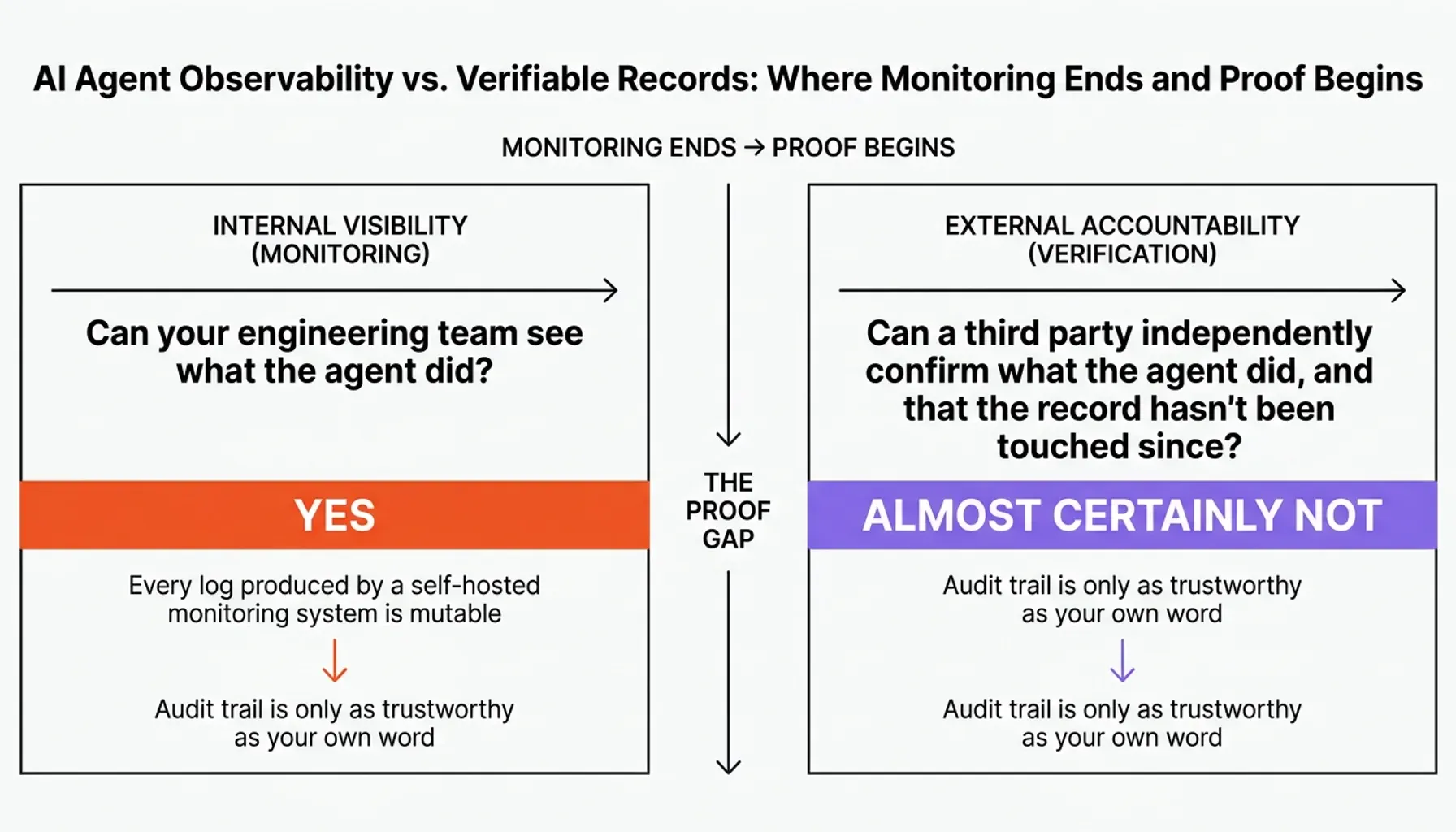
Here's the core problem: every log produced by a self-hosted monitoring system is mutable. An administrator with sufficient access can alter, delete, or overwrite records. In a dispute, your audit trail is only as trustworthy as your own word, which is precisely what auditors and regulators cannot accept.
This creates a critical distinction:
- Internal visibility (monitoring): Can your engineering team see what the agent did? Yes.
- External accountability (verification): Can a third party independently confirm what the agent did, and that the record hasn't been touched since? Almost certainly not.
The Proof Gap lives in that space. When an autonomous agent makes a high-stakes decision, blocking a transaction, flagging a patient record, routing power in a grid, can you prove the log of that decision was not altered after the fact? If the answer is "we trust our internal systems," you have observability. You do not have verifiable records.
AI trust, risk, and security management frameworks are increasingly recognizing this gap, but most organizations still treat monitoring as a substitute for verification rather than a complement to it.
Observability: Answering 'Why' for Engineering Teams
Modern observability is a sophisticated discipline. Distributed tracing platforms and LLM-specific evaluation frameworks give engineering teams granular insight into agent behavior: which tools were called, what prompts were constructed, how latency was distributed, where errors occurred.
This is genuinely valuable. The telemetry data lifecycle, from raw event capture through aggregation, storage, and visualization, enables rapid debugging, performance tuning, and anomaly detection. For engineering teams, it is indispensable.
But telemetry is not evidence.
The In-House Problem is structural, not technical: any monitoring system operated by the same organization that operates the AI system cannot serve as independent verification. When a financial regulator, insurance underwriter, or court asks whether an agent behaved correctly, the answer cannot come solely from logs the organization itself controls and could theoretically modify.
Consider the data lifecycle of a typical observability record:
- Agent generates an event
- Event is captured by a local collector
- Collector forwards to a centralized store (often cloud-hosted by the same vendor)
- Store is queryable by admins with elevated permissions
- Retention and deletion policies are set by the operator
At every step, the chain of custody is internal. A determined actor, or a compromised admin account, can interfere. The principle of non-repudiation, foundational to legal evidence standards, requires that a record cannot be denied or altered by the party who created it. Self-hosted logs fail this test structurally.
This is not a criticism of observability tooling. The problem is scope: these platforms answer why for engineers. They are not designed to answer what happened for auditors, regulators, or opposing counsel.
The moment an AI agent operates in a context where its decisions carry legal, financial, or safety consequences, the engineering team's dashboard is insufficient. A second layer is required, one that produces records that are independent, immutable, and mathematically verifiable.
Verifiable Records: Answering 'What Happened' for Regulators
A verifiable record has three properties that distinguish it from a log:
- Immutability: The record cannot be altered after creation without detection.
- Timestamping: The record is provably tied to a specific moment in time.
- Independence: The record's integrity does not depend on the trustworthiness of the system owner.
The mechanism that delivers all three simultaneously is blockchain timestamping. The process is precise: a SHA-256 cryptographic hash is computed from the agent's decision data, the input, the reasoning trace, the output, and any tool calls executed. That hash is anchored to a public blockchain such as Bitcoin or Ethereum. The blockchain entry is permanent, publicly auditable, and controlled by no single administrator.
The result: any future attempt to alter the original record produces a different hash. The mismatch is immediately detectable. No admin override, no database migration, no vendor policy change can erase the original proof of existence.
This eliminates what security architects call the "admin-in-the-middle" risk. In a self-hosted system, a privileged user can alter records and cover the trail. When the integrity proof lives on a public blockchain, that attack vector disappears. The blockchain belongs to no one, and therefore no one can manipulate it.
For regulated industries, this matters directly. NIST SP 800-226, the federal guidelines for evaluating differential privacy guarantees, and the broader NIST AI Risk Management Framework both require demonstrable evidence of data integrity controls. A monitoring dashboard is not a control, it is a view. A blockchain-anchored hash is a control: it mathematically enforces the integrity of the record it seals.
The same logic applies to German GoBD compliance and Swiss GeBüV requirements, which mandate audit-proof retention of records in a form that cannot be subsequently altered. These standards were written for financial documents, but their logic applies directly to AI decision trails: if a record can be changed without detection, it is not a compliant record.
Verifiable records are not a replacement for observability. They answer a different question, the question regulators ask, not the question engineers ask.
The AI Integrity Layer: Securing Critical Infrastructure and Large-Scale Outputs
Move beyond enterprise chatbots and the stakes escalate sharply. Autonomous agents operating in energy grids, defense logistics, financial clearing, and healthcare diagnostics are not productivity tools. They are high-risk AI systems under the EU AI Act, subject to mandatory transparency, auditability, and human oversight requirements.
In these environments, the Proof Gap is not an inconvenience. It is a deployment blocker.
Consider a concrete scenario: an AI agent managing load balancing in a power distribution network detects an anomaly and executes a safety guardrail, blocking an automated command that would have caused a cascade failure. The guardrail fires correctly. The grid is protected. Forty-eight hours later, an incident review board asks for proof that the guardrail fired at the moment recorded, with the inputs documented, and that the log has not been retroactively modified to show compliance.
If the only record is an internal log, the answer is: "Trust us." That answer does not satisfy a grid regulator, an insurance underwriter, or a post-incident legal proceeding.
With a blockchain-anchored integrity layer, the answer is mathematical: the SHA-256 hash of the guardrail event, anchored to Bitcoin at block height X, matches the hash of the current record. The timestamp is immutable. The record is intact. Verification takes seconds and requires no trust in the organization that operates the system.
This is what provable AI output integrity for critical infrastructure means in practice. It is not about adding a compliance checkbox. It is about making the safety architecture independently auditable.
The same principle applies to protecting the security log itself. In a compromised environment, an attacker's first priority is often to alter the audit trail, to remove evidence of their access. When the audit trail is blockchain-anchored, that attack fails. The hash anchored before the compromise proves what the log contained at that moment. Any subsequent alteration is detectable.
For AI agents operating across agentic commerce workflows, the integrity layer must be external to the system it monitors. An audit trail that lives inside the system it audits is not an audit trail. It is a feature.
Black-box AI logic is a liability in high-stakes environments. Provable, verifiable, independently auditable records transform that liability into a defensible architecture.
Complementary, Not Competitive: Building the Modern AI Trust Stack
Most companies get this wrong. The goal is not to replace observability platforms. The goal is a trust stack where each layer serves its intended purpose.
The architecture is straightforward:
Layer 1, Observability (Engineering) Distributed tracing, LLM evaluation tools, and log aggregation capture the full operational trace of agent behavior. Engineers use this layer for debugging, performance optimization, and anomaly detection. This layer is mutable by design, engineers need to update, annotate, and query logs freely.
Layer 2, Verification (Compliance) At defined checkpoints, policy evaluations, human-in-the-loop approvals, final output delivery, safety guardrail triggers, a cryptographic hash of the relevant record is computed and anchored to a public blockchain. This layer is immutable by design. It does not replace the operational log; it seals a checkpoint of it.
The integration pattern is event-driven and lightweight. When a significant agent action occurs, the observability system emits an event. A sidecar process computes the SHA-256 hash and calls the OriginStamp API. The blockchain anchor is returned and stored alongside the original record. From that moment, the record's integrity is independently verifiable.
Triggering events worth sealing include:
- Policy evaluations: When an agent consults a guardrail or compliance rule
- Human-in-the-loop approvals: When a human operator reviews and approves an agent action
- Final output delivery: When an agent delivers a decision, document, or transaction
- Anomaly flags: When the system detects behavior outside expected parameters
This architecture also has a direct financial dimension. Insurance underwriters for AI-related professional liability increasingly require evidence of audit trail integrity and non-repudiation. Organizations that demonstrate blockchain-anchored records of agent behavior present a materially lower risk profile. The cost of implementing the verification layer is a fraction of the premium reduction it can justify.
If you're already building tamper-proof logs for autonomous agent actions or establishing verifiable proof of agent authorization, the trust stack model applies directly: observability captures the operational context, verification seals the accountability record.
The modern AI trust stack is not a choice between monitoring and verification. It is both, in their proper roles, serving their proper audiences.
Conclusion: From Monitoring to Mathematical Proof
Observability is for performance. Verification is for trust. These are not competing priorities, they are sequential requirements for any AI system operating in a regulated, high-stakes, or legally accountable environment.
The Proof Gap is real, and it is growing. As autonomous agents take on more consequential actions in finance, healthcare, energy, and defense, the gap between "we have logs" and "we can prove what happened" becomes a deployment risk, a legal risk, and an insurance risk simultaneously.
The path forward is Compliance by Design: engineering AI systems where verifiable records are not retrofitted after an incident but built into the architecture from the start. The blockchain timestamping layer is lightweight, API-driven, and integrates cleanly with existing observability stacks. It does not slow down the system. It seals the moments that matter.
Closing the AI agent accountability gap requires more than a dashboard. It requires mathematical proof that your records are what you say they are, anchored to infrastructure that no administrator, including your own, can alter.
A system you cannot audit with mathematical certainty is a system you cannot fully deploy. The question is not whether your agents are observable. The question is whether their actions are provable.
Explore how OriginStamp's blockchain timestamping for AI outputs and security logs delivers the integrity layer your autonomous systems require, independent, immutable, and built for the demands of regulated environments.
Thomas Hepp
Co-Founder
Thomas Hepp is the founder of OriginStamp and creator of the OriginStamp timestamp, which has set the standard for tamper-proof blockchain timestamps since 2013. As one of the earliest innovators in the field, he combines deep technical expertise with a pragmatic focus on solving real business problems, and is a recognized voice in blockchain security, AI analytics, and data-driven decision support. His work has earned multiple international awards, including a top Best Project recognition from ETH Zurich and the Swiss Confederation. He publishes regularly on blockchain, AI, and digital innovation.