
How to Prove a Document Existed on a Specific Date
Jun 11, 2026

Thomas Hepp
Jun 11, 2026

The File Says 2019. Can You Prove It?
A contract dispute. A patent challenge. A regulatory audit. In each of these scenarios, one question cuts through everything else: when did this document actually exist in this exact form? File metadata gives you a date. It proves nothing. Any system administrator, or a motivated adversary, can alter a file's creation timestamp in under 60 seconds without leaving a trace.
This is not a theoretical risk. It is a documented, recurring failure point in legal disputes, compliance reviews, and intellectual property contests worldwide. The solution is not a better metadata field. It is mathematical proof, anchored to a public ledger that no single party controls.
What follows explains exactly how that proof works, why traditional alternatives fall short, and how organizations can build a verifiable, tamper-proof history of their digital assets at any scale.
The Challenge of Proving Digital Existence
Why File Metadata Is Not Evidence
When you right-click a document on Windows or macOS and check its properties, you see a creation date. That date lives in the file system, a mutable, locally managed index that any user with sufficient privileges can modify. Admissibility of digital evidence in legal and regulatory proceedings requires demonstrably reliable authentication methods. A file system timestamp does not meet that bar.
The problem extends beyond simple manipulation. Copying a file resets its creation date. Migrating to a new server resets it again. Even routine backup-and-restore operations can overwrite the original timestamp entirely. By the time a document reaches a courtroom or an audit, its metadata may have been reset three times, with no malicious intent whatsoever.
If you are a compliance officer preparing for a regulatory review, this is the gap that keeps audits from going smoothly: you have the document, but you cannot prove it existed before the deadline that matters.
The Centralized Witness Problem
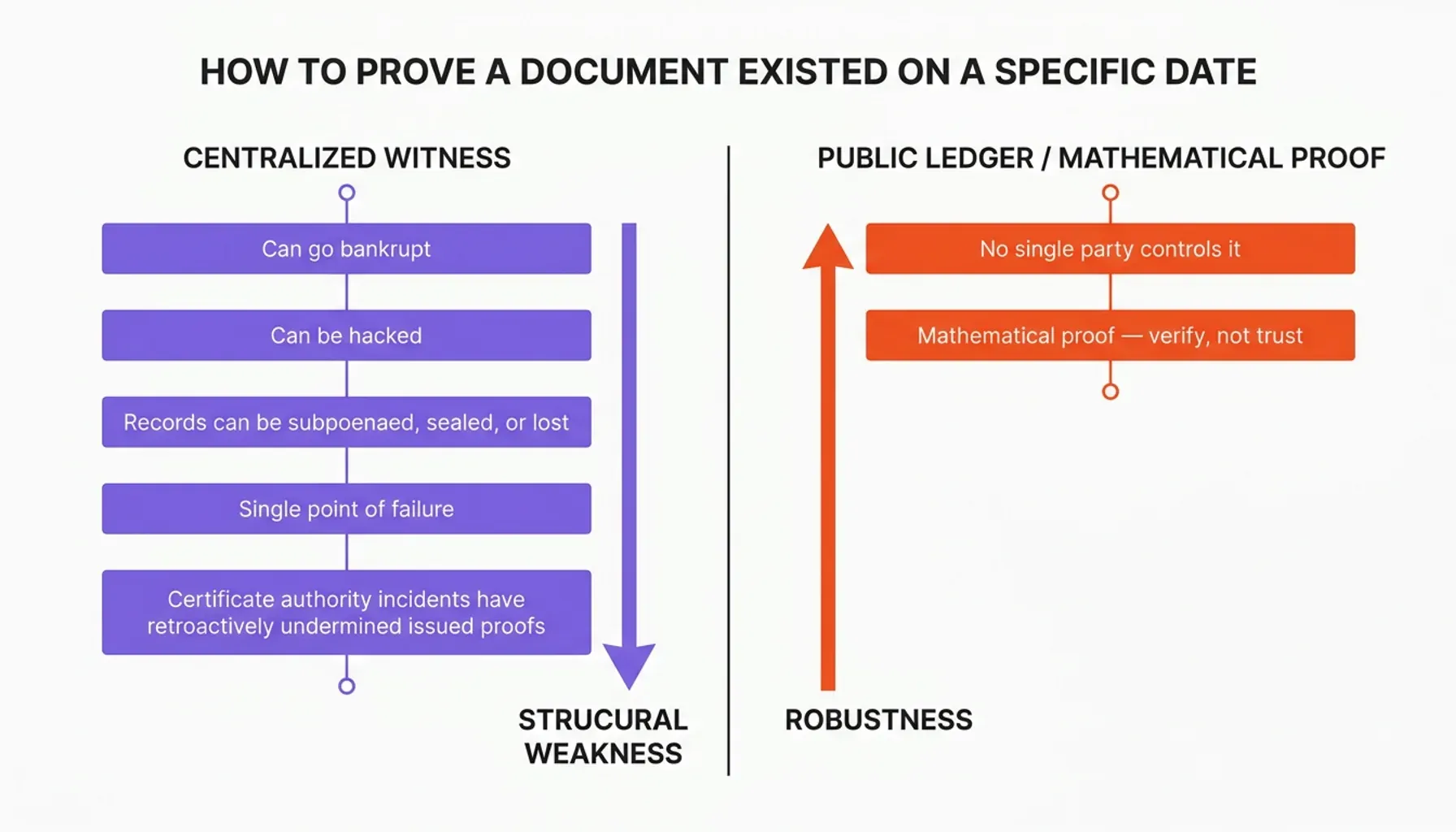
The traditional response to this problem has been to involve a trusted third party: a notary, an escrow agent, or a timestamping authority. These entities serve as witnesses, attesting that a document existed at a particular point in time.
The weakness is structural. Centralized witnesses introduce a single point of failure. They can go bankrupt. They can be hacked. Their records can be subpoenaed, sealed, or simply lost. Even well-established trusted timestamping infrastructure can fail in ways that retroactively undermine the proofs it issued, a risk that has materialized repeatedly in certificate authority incidents over the past decade.
Real-World Scenarios That Demand Proof
The need to prove document existence on a specific date arises across industries:
- Intellectual property: A software developer needs to prove their algorithm predates a competitor's patent filing.
- Contract disputes: Two parties disagree about which version of an agreement was in force on a given date.
- Research integrity: A clinical researcher needs to demonstrate that their hypothesis was documented before results were known.
- Compliance audits: A regulated entity must show that a policy document existed and was approved before a regulatory deadline.
In every case, the question is the same: can you prove it, or can you only assert it?
The shift happening across modern document management is from "trust me" to "verify mathematically." That shift requires a different infrastructure entirely.
The Mechanics of Digital Fingerprinting: SHA-256 Hashing
What a Cryptographic Hash Actually Does
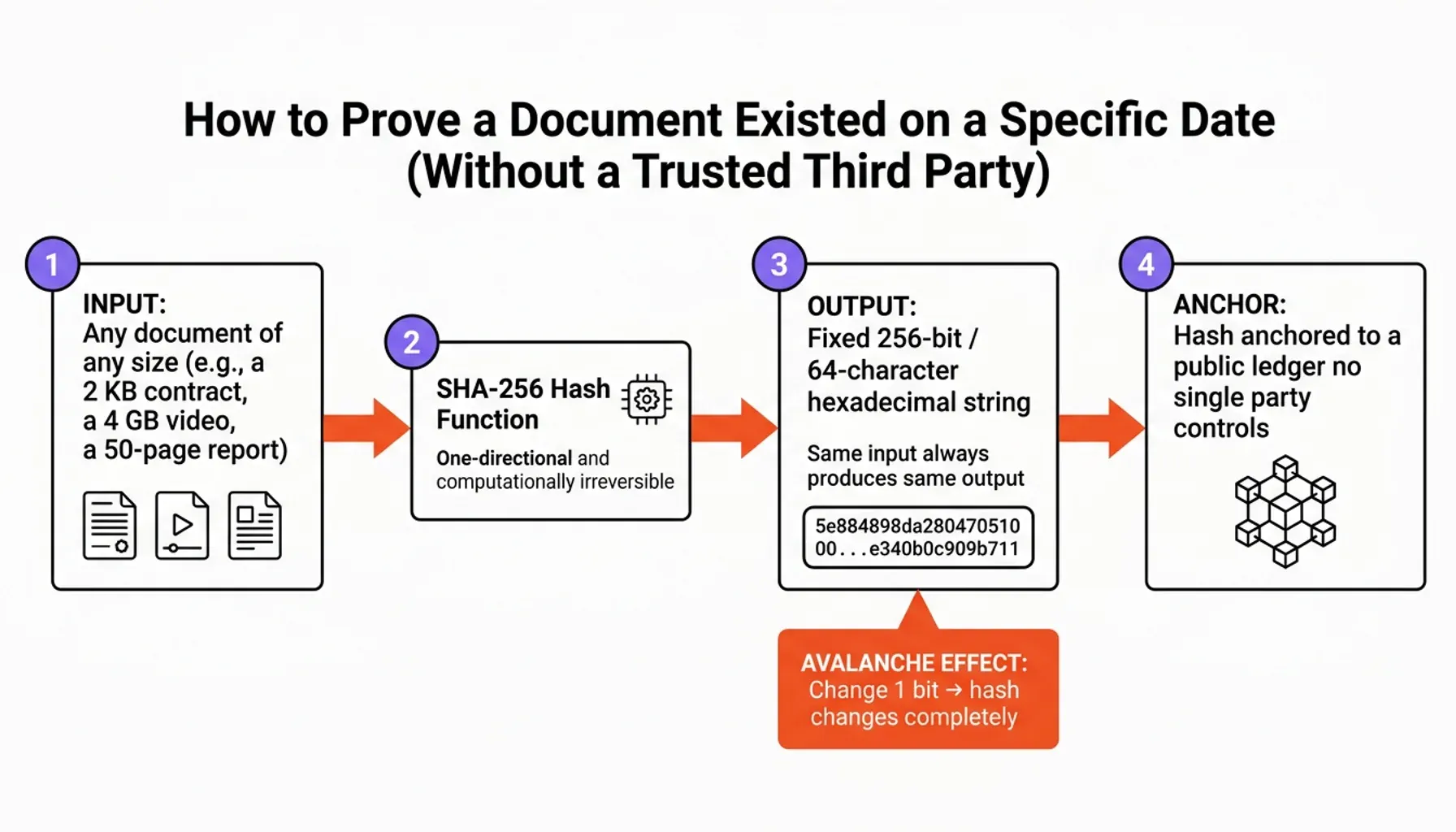
A cryptographic hash function takes any input, a 2 KB contract, a 4 GB video file, a 50-page research report, and produces a fixed-length output string. With SHA-256, that output is always exactly 256 bits, rendered as a 64-character hexadecimal string. The same input always produces the same output. Different inputs produce different outputs.
This fixed-length fingerprint is the foundation of tamper-evident proof. The hash represents the document's exact state at the moment of processing. It is deterministic, one-directional, and computationally irreversible. You cannot reconstruct the original document from its hash.
Think of it this way: you are not storing your contract in a vault. You are pressing a wax seal into wet concrete. The seal proves the letter existed before the concrete set, and no one can reopen the concrete without it being obvious. That is precisely what SHA-256 anchoring does to your document's identity at the moment you timestamp it.
The Avalanche Effect
Here's the thing. The property that makes SHA-256 particularly powerful for data integrity is the avalanche effect. Change a single bit in the input, alter one character, add a space, adjust a decimal point, and the resulting hash changes completely. Not slightly. Completely. A document that reads "payment due: $10,000" and one that reads "payment due: $10,001" produce hashes that share no recognizable relationship.
This means any modification to a document, however minor, is immediately detectable. You do not need to compare the documents side by side. You compare two hash values. If they match, the documents are identical. If they differ, something changed.
Privacy by Design
A critical and often overlooked property of hash-based proof is privacy. When you submit a document hash to a blockchain timestamping service, you are not submitting the document itself. The hash reveals nothing about the content. A third party can verify that your document existed on a specific date without ever seeing what it contains.
This makes blockchain timestamping viable for sensitive materials, including legal contracts, medical records, and proprietary research, where confidentiality is non-negotiable. For compliance officers handling regulated data, this is not a minor convenience. It is the feature that makes adoption legally defensible.
Collision Resistance
The mathematical impossibility of finding two different documents that produce the same SHA-256 hash, a "collision," is what gives the fingerprint its legal weight. The search space is 2²⁵⁶ possible values. The total number of atoms in the observable universe is estimated at roughly 10⁸⁰. Finding a SHA-256 collision by brute force is not a computational challenge. It is a physical impossibility with any foreseeable technology.
This is not a marketing claim. It is the mathematical foundation on which the entire digital security infrastructure, from HTTPS to code signing to blockchain, depends.
What Hashing Cannot Do Alone
Hashing proves a document's integrity, that it has not changed. But a hash on its own carries no timestamp. Without anchoring that hash to an independent, immutable time reference, you can prove what the document contains, but not when it existed. The hash must be embedded in a public record whose time cannot be retroactively altered. That is precisely what blockchain anchoring provides.
Why Traditional Timestamping Authorities Fall Short
How RFC 3161 Works
The RFC 3161 standard for trusted timestamping defines a protocol for trusted timestamping. A client submits a hash to a Timestamping Authority (TSA). The TSA signs the hash with its private key and returns a timestamp token. The token cryptographically binds the hash to the TSA's clock.
This is a functional solution, until it isn't.
The Single Point of Failure
RFC 3161 timestamps are only as trustworthy as the TSA that issued them. That trust rests on Public Key Infrastructure (PKI): a chain of certificates, root authorities, and revocation mechanisms. Every link in that chain is a potential failure point.
If a TSA's private key is compromised, every timestamp it ever issued becomes suspect. If the TSA goes bankrupt or discontinues its service, the infrastructure needed to verify its timestamps may disappear with it. If a root certificate expires without renewal, the entire chain of trust breaks.
These are not hypothetical scenarios. PKI-based systems require continuous maintenance, including certificate renewals, Certificate Revocation List (CRL) updates, and active monitoring. Organizations that issued thousands of timestamps under a now-defunct TSA face a genuine verification problem years later. If you are a paralegal assembling evidence for a dispute that spans a decade, discovering that your timestamping authority no longer exists is not a minor inconvenience. It can invalidate your entire evidentiary chain.
Certificate Lifecycle Risks in Practice
Beyond outright failure, PKI systems introduce subtler risks. Certificates have expiry dates. If a timestamp token was signed with a certificate that has since expired, verifying that token requires access to historical certificate revocation data, data that may not be reliably archived. Cross-border disputes add further complexity: certificate authorities recognized in one jurisdiction may carry no legal weight in another. These are operational realities that blockchain anchoring sidesteps entirely.
Trusted vs. Trustless
Most companies get this wrong. They treat "trusted" and "trustworthy" as synonyms. They are not.
A trusted system requires you to believe in the integrity and permanence of a specific institution. A trustless system requires you to believe in mathematics and the properties of a decentralized network. The Bitcoin blockchain has been continuously operational since January 2009. Its transaction history is replicated across tens of thousands of independent nodes worldwide. No single entity controls it. No single entity can alter it.
This is the architectural shift that makes blockchain-based proof qualitatively different from PKI-based timestamping, not incrementally better, but structurally superior for long-term, independent verification.
Blockchain Anchoring: The Decentralized Proof of Date
The Anchoring Process
Embedding a document hash into a public blockchain transaction is conceptually straightforward. A hash is included in a transaction's data payload, on Bitcoin typically via the OP_RETURN opcode, on Ethereum via transaction input data. Once that transaction is confirmed and included in a block, the hash becomes part of the blockchain's permanent, immutable record.
The block containing the transaction carries a timestamp. Every subsequent block in the chain references the previous block's hash. Altering the timestamp of any block would require recomputing the proof-of-work for that block and every block after it, simultaneously outpacing the combined computational power of the entire network. This is the decentralized consensus mechanism that makes blockchain timestamps mathematically provable rather than institutionally asserted.
Vendor Independence
This is the property that distinguishes blockchain timestamping from every other approach: the proof survives the service provider.
If OriginStamp ceased operations tomorrow, every timestamp ever anchored to Bitcoin or Ethereum would remain independently verifiable. Anyone with access to a public block explorer, free, open-source tools that query the blockchain directly, can confirm that a specific hash was recorded in a specific block at a specific time. No account. No subscription. No proprietary software.
This is what tamper-proof blockchain timestamps deliver in legal and compliance contexts: proof that is mathematically independent of any single institution's continued existence or integrity.
Dual-Chain Anchoring
Anchoring to both Bitcoin and Ethereum simultaneously adds a further layer of redundancy. The two blockchains operate independently, with different consensus mechanisms and different global node networks. The probability of both being compromised in a coordinated attack approaches zero. For high-stakes documents, patents, legal agreements, regulated financial records, dual-chain anchoring is not overkill. It is proportionate to the risk.
Block Headers and Mathematical Certainty
Each block header contains a cryptographic hash of the previous block, a Merkle root of all transactions in the block, a timestamp, and a nonce. The chained structure means that the timestamp of any given block is constrained by the timestamps of all preceding and following blocks. A fraudulent timestamp would require rewriting the entire subsequent chain, a task that grows more computationally expensive with every new block added.
For documents anchored years ago, this mathematical protection compounds over time. The older the timestamp, the more computationally infeasible forgery becomes. A compliance officer reviewing records from five years ago is not relying on an institution's word. They are relying on the accumulated proof-of-work of an entire global network.
Legal Admissibility Considerations
Blockchain timestamps have been recognized as evidence in an increasing number of jurisdictions. China's Supreme People's Court ruled in 2018 that blockchain-based evidence is admissible in civil proceedings. The European Union's eIDAS framework acknowledges electronic timestamps as legally significant. In the United States, blockchain records have been admitted under the Federal Rules of Evidence as self-authenticating business records in several cases. The legal landscape is still evolving, but the trajectory is clear: courts are moving toward accepting cryptographic proof as a reliable authentication method. Organizations that build blockchain-based audit trails now are positioning themselves ahead of that curve.
Step-by-Step: Creating Your Own Tamper-Proof Audit Trail
The Core Workflow
Creating a verifiable proof of document existence requires four steps:
- Generate the hash: Run your document through a SHA-256 hash function. This produces the document's unique fingerprint.
- Anchor to blockchain: Submit the hash to a blockchain timestamping service. The hash is embedded in a Bitcoin and/or Ethereum transaction.
- Receive and store the receipt: The service returns a certificate containing the transaction ID, block number, timestamp, and the original hash.
- Verify on demand: At any future point, re-hash the original document and check that the hash matches the one recorded in the blockchain transaction.
The process takes seconds. The proof lasts as long as the blockchain exists.
For a practical implementation of this workflow in regulated document environments, see E-Invoice Archiving: Format, Integrity, and Audit Trails, which covers how tamper-proof timestamping applies to financial records subject to strict retention rules.
The Critical Rule: Preserve the Original
Verification depends entirely on the original file remaining byte-for-byte identical. A document that has been re-saved, reformatted, compressed, or had its metadata updated will produce a different hash. The verification will fail, not because the timestamp is invalid, but because the document is no longer the same document.
This has direct implications for document management. Store high-value assets in read-only archives immediately after timestamping. Clearly distinguish any working copies from the archived original. If you are a paralegal managing evidence for a long-running dispute, this discipline is not optional. It is the difference between proof that holds and proof that unravels under cross-examination.
Independent Verification Without Proprietary Tools
One of the most powerful features of blockchain-based proof is that verification requires no proprietary software. Take the transaction ID from your timestamp receipt, enter it into any public block explorer, Blockstream for Bitcoin, Etherscan for Ethereum, and you will see the raw transaction data, including the embedded hash and the block timestamp. Anyone can do this. Anywhere. At any time.
This is the operational definition of trustless verification.
Long-Term Integrity for High-Value Assets
For patents, medical records, legal agreements, and regulatory submissions, preserving both the original file and the timestamp receipt over the long term is essential. Blockchain timestamps do not expire. A hash anchored today will be verifiable in 30 years, provided the original file is intact. This makes blockchain timestamping particularly well-suited to assets with long legal or regulatory lifespans.
For organizations managing regulated document archives, the requirements for revision-proof e-invoice archiving provide relevant context on long-term tamper-proof retention obligations and how blockchain anchoring satisfies them.
Scaling Digital Integrity for Enterprise Workflows
The Volume Problem
Manual timestamping works for individual documents. It breaks down for enterprise workflows that generate thousands of documents daily, invoices, contracts, audit logs, sensor data, compliance records. At scale, manual processes introduce delays, inconsistencies, and gaps in the audit trail.
The answer is automation through API integration.
RESTful API Integration
A well-designed blockchain timestamping API accepts a hash via a standard HTTP POST request and returns a receipt. Integrate this directly into any ERP system, Document Management System (DMS), or content pipeline. Every document is automatically hashed and anchored at the moment of creation or approval, no human intervention required.
For startup CTOs building document-intensive platforms, this is the architectural decision that separates systems designed for scale from systems that create compliance debt. Every document in the system carries an immutable proof of its state at creation. Disputes resolve with data, not assertions. For more on how this integrates with enterprise archiving infrastructure, see What Is an ERP Archive? Key Benefits & Requirements.
Hash Aggregation: Cost-Efficient at Scale
Anchoring every individual document hash as a separate blockchain transaction would be expensive and slow. The solution is hash aggregation using Merkle trees, a data structure that combines thousands of individual hashes into a single root hash, which is then anchored in one transaction.
Each individual document retains its own provable position within the Merkle tree. The cost of anchoring ten thousand documents equals the cost of anchoring one. Individual file integrity is preserved. Transaction costs are minimized. For high-volume environments processing millions of records annually, this is not a technical footnote. It is what makes the economics of continuous timestamping viable.
Handling Document Versions and Amendments
Enterprise workflows rarely produce static documents. Contracts get amended. Policies get revised. Reports get updated. Each version requires its own timestamp to establish a verifiable chronology. A well-implemented timestamping workflow assigns a new hash and a new blockchain anchor to every approved version, preserving the complete amendment history as an immutable sequence. This version chain becomes a powerful asset in disputes: you can demonstrate not just what the final document said, but exactly when each change was made and in what order.
Strategic Value Beyond Compliance
The value of a comprehensive, automated timestamp infrastructure extends beyond regulatory compliance. Organizations that maintain a verifiable history of their data resolve disputes faster, demonstrate due diligence in litigation, and build auditable evidence trails for AI-driven decisions. For organizations exploring AI governance, AI Governance: Auditing LLM Decision Trails with Blockchain examines how the same timestamping principles apply to machine learning workflows, including proving when a model's training data or decision logic was fixed.
The strategic case is straightforward: a verifiable data history is a competitive and legal asset. Building it systematically from day one costs far less than reconstructing it after a dispute arises.
Conclusion: Securing Your Digital Legacy
File metadata is not evidence. Notaries are single points of failure. PKI-based timestamping authorities can disappear. None of these approaches provide the one property that matters most in a dispute: proof that is mathematically independent of any party's continued goodwill or existence.
Blockchain-based timestamping solves this problem at its root. A SHA-256 hash, anchored to Bitcoin and Ethereum, creates a permanent, publicly verifiable record that a specific document existed in a specific form at a specific point in time. No administrator can alter it. No provider bankruptcy can erase it. No adversary can forge it without rewriting the entire blockchain, a task that is computationally impossible.
For individual documents, the process takes seconds. For enterprise workflows, API integration makes it continuous and automatic. The proof compounds over time: the older a timestamp, the more mathematically certain it becomes.
Organizations that build this infrastructure now are not just solving a compliance problem. They are building a verifiable history of their digital assets, one that will hold up in court, in audits, and in disputes that have not yet materialized.
Explore OriginStamp's blockchain timestamping service to see how tamper-proof, dual-chain proof of existence works in practice, and how quickly it can be integrated into your existing document workflows.
Thomas Hepp
Co-Founder
Thomas Hepp is the founder of OriginStamp and creator of the OriginStamp timestamp, which has set the standard for tamper-proof blockchain timestamps since 2013. As one of the earliest innovators in the field, he combines deep technical expertise with a pragmatic focus on solving real business problems, and is a recognized voice in blockchain security, AI analytics, and data-driven decision support. His work has earned multiple international awards, including a top Best Project recognition from ETH Zurich and the Swiss Confederation. He publishes regularly on blockchain, AI, and digital innovation.