
MiCA July 2026 Deadline: Building a Defensible Evidence Trail
Jun 11, 2026

Thomas Hepp
Jun 11, 2026

The Clock Is Running: MiCA's July 2026 Deadline and the Evidence Trail That Protects You
Imagine it's October 2026. Sofia Reyes, Chief Compliance Officer at a mid-sized crypto exchange in Amsterdam, opens her inbox to find an inspection notice from the Dutch Authority for the Financial Markets. The NCA wants a complete audit trail covering January through June 2026: white papers, governance approvals, client notices, transaction logs, the works. Sofia pulls up the firm's compliance folder. The documents are there. But the timestamps are server-generated, the version history is incomplete, and there's a six-month gap where the old system simply stopped logging changes after a migration.
She has two weeks to respond.
That scenario is not hypothetical. It's the situation hundreds of CASPs across Europe will face once active enforcement begins. And the regulation that makes it possible, the Markets in Crypto-Assets Regulation, doesn't care how good your intentions were. It cares what you can prove.
This is a technical and strategic guide for CASPs, legal teams, and compliance officers who need to build an evidence trail that survives regulatory inspection, not just before July 2026, but for the years of enforcement that follow.
The 1 July 2026 Cliff: Why the MiCA Transition Period Is Ending
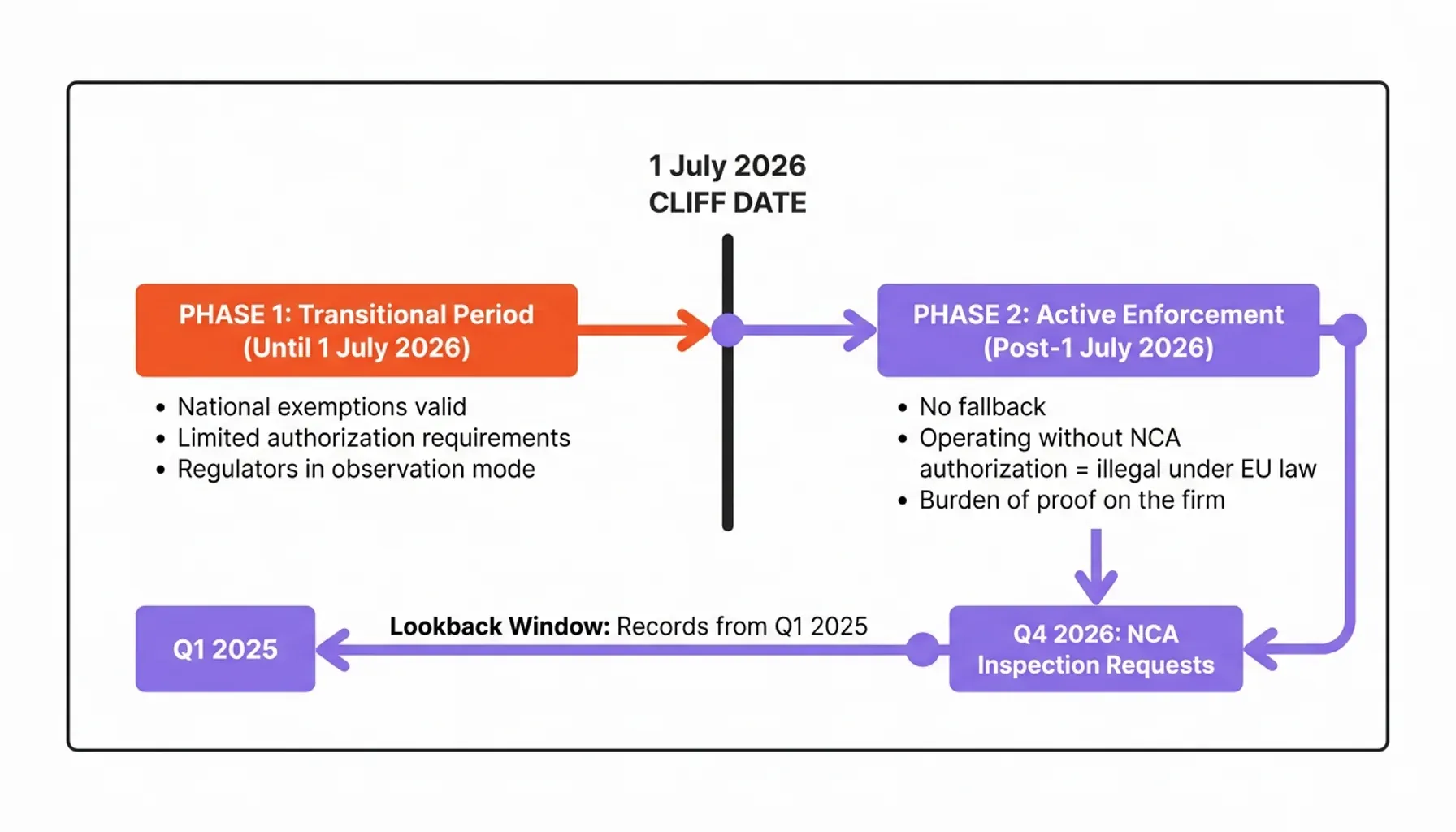
MiCA's transitional regime was never a grace period for inaction. It was a structured runway, a defined window for firms to migrate from fragmented national frameworks to a unified EU authorization standard. That runway ends on 1 July 2026.
Until that date, firms operating under national exemptions could continue providing services with limited authorization requirements. After it, there is no fallback. A CASP without a valid authorization from its National Competent Authority (NCA) is operating illegally under EU law.
The shift is qualitative, not just administrative. During the transitional period, regulators were largely in observation mode: gathering data, issuing guidance, building supervisory capacity. Post-July 2026, the posture shifts to active enforcement. ESMA has been explicit that the burden of proof rests with the firm, not the regulator. You don't demonstrate compliance when asked. You demonstrate that you have been compliant from the moment you began operating.
Regulators will look backward. Far backward.
An NCA conducting a post-authorization inspection in Q4 2026 will want records from Q1 2025. Incomplete, inconsistent, or unverifiable records mean sanctions ranging from financial penalties to forced wind-down.
Legacy firms that relied on national exemptions face the sharpest risk. Their documentation was often built to satisfy local requirements that are now superseded. Rebuilding that paper trail retroactively isn't just difficult; in many cases, it's legally insufficient. The only defensible position is a forward-looking evidence architecture that creates verifiable records in real time, starting now.
The EU's broader digital compliance wave illustrates the same pattern across sectors: regulatory deadlines compress faster than legacy systems can adapt.
The Enforcement Reality: If It Isn't Provable, It Didn't Happen
Most companies get this wrong. Regulatory inspections by NCAs are not audits in the traditional accounting sense. They are evidentiary exercises. The inspector's core question isn't "do you have a compliance policy?" It's "can you prove that policy was executed, at this specific time, in this specific form, without modification?"
That distinction destroys most firms' current compliance posture. A policy document stored in a SharePoint folder proves nothing about when it was created, whether anyone altered it since, or whether it was actually in effect at the time a specific client interaction occurred.
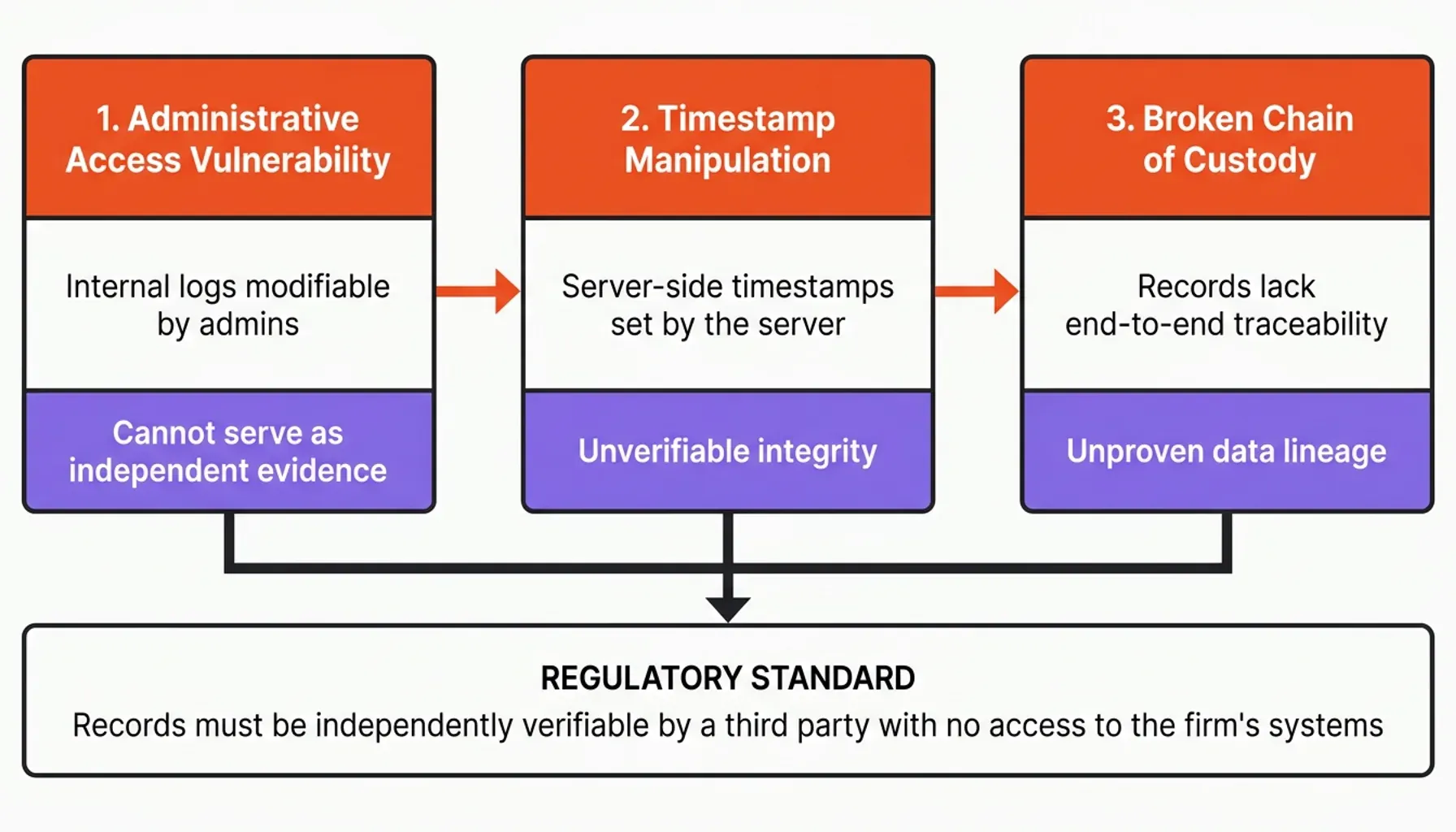
The FATF Recommendation 15 framework for virtual assets reinforces this evidence-first standard. Regulators expect firms to maintain records that are not merely retrievable but independently verifiable, meaning a third party with no access to the firm's systems can confirm the record's integrity.
Three failure modes are common in digital record-keeping for CASPs:
Administrative access vulnerability. Internal logs are only as trustworthy as the access controls around them. If a system administrator can modify a log entry, even with good intentions, that log cannot serve as independent evidence. Regulators know this. They will probe it.
Timestamp manipulation. Server-side timestamps are set by the server. A determined actor with system access can alter them. An NCA inspector who understands this will discount any timestamp not anchored to an external, immutable source.
Version ambiguity. When a document has been revised multiple times, which version was in effect at a given moment? Without a cryptographic record of each version's existence at a specific point in time, you simply cannot answer that question definitively.
The firms that pass NCA inspections cleanly are those that produce a complete, independently verifiable chain of evidence: not just for what they did, but for exactly when they did it and in what form. BaFin's guidance on crypto-asset supervision makes clear that German-supervised CASPs are expected to meet precisely this standard.
OriginVault's audit-proof archiving infrastructure is designed specifically to close these gaps, providing an immutable evidence layer that sits between your operational systems and your regulatory obligations.
Critical Compliance Artifacts: What Needs a Tamper-Proof Seal?
MiCA imposes documentation requirements across the full lifecycle of a CASP's operations. Not all documents carry equal regulatory weight, but several categories are particularly high-stakes, and particularly vulnerable to challenge if you can't prove their integrity.
White Papers and Disclosure Documents
Under MiCA Title V, crypto-asset service providers must publish accurate, up-to-date information about the assets they handle. White papers issued to retail investors create legal obligations at the moment of publication. If a firm later modifies its white paper, even legitimately, it must prove what the original document said at the time of each client interaction.
Without a cryptographic timestamp anchoring each version, you can't definitively answer the question: "What did your disclosure say on the date this client made their investment decision?" That gap is a litigation and enforcement liability. Full stop.
Authorization Documentation
Internal governance records, including board approvals, risk committee decisions, and authorization sign-offs, form the backbone of a CASP's compliance narrative. They prove the firm's governance structure was functioning as required. But they're only useful if their authenticity and timing can be verified. A document that can be backdated or modified after the fact isn't a governance record. It's a risk.
Client Notices and Terms of Service
Every update to client-facing terms creates a new version history. CASPs must demonstrate which version of their terms governed a specific client relationship at a specific time. This isn't just a regulatory requirement; it's the primary defense against client disputes and class-action litigation. A timestamped, immutable record of each version's publication date is the only reliable protection.
Asset-Transfer Logs and Transaction Metadata
Transaction records are the most operationally sensitive category. ISO/TC 307 standards for blockchain and distributed ledger technologies establish best practices for ensuring transaction metadata is preserved with integrity. For CASPs, this means anchoring transaction logs in a way that prevents retroactive manipulation, not just for regulatory reporting, but for forensic reconstruction if a dispute or investigation arises.
Each of these artifact types requires the same foundational capability: proof that the document or record existed in a specific form at a specific moment in time, verifiable by any party without relying on the firm's own infrastructure.
Market Abuse Prevention, Transaction Monitoring, and Reporting Duties
Evidence preservation doesn't stop at static documents. MiCA imposes active, ongoing obligations that generate their own audit trail requirements, and this is where many CASPs are most exposed.
Market Abuse Under MiCA Title VI
MiCA's market abuse framework, covering insider trading, market manipulation, and unlawful disclosure of inside information, applies to crypto-assets admitted to trading on a CASP's platform. This isn't a soft obligation. It mirrors the Market Abuse Regulation (MAR) that governs traditional securities, adapted for crypto markets.
What does this mean in practice? You need to:
- Maintain a real-time surveillance system capable of detecting anomalous trading patterns: wash trading, spoofing, layering, and coordinated pump-and-dump activity
- Keep a documented record of every alert generated, every investigation triggered, and every decision made in response
- Preserve those records in a tamper-evident format, because an NCA investigating a market abuse allegation will want to reconstruct your surveillance timeline, not just your conclusions
The evidentiary challenge here is acute. Market abuse investigations are retrospective by nature. Regulators will ask what your surveillance system flagged on a specific date, what your compliance team did with that flag, and how long it took to escalate or close. If your alert logs are mutable, or if your investigation records live in a shared inbox with no version control, you have no defense.
Immutable timestamping of surveillance alerts and investigation records is not optional for CASPs running trading platforms. It's the difference between demonstrating a functioning compliance program and being unable to prove one existed.
Transaction Monitoring Obligations
MiCA's transaction monitoring requirements intersect directly with the EU's Transfer of Funds Regulation (TFR), which extends the travel rule to crypto-asset transfers. From a compliance architecture perspective, this creates a dual obligation:
- Real-time monitoring: screening transactions against sanctions lists, identifying high-risk counterparties, and flagging transactions that exceed reporting thresholds
- Record preservation: maintaining a complete, tamper-evident log of every transaction screened, every match identified, and every decision made
The travel rule specifically requires CASPs to collect, verify, and transmit originator and beneficiary information for transfers above €1,000. That information must be retained and retrievable. An NCA inspector asking for the originator data on a specific transaction from eight months ago expects a precise, verifiable answer, not an approximation reconstructed from fragmented logs.
Suspicious Transaction Reporting
When a CASP identifies a transaction that may be connected to money laundering or terrorist financing, it must file a Suspicious Transaction Report (STR) with its national Financial Intelligence Unit (FIU). The obligation doesn't end at filing. The CASP must also preserve evidence that the report was filed, when it was filed, and what information it contained, without tipping off the subject of the report.
This creates a specific archiving challenge: STR records must be isolated from general operational systems (to prevent inadvertent disclosure), retained for the legally required period (typically five years under AMLD6), and verifiable as authentic at the time of filing. A blockchain-sealed, encrypted archive is the natural solution. The seal proves the filing date and content; the encryption protects the confidentiality of the report.
Beyond Databases: Using Blockchain Timestamps for Mathematical Proof
Here's the thing. The solution to the evidence problem isn't a better database. Databases are controlled by administrators. The solution is a cryptographic mechanism that creates proof independent of any single party's control.
Here's how blockchain timestamping works. You take a document, any document, and run it through a SHA-256 cryptographic hash function. The result is a unique 64-character string: the document's digital fingerprint. Change a single character in the document, and the hash changes entirely. The hash itself contains no sensitive information; it's a mathematical representation, not the document.
That hash gets anchored to a public blockchain, Bitcoin or Ethereum. The blockchain records the hash in a block with a network-verified timestamp. From that moment, the proof is immutable. No administrator, no regulator, and no court order can alter the blockchain record. The hash exists permanently, publicly, and independently.
This creates what's technically called Proof of Existence: mathematical certainty that a specific document existed in a specific form at a specific point in time. For regulatory purposes, this is the gold standard of evidence.
Three properties make blockchain timestamps superior to internal server logs for legal defense:
Independence. The proof doesn't rely on the firm's own infrastructure. An NCA inspector can verify the timestamp using public blockchain explorers without any cooperation from the firm being inspected.
Immutability. Bitcoin and Ethereum blocks are computationally irreversible. Altering a timestamped record would require rewriting the entire blockchain. Not happening.
Privacy preservation. The hash reveals nothing about the document's contents. You can prove the integrity of a confidential client record without exposing that record to the public chain. Sensitive data stays private; the proof of its integrity is public.
Peer-reviewed research on decentralized trusted timestamping confirms that this approach meets the evidentiary standards required in legal and regulatory proceedings across multiple jurisdictions.
For compliance teams building their MiCA evidence architecture, this means every critical document, including white papers, governance approvals, client notices, transaction logs, surveillance alerts, and STR filings, should be hashed and anchored at the moment of creation or publication. The cost is negligible. The evidentiary value is decisive.
Architecting an Audit-Proof Backend for Long-Term Retention
Blockchain timestamping solves the integrity problem. But a CASP's compliance architecture needs more than proof of existence. It needs a complete, organized, long-term retention system that can surface any document on demand during an NCA inspection.
This is where the infrastructure layer becomes critical. A compliance backend for MiCA purposes must satisfy several non-negotiable requirements.
Integration without disruption. The compliance layer must connect directly to existing ERP, CRM, and operational systems. A standalone archiving solution that requires manual uploads introduces gaps and human error, the exact vulnerabilities regulators exploit. White-label integration means the compliance infrastructure operates invisibly within existing workflows.
Multi-tenancy with strict separation. CASPs operating across multiple jurisdictions or serving institutional clients with segregated accounts need a system that maintains separate data spaces while providing a unified audit trail. Client data must be isolated; the integrity layer must be unified.
Encryption and sealing. AES-256 encryption ensures archived documents are protected at rest. Combined with blockchain seals, this creates a two-layer protection: the data is encrypted against unauthorized access, and the seal makes any tampering mathematically detectable, even by system administrators with full database access.
Cloud agnosticism and data sovereignty. A compliance infrastructure locked to a single cloud provider creates concentration risk and potential data sovereignty issues under GDPR. A cloud-agnostic architecture, deployable on AWS, Azure, or on-premises, ensures data residency requirements can be met regardless of jurisdiction-specific variations.
Long-term retention standards. European archiving standards, including GoBD in Germany and GeBüV in Switzerland, define specific requirements for audit-proof retention. A compliance backend built to these standards provides a defensible foundation not just for MiCA but for the full spectrum of European regulatory obligations.
OriginVault's compliance archiving infrastructure delivers all of these capabilities as a white-label backend, meaning CASPs and the platforms serving them can embed a fully audit-proof retention layer without rebuilding their core systems.
The KRM certification criteria and ISO 27001 information security standards provide the external benchmarks against which this infrastructure should be measured. A system that meets both is defensible in any European jurisdiction.
Practical MiCA Readiness Checklist for CASPs Before July 2026
Abstract frameworks don't help when you're three months from a deadline. Here's a concrete checklist. Work through it systematically. Be honest about the gaps.
Authorization and Governance
- NCA authorization application submitted (or national transitional exemption confirmed as valid through 1 July 2026)
- Board-level governance structure documented and verifiable, with timestamped records of all relevant approvals
- Compliance officer appointed with documented scope of responsibility
- Internal audit function established with independent reporting line
- Conflicts of interest policy in place and version-controlled
Documentation Integrity
- All white papers cryptographically timestamped at publication, with version history preserved
- Client terms of service version-controlled with immutable publication dates for each version
- All material governance decisions (board resolutions, risk committee approvals) sealed with blockchain timestamps
- Document retention policy covering the full MiCA-required retention period (minimum five years for most categories)
- No compliance-critical documents stored solely in mutable systems (SharePoint, email, unversioned databases)
Transaction Monitoring and Travel Rule
- Travel rule compliance system implemented for transfers above €1,000 (originator and beneficiary data collection, verification, and transmission)
- Transaction screening against EU sanctions lists operational and logged
- Threshold-based monitoring alerts configured and generating tamper-evident logs
- STR filing process documented, with encrypted, timestamped records of all filings
Market Abuse Prevention
- Real-time market surveillance system deployed for all assets admitted to trading
- Alert management workflow documented, with immutable records of alerts generated, investigated, and closed
- Inside information handling procedures in place, with access logs preserved
- Suspicious trading pattern escalation process tested and documented
Client Protection
- Suitability and appropriateness assessment procedures documented for retail clients
- Client asset segregation records maintained and verifiable
- Complaint handling process documented with timestamped records of all complaints and resolutions
- Marketing materials reviewed for compliance with MiCA's retail investor protection requirements
Incident Response and Reporting
- Operational incident reporting process established (MiCA requires notification of significant ICT incidents to NCAs)
- Incident records preserved in tamper-evident format with accurate timestamps
- Business continuity and disaster recovery plans tested and documented
Infrastructure Verification
- Compliance archive meets GoBD/GeBüV standards (or equivalent for your jurisdiction)
- Blockchain sealing active for all high-stakes document categories
- Third-party verification of timestamp integrity confirmed (can an NCA inspector verify your records without your cooperation?)
- Data residency confirmed as compliant with GDPR for all archived records
If you have gaps in more than three of these categories, you're behind. Not critically, but the clock is running. Prioritize the documentation integrity and transaction monitoring sections first; those are where NCAs will focus their initial inspections.
Preparing for Inspection: A Strategy for July 2026 and Beyond
The MiCA July 2026 deadline is a forcing function, not a finish line. NCAs will conduct ongoing supervision after authorization, and the evidence standards don't relax after the initial approval. A CASP that builds a defensible evidence trail for the authorization process has built something with permanent value.
Start with a gap assessment. Run your current digital evidence preservation workflows against these questions:
- Can you produce a cryptographically verifiable record of every white paper version published in the last 24 months?
- Can you demonstrate the exact state of your terms of service at the time of any specific client interaction?
- Are your transaction logs anchored to an external, immutable source, or do they rely solely on internal server timestamps?
- Can your governance records be verified by a third party without access to your internal systems?
- Can you reconstruct your market surveillance timeline for any given trading day in the past six months?
If the answer to any of these is no, close the gap before July 2026. Not after.
Jurisdiction-specific uncertainty is real. Different EU member states have implemented MiCA with varying degrees of specificity in their local guidance. The correct response to that uncertainty isn't to calibrate to the lowest standard. Build to the highest. A cryptographically verifiable evidence trail satisfies every NCA's requirements, regardless of local variation.
The long-term value extends beyond regulatory defense. Institutional clients, including asset managers, banks, and corporate treasuries, increasingly require their CASP counterparties to demonstrate data integrity as a condition of engagement. A provable compliance architecture isn't just a regulatory necessity. It's a commercial differentiator in a market where trust is the primary product.
The European Commission's Digital Finance Package signals that this regulatory direction is permanent and expanding. CASPs that build their evidence infrastructure now aren't just solving for July 2026. They're building the foundation for the next decade of European digital finance regulation.
The same regulatory pressure is reshaping compliance across industries: France's 2026 e-invoicing mandate and Belgium's Peppol B2B requirements both reflect the same EU-wide shift toward mandatory, verifiable digital records. The lesson is identical. Build the infrastructure before the deadline, not in response to an inspection notice.
Conclusion: Proof Is the Product
The MiCA July 2026 deadline isn't a compliance checkbox. It's the opening of a sustained enforcement era for crypto-asset services in Europe. The firms that navigate it successfully won't be those with the most sophisticated policies. They'll be those that can prove, mathematically and independently, that their policies were executed correctly, at the right time, in the right form.
Think back to Sofia in Amsterdam, staring at a six-month gap in her audit trail with two weeks to respond. That gap didn't appear overnight. It accumulated through a series of reasonable-seeming decisions: a system migration that wasn't fully logged, a document update that wasn't version-controlled, a server timestamp that nobody thought to anchor externally. Each decision seemed fine at the time. Together, they created a liability.
Building defensible proof requires more than good intentions and well-organized folders. It requires a cryptographic evidence layer that anchors documents to immutable public blockchains, a retention architecture that meets European legal standards, and an infrastructure that integrates with existing systems without creating new operational gaps.
The time to build this is now, before the deadline, before the inspection, and before a gap in your evidence trail becomes a regulatory finding.
If you're evaluating how to implement an audit-proof compliance backend that meets MiCA's evidentiary demands, explore OriginVault's audit-proof archive for compliance, a white-label, blockchain-sealed retention infrastructure built specifically for the European regulatory environment.
Thomas Hepp
Co-Founder
Thomas Hepp is the founder of OriginStamp and creator of the OriginStamp timestamp, which has set the standard for tamper-proof blockchain timestamps since 2013. As one of the earliest innovators in the field, he combines deep technical expertise with a pragmatic focus on solving real business problems, and is a recognized voice in blockchain security, AI analytics, and data-driven decision support. His work has earned multiple international awards, including a top Best Project recognition from ETH Zurich and the Swiss Confederation. He publishes regularly on blockchain, AI, and digital innovation.