
Tamper-Proof Records: What Makes Digital Data Immutable
Jun 11, 2026

Thomas Hepp
Jun 11, 2026

Every digital file you trust today can be silently altered. No alarm. No audit log entry. No trace, unless you built the proof before the dispute began.
This is the core problem with digital records. Not that they get hacked dramatically, but that they can be quietly changed by anyone with sufficient access. A database administrator can edit an entry. A timestamp in file metadata can be reset with a single command. A document stored on a corporate server carries no independent proof of what it contained last Tuesday, let alone three years ago.
The organizations that understand this reality have stopped asking "Is our data secure?" and started asking "Can we prove our data is unchanged?" That shift, from trust-based to math-based verification, is what separates modern data integrity from wishful thinking.
The Illusion of Digital Permanence: Why Standard Files Fail
Standard file systems were never designed for evidentiary integrity. They were designed for convenience: fast read/write access, flexible modification, easy deletion. The side effect of that design is a fundamental fragility that most organizations underestimate until they face a legal challenge or regulatory audit.
Consider what a standard file actually records. A Word document, a PDF, a database entry, each carries metadata: creation date, modification date, author. But that metadata lives inside the file itself, or in the file system's index. Both are writable. A determined insider, or a sophisticated attacker, can alter a document's content and reset its timestamps with freely available tools. The file system sees nothing unusual. The backup contains the altered version. The audit log, if it exists at all, is stored in the same database that was just modified.
This is the Admin Problem at its core. Privileged users, database administrators, IT managers, system owners, have the technical ability to modify records and cover their tracks within a closed system. Internal access controls slow them down. They do not make tampering mathematically impossible.
The stakes are not abstract. In legal disputes, digital evidence admissibility depends on demonstrating chain of custody and integrity. In financial audits, regulators require proof that records reflect the original transaction, not a convenient revision. In intellectual property litigation, the difference between a provable creation date and an unverifiable claim can cost millions.
The shift required here is fundamental: stop trusting the person who controls the system, and start verifying the math that governs the record.
Tamper-Evident vs. Immutable: Clearing the Confusion
Most companies get this wrong. These two terms appear interchangeably in vendor marketing, but they describe meaningfully different things.
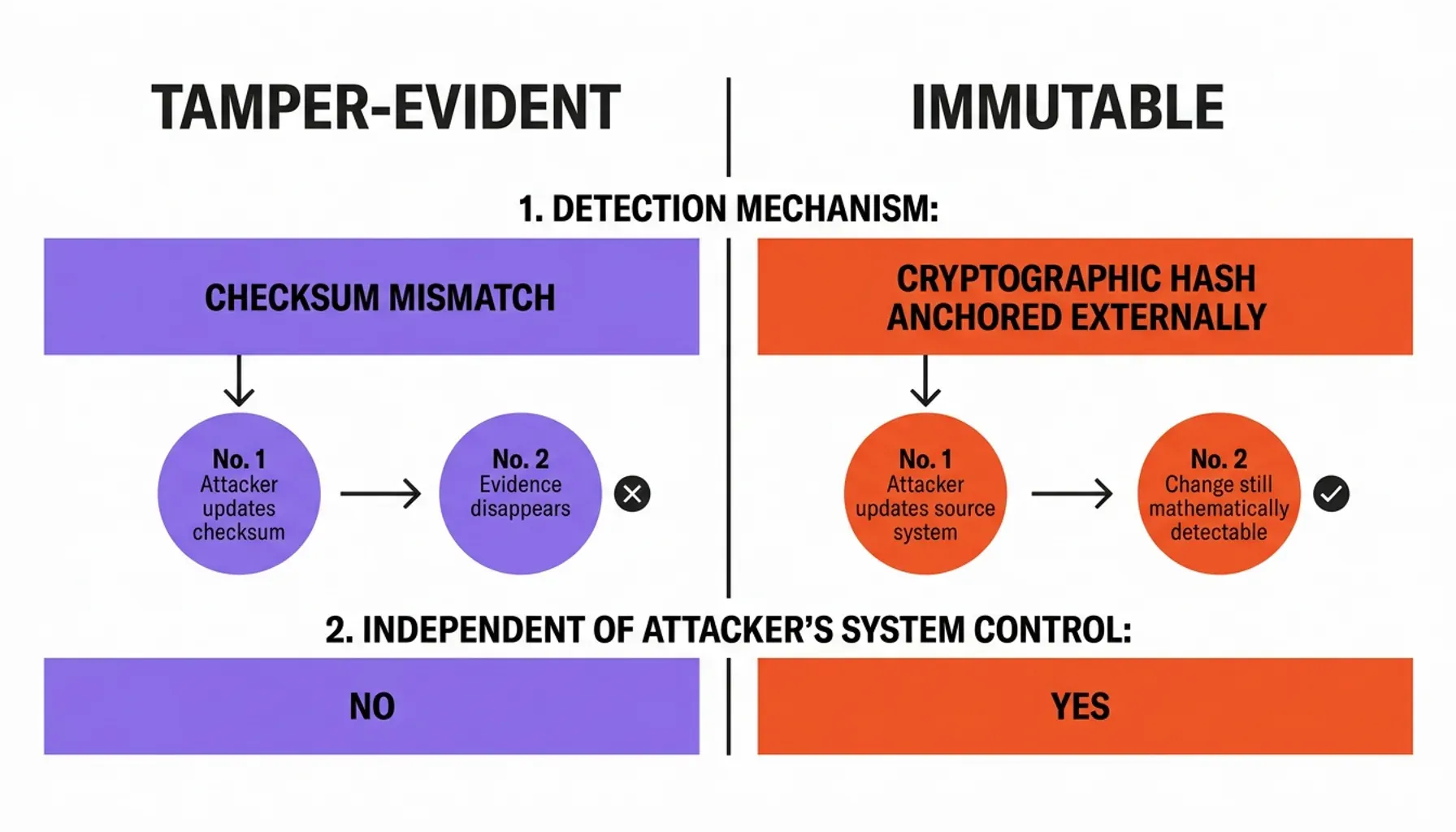
Tamper-evident means that modification leaves a detectable mark. A wax seal on an envelope is tamper-evident, you can see it was broken. A digital equivalent might be a checksum stored alongside a file. If the file changes, the checksum no longer matches. But if the attacker also updates the checksum, the evidence disappears.
Immutable in a digital context does not mean "impossible to change." It means that any change is mathematically detectable, even if the attacker controls the original system. That distinction matters enormously.
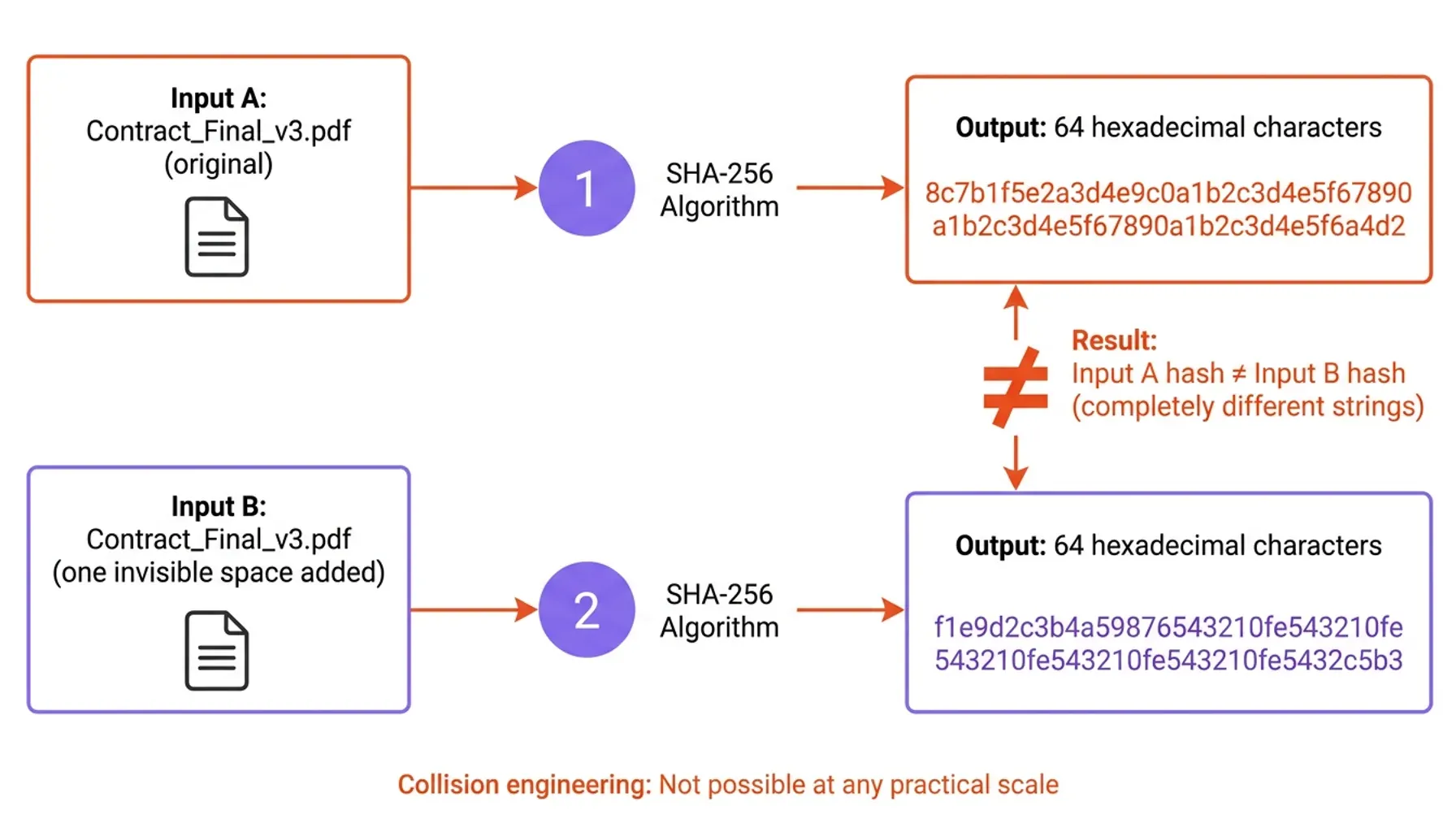
The mechanism that makes this possible is the cryptographic hash function. Every document, regardless of size, can be run through a SHA-256 algorithm to produce a fixed-length string of characters: 64 hexadecimal characters that represent the document's unique digital fingerprint. Change a single character in the document, and the hash changes completely. The fingerprint of "Contract_Final_v3.pdf" and "Contract_Final_v3.pdf" with one invisible space added are entirely different strings. There is no way to engineer a collision that produces the same hash for two different documents at any practical scale.
This is the SHA-256 fingerprint, the foundation of how blockchain timestamping works in practice.
A common misconception follows from here: that making a document "blockchain-immutable" means storing the document on a public blockchain. Wrong on multiple levels. Public blockchains are not storage systems. Writing raw document data on-chain is prohibitively expensive, slow, and, critically, destroys privacy. Sensitive contracts, medical records, and financial documents cannot be broadcast to a public ledger.
What gets anchored is the hash. Only the fingerprint. The document stays in your controlled environment. The hash goes to Bitcoin or Ethereum, two independent, globally distributed blockchains operated by no single authority. Once a hash is embedded in a confirmed blockchain transaction, it cannot be removed or altered. The blockchain's consensus mechanism ensures that rewriting history would require controlling more than half of the network's computational power, a practical impossibility for either Bitcoin or Ethereum at their current scale.
This distributed anchoring eliminates the single-point-of-trust problem. No central authority, not a notary, not a software vendor, not a government registry, controls the proof. The proof lives in the blockchain itself, verifiable by anyone with the original document and the transaction ID.
For organizations that need to understand what blockchain actually is and how data integrity works at a technical level, the architecture is well-documented and independently auditable.
The Mechanics of Trust: Merkle Trees and Blockchain Anchoring
Anchoring every document hash as an individual blockchain transaction would be impractical. Bitcoin processes roughly 7 transactions per second. An organization generating thousands of documents per day cannot wait for individual blockchain confirmations for each one.
The solution is Merkle tree aggregation: a data structure that condenses thousands of individual hashes into a single root hash, called the Merkle root.
Here is how it works. Document hashes are paired and hashed together. Those combined hashes are paired and hashed again. This process repeats until a single hash remains, the root. That root represents, in one fixed-length string, the cryptographic fingerprint of every document in the batch. Only the root gets anchored to the blockchain.
The result: one blockchain transaction, one Merkle root, and a mathematically provable relationship between that root and every individual document hash in the batch. Any document in the set can be independently verified by reconstructing its path through the Merkle tree to the root, without accessing any other document in the set.
This is the architecture behind OriginStamp's blockchain timestamping service: hashes are collected, aggregated via Merkle tree, and anchored simultaneously to Bitcoin and Ethereum. Dual-chain anchoring matters. If one blockchain were theoretically compromised, the proof survives on the other.
The timestamping process maps as follows:
- Hash generation, A SHA-256 fingerprint is computed locally from the document. The document itself never leaves your environment.
- Aggregation, The hash joins a batch. The batch is processed into a Merkle tree.
- Anchoring, The Merkle root is embedded in a Bitcoin and Ethereum transaction, confirmed by the network, and recorded permanently.
- Certificate issuance, A timestamp certificate links the document hash to the specific blockchain transaction, including block height and confirmation time.
Independent verification requires only three things: the original document, the certificate, and access to any blockchain explorer. No software vendor. No proprietary system. No ongoing relationship with the provider. The proof is self-contained and globally verifiable.
This long-term independence is not incidental. OriginStamp's approach has been developed over 12 years, backed by peer-reviewed academic publications, precisely because proof of existence must remain valid decades after the software that created it is decommissioned.
High-Stakes Use Cases: When 'Good Enough' Security Risks Everything
Blockchain timestamps are not a theoretical improvement. They resolve specific, high-cost problems in real operational contexts.
Intellectual Property and Prior Art
Patent litigation turns on dates. Who invented what, and when? A blockchain timestamp creates an irrefutable record that a specific document, a design, a formula, a codebase, existed in a specific form at a specific moment. Unlike a notary stamp or an internal file server record, that timestamp cannot be backdated, altered, or challenged on the grounds that the organization controlled the evidence. The proof lives on a public blockchain that the organization does not operate.
Sensitive Archives: Medical and Historical Records
Long-term storage introduces a silent threat: bit rot. Storage media degrades. Files can be silently corrupted without visible error. A blockchain-timestamped archive detects corruption immediately, the hash of the retrieved file no longer matches the anchored fingerprint. Beyond bit rot, medical records require protection against malicious edits. A blockchain-sealed patient record makes any unauthorized modification immediately detectable, regardless of who has database access.
Regulatory Filings
European compliance frameworks increasingly require demonstrable tamper-proof records. GoBD in Germany and GeBueV in Switzerland mandate that archived records cannot be altered after the fact, and that this integrity is provable, not merely asserted. Organizations that rely solely on internal controls to satisfy these requirements face audit exposure. Blockchain timestamping provides an independent, mathematically provable integrity layer that satisfies the evidentiary standard these frameworks require.
B2B Contract Disputes
Here's the thing. When two parties dispute what a contract said at signing, the organization with a blockchain timestamp wins the argument. Not because they have better lawyers, but because they have objective, third-party-verifiable proof. Blockchain-based timestamps build customer confidence precisely because they remove the vendor from the chain of trust entirely.
The pattern across all these cases is consistent: the cost of not having tamper-proof records is always higher than the cost of creating them.
The Architecture of Bulletproof Archiving
Storage is not archiving. This distinction matters at the infrastructure level.
A file server stores data. A bulletproof archive proves data integrity continuously. The difference is an active integrity engine: a system that does not merely retain documents but cryptographically seals them at the moment of creation and verifies their integrity on demand.
The dual-layer protection model combines two mechanisms:
AES-256 encryption controls access. It ensures that only authorized parties can read the document. But encryption alone does not prove that a document is unchanged. An administrator with decryption keys can modify the plaintext, re-encrypt it, and store the altered version. Encryption protects confidentiality. It does not protect integrity.
Blockchain timestamping protects integrity. The hash anchored at creation time serves as a permanent reference point. Any subsequent modification, intentional or accidental, produces a hash mismatch. The tampering is detectable even by someone who has never seen the original document, using only the certificate and a blockchain explorer.
Together, AES-256 encryption and blockchain certificates create a data seal that protects against both unauthorized access and undetected modification. Even system administrators cannot alter documents without detection.
Audit trails in this architecture are themselves tamper-proof. Every lifecycle event, document creation, access, modification attempt, retrieval, generates a log entry that is cryptographically linked to the preceding entry. Deleting or altering a log entry breaks the chain. The absence of a record is itself evidence of tampering.
Future-proofing is a structural requirement, not an afterthought. Software vendors get acquired, decommissioned, or pivot. An archive built on a proprietary integrity mechanism fails the moment the vendor does. Blockchain-backed timestamps are independent of any vendor's continued existence. The proof lives on Bitcoin and Ethereum: networks with no single owner and no shutdown mechanism.
Implementing Digital Sovereignty: Decisions for the C-Suite
For technology and operations leaders, tamper-proof records are a strategic infrastructure decision, not a feature request. The build-vs-buy question deserves honest analysis.
Building a proprietary blockchain integration requires maintaining cryptographic libraries, managing blockchain node connections across multiple chains, handling Merkle tree construction, and ensuring that the timestamping infrastructure remains operational as blockchain protocols evolve. This is not a one-time engineering project. It is ongoing infrastructure with specialized maintenance requirements. Most organizations that attempt it underestimate the long-term operational cost by a significant margin.
The alternative is integrating a proven, API-based timestamping layer, one that handles the cryptographic complexity and delivers verifiable certificates without requiring your team to become blockchain engineers.
Cloud-agnostic integrity is a related requirement. Your proof of existence must not depend on AWS, Azure, or any specific cloud provider's continued operation or terms of service. A blockchain timestamp anchored to Bitcoin and Ethereum exists independently of your cloud infrastructure. If you migrate providers, the proof migrates with you, because it lives on the blockchain, not in a vendor's database.
The operational model that delivers the most value is compliance without effort: automated sealing at the point of document creation. No manual process. No human decision about which documents need protection. Every document gets a blockchain certificate at creation, and the integrity layer runs silently in the background.
Deepfake video evidence cases have already demonstrated what happens when organizations lack creation-time proof. The lesson applies equally to contracts, financial records, and regulatory filings: reactive security, adding proof after a dispute arises, is too late.
The strategic shift is from reactive to proactive. Build the evidence before you need it, using infrastructure that remains valid regardless of what happens to the software that created it.
Tamper-proof records are not a compliance checkbox. They are the foundation of any organization that needs to prove, not merely claim, that its data is trustworthy. The math exists. The infrastructure is mature. The only question is whether your organization builds its evidence before or after the dispute begins.
Explore how bulletproof archiving with blockchain timestamping can make your organization's records independently verifiable, permanently, and without reliance on any single authority.
Thomas Hepp
Co-Founder
Thomas Hepp is the founder of OriginStamp and creator of the OriginStamp timestamp, which has set the standard for tamper-proof blockchain timestamps since 2013. As one of the earliest innovators in the field, he combines deep technical expertise with a pragmatic focus on solving real business problems, and is a recognized voice in blockchain security, AI analytics, and data-driven decision support. His work has earned multiple international awards, including a top Best Project recognition from ETH Zurich and the Swiss Confederation. He publishes regularly on blockchain, AI, and digital innovation.