
Build vs. Buy: The E-Invoice Archive Decision Guide
Jun 4, 2026

Thomas Hepp
Jun 4, 2026

Every e-invoicing mandate ships with a hidden requirement that most software teams discover too late: storing the file is the easy part. Proving it never changed is the hard part.
Whether you're a CFO weighing compliance risk, a CTO scoping a new feature, or a product manager defending a roadmap, the build-vs-buy question for a compliant e-invoice archive is one of the highest-stakes infrastructure calls you'll make this decade. Get it wrong and you inherit years of regulatory liability. Get it right and compliance becomes a feature you can sell.
This guide is about the decision itself: the real five-year cost of building, the opportunity cost hiding inside it, and the five questions that tell you which way to go.
The E-Invoicing Mandate: Why Archiving Is No Longer Optional
The EU e-invoicing standard EN 16931 didn't just standardize invoice formats. It changed the legal status of digital documents. Across Germany, Switzerland, France, and the broader European market, the structured electronic invoice is now the legal record. Paper is the backup, not the other way around.
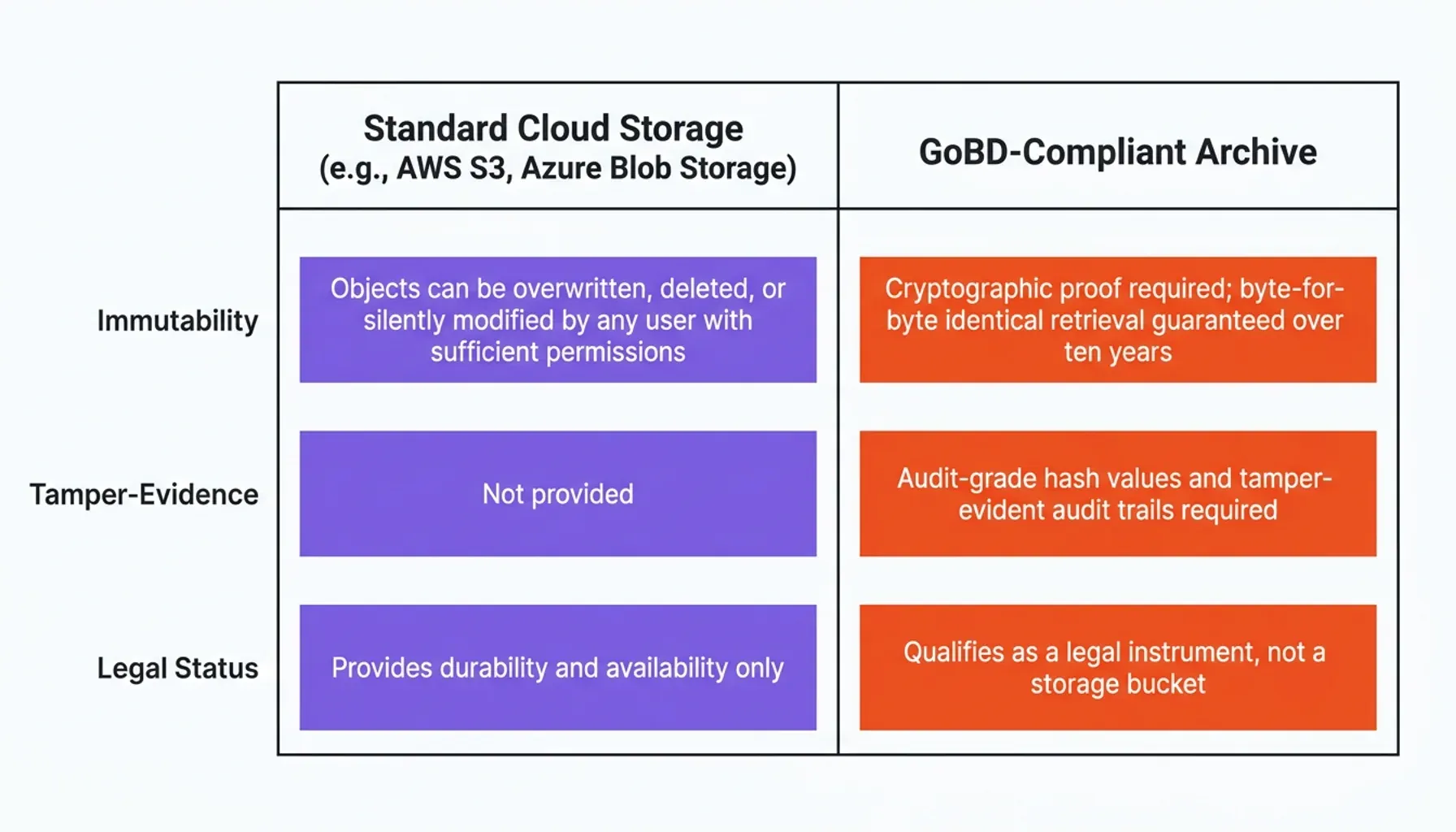
That carries a consequence most software vendors underestimate: the archive is now a legal instrument, not a storage bucket.
Uploading invoice files to AWS S3 or Azure Blob Storage does not make a compliant e-invoice archive. Those services give you durability and availability. They do not give you immutability in the legal sense. Any user with the right permissions can overwrite, delete, or silently modify a cloud storage object. Under GoBD guidelines, that is a disqualifying flaw. The archive has to guarantee that a document stored today is byte-for-byte identical when it's pulled in ten years.
The stakes here are not abstract. Enterprise and mid-market buyers, the exact customers ERP vendors fight over, now treat archiving compliance as a standard due-diligence checkpoint in procurement. A vendor who can't demonstrate GoBD or GeBüV conformance gets cut before the demo. Non-compliance isn't a risk to manage. It's a deal-breaker.
So before any build-or-buy math, understand what a GoBD-compliant archive actually requires. That's the entry ticket.
What the Law Demands (in Three Sentences)
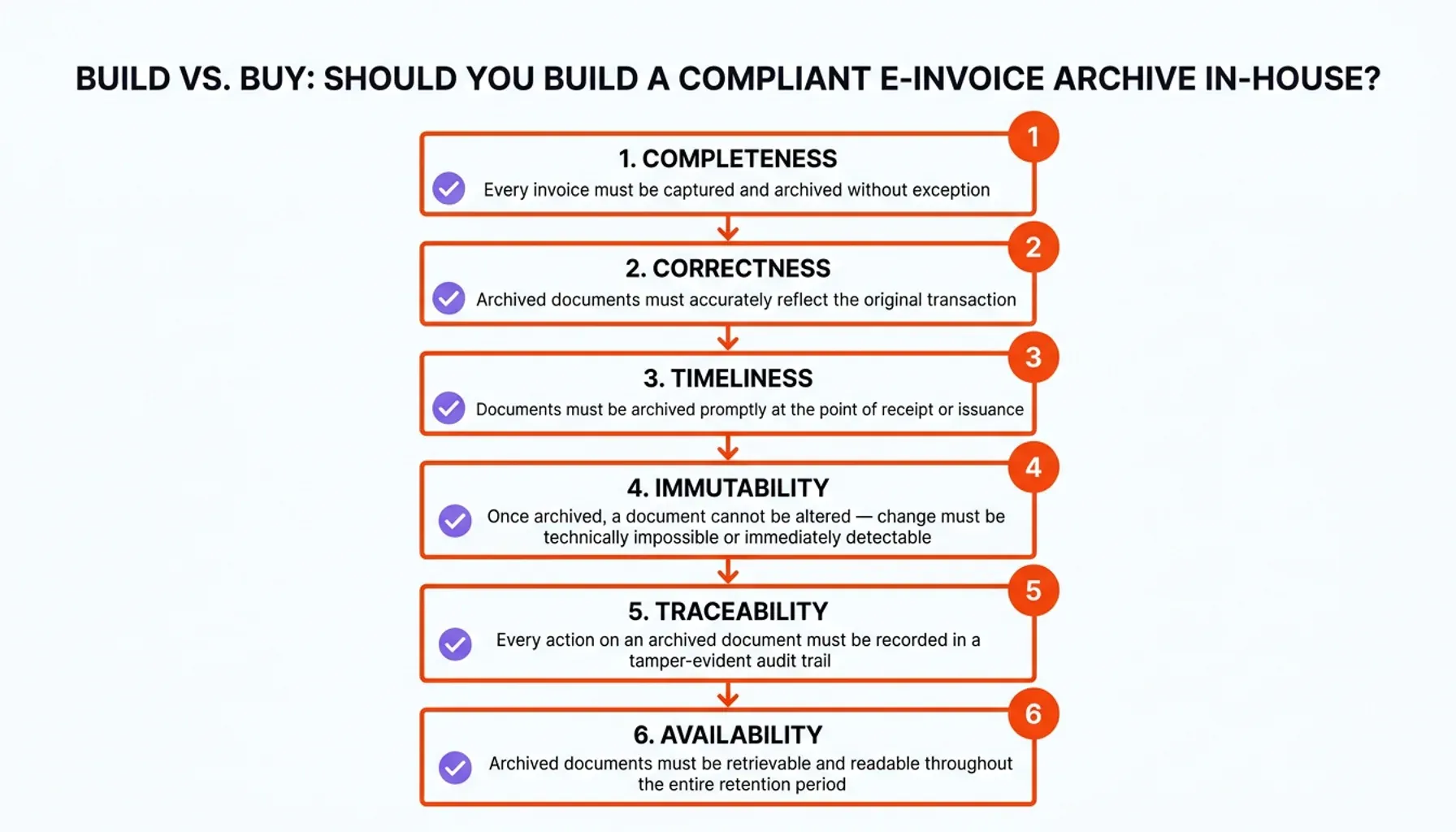
Here's the whole regulatory burden, compressed. In Germany the GoBD requires that every invoice be captured completely, archived promptly, kept readable for the full retention period, and rendered tamper-proof through technical means rather than a policy promise, with a tamper-evident audit trail recording every access, migration, and format conversion. In Switzerland the GeBüV and KRM regime sets parallel demands but runs through its own KRM certification pathway that Swiss enterprise buyers treat as a procurement prerequisite. Retention sits at ten years in both countries (and 5 to 10 across the EU, depending on the country) which is the real point for a build team: you are signing up to keep this system legally admissible for a decade, not shipping a feature once.
That last clause is where in-house builds quietly fail. A document is legally admissible only if its integrity can be proven by objective means, not by your assurance. That distinction drives everything below.
The Allure of the In-House Build: Control vs. Opportunity Cost
The argument for building internally is almost always the same: "We already have the data. We have engineers. How hard can it be?"
Call it the Developer-Ego Trap. It's expensive, and the price tag hides in the years nobody budgets for.
GoBD and GeBüV are not API specs. They're legal frameworks with interpretive edges that shift through tax-court rulings, auditor guidance, and regulatory clarifications. Building a system that passes an initial internal review is achievable. Keeping that system conformant through amendments, new format requirements, and third-party audits over five years is a different animal entirely.
The total-cost-of-ownership picture is where leadership teams flinch:
- Year 1 — Build. Six to eighteen months of senior engineering time, plus legal review and QA for the edge cases. For a mid-market ERP vendor, two senior engineers plus fractional legal counsel realistically lands in the €250,000-€400,000 range before a single invoice is archived in production.
- Years 2-3 — Maintain. Regulatory updates, new format support (ZUGFeRD vs. XRechnung, Factur-X), and internal audit prep. Budget a meaningful slice of one engineer's year, every year, indefinitely.
- Years 4-5 — Certify. If you pursue formal KRM certification for GeBüV, expect structured external audits, heavy documentation, and recurring conformance testing — a six-figure CHF commitment on its own.
Enterprise software research lands on the same uncomfortable number again and again: maintenance and compliance overhead eat 60 to 80 percent of a feature's lifetime cost. The shiny initial build is the smallest line item on the page.
Then there's opportunity cost, the Swiss-Army-Knife trap. Every sprint your team spends building an archive engine is a sprint not spent on what your product actually competes on. For an ERP vendor that edge is workflow automation, industry-specific logic, or UX. Archiving is a compliance utility. It's necessary, but it wins you no deals on its own merits. Build it in-house and your best engineers are pouring months into infrastructure your competitors can simply buy off the shelf. The math on monetizing a bought-in archive instead is its own subject, covered in the revenue strategy for embedded compliance.
What In-House Builds Actually Have to Get Right
Strip away the marketing and audit-proof archiving rests on a small set of hard guarantees: a document's integrity, its authenticity, and its long-term legibility, each provable to an auditor who trusts none of your internal systems — and the integrity and audit-trail mechanics plus the tamper-proof vs. merely-secure-storage distinction are exactly where most teams underestimate the depth.
The piece teams skip is legibility. A document archived today has to stay readable in fifteen or thirty years, which means format-migration strategies, metadata preservation, and documented rendering processes for formats that go obsolete. ISO/IEC 27001 frameworks expect organizations to plan for exactly this, and tax authorities expect to see that planning during an audit. None of it is hard in isolation. All of it together, sustained for a decade and survivable under hostile inspection, is the part that drains engineering teams.
There's also the blockchain-anchored timestamping angle worth flagging: anchoring a document's SHA-256 hash to a public chain produces a proof of existence no administrator and no database breach can quietly rewrite, which is precisely the kind of independent evidence auditors reward.
And understanding the full scope of what an ERP archive must deliver, technically and legally, is essential before you commit engineers to either path.
Risk Assessment: The Admin Threat
The sharpest compliance risk is also the most internal: your own database administrators. Auditors and procurement teams ask it plainly — can your own staff alter archived records? "Technically yes, but we have access controls" is not a passing answer under GoBD or GeBüV, because the bar is cryptographic immutability, not policy-based restriction, where even a superuser can't modify a record without the change being detectable by an outside party.
That single requirement reshapes the architecture, and it's the technical foundation of the OriginVault tamper-proof archiving approach for e-invoicing: a data seal that anyone can verify independently of the archive provider itself. Building that verification engine and pursuing independent certification in-house is a multi-year, multi-hundred-thousand-CHF commitment. Embedding a pre-certified layer turns that capital expense into a predictable operating cost and hands you the certification on day one.
What a White-Label Layer Hands You
The build-vs-buy framing hides something your customers feel acutely: they don't want a third-party archive bolted on. They want your archive.
A properly built white-label layer, like the OriginVault white-label invoice archiving layer, is invisible to the end customer. It runs under your brand, integrates through a single API, and ships the compliance layer as a native feature. In one paragraph, here's what that buys the buy side: brand sovereignty (no unfamiliar interface or second login eroding trust), multi-tenant isolation handled for you (each customer's data cryptographically sealed and logically separated without re-architecting your schema), and a real liability transfer — the specialist holds the certifications, maintains the cryptographic infrastructure, and absorbs each regulatory update, so your exposure narrows to the integration itself.
The deeper question of how that architecture and API actually work under your brand has its own home: white-label e-invoice archiving for software vendors. And if KRM-certified archiving is your wedge into the Swiss market, presenting it in a demo is a sales accelerant uncertified competitors simply can't match.
Decision Matrix: When to Build and When to Partner
Strip it down and build-vs-buy is a resource-allocation question. Here's the five-point checklist for CTOs and product managers sizing up their own capacity:
1. Do you have dedicated compliance engineering resources? Not general-purpose engineers. Specialists who hold tax law, cryptographic standards, and audit documentation in their heads at once. Without them, building runs slower and riskier than it looks on the estimate.
2. Can you sustain a five-year compliance maintenance commitment? GoBD and GeBüV evolve. E-invoicing formats evolve. Your maintenance obligation doesn't end at launch. It starts there.
3. Is archiving a core differentiator for your product? If your edge is workflow, industry logic, or UX rather than compliance plumbing, building archiving in-house misallocates your best engineers onto infrastructure that wins no deals.
4. Do your target customers require third-party certification? Selling into German or Swiss enterprise markets, the answer is almost always yes. Building toward certification with no defined pathway is a real risk, not a footnote.
5. What is the revenue opportunity of shipping faster? Every month of build time is a month without a certifiable compliance feature in your product. That's the one-line version — the full monetization model lives in the revenue strategy for embedded compliance.
For most ERP vendors, the honest answers point clearly toward partnership. The strategic move is to aim internal talent at the value proposition only your team can build, and embed specialized infrastructure for everything else.
Compliance isn't a differentiator. It's a prerequisite. The vendors who internalize that distinction ship faster, close more enterprise deals, and carry less regulatory risk than the ones who keep treating archiving as an engineering puzzle instead of a sourcing decision.
Choosing between a DMS, ECM, or dedicated archive system is its own consequential call, and understanding how these systems differ is groundwork worth laying before you finalize the architecture.
If your e-invoicing roadmap includes audit-proof archiving for German or Swiss enterprise customers, explore OriginVault's white-label compliant invoice archiving solution — a pre-certified, API-first compliance layer you embed under your own brand and ship in weeks, not years.
Thomas Hepp
Co-Founder
Thomas Hepp is the founder of OriginStamp and creator of the OriginStamp timestamp, which has set the standard for tamper-proof blockchain timestamps since 2013. As one of the earliest innovators in the field, he combines deep technical expertise with a pragmatic focus on solving real business problems, and is a recognized voice in blockchain security, AI analytics, and data-driven decision support. His work has earned multiple international awards, including a top Best Project recognition from ETH Zurich and the Swiss Confederation. He publishes regularly on blockchain, AI, and digital innovation.