
White-Label E-Invoice Archiving for Software Vendors
Jun 4, 2026

Thomas Hepp
Jun 4, 2026

Sending an e-invoice is the easy part. Proving it was never altered, for the next ten years, under your own brand, is where most software platforms quietly fall short.
Tax authorities across Europe are closing the gap between invoice transmission and legally compliant archiving. For ERP vendors, accounting platforms, and document-management providers, that gap is no longer a back-office inconvenience. It is a liability you carry on behalf of every customer you serve, and a revenue line most of your competitors have not noticed yet. White-label e-invoice archiving is how you turn the first into the second.
The Shift from Passive Storage to Mandatory E-Invoicing Compliance
The regulatory pressure is real and it is accelerating. The VAT in the Digital Age (ViDA) reform, driven by the European Commission's VAT agenda, pushes the EU toward mandatory structured e-invoicing by 2030. Germany already requires businesses to accept structured invoices as of January 2025, and France, Italy, Poland, and Belgium are each rolling out their own mandates on staggered deadlines with retention windows of seven to ten years. The full sequence is laid out in the EU e-invoicing mandate timeline through 2030; for software vendors the takeaway is blunt: e-invoicing is becoming infrastructure, and so is keeping the invoices.
Here is the part most vendors underestimate. Sending a structured invoice and retaining it are two different obligations. Encrypted cloud storage is not compliant archiving — a file in an S3 bucket can be rewritten by any administrator with access, and an auditor knows it. What authorities want is immutable, audit-proof retention where tampering is mathematically detectable, not merely discouraged by an access policy.
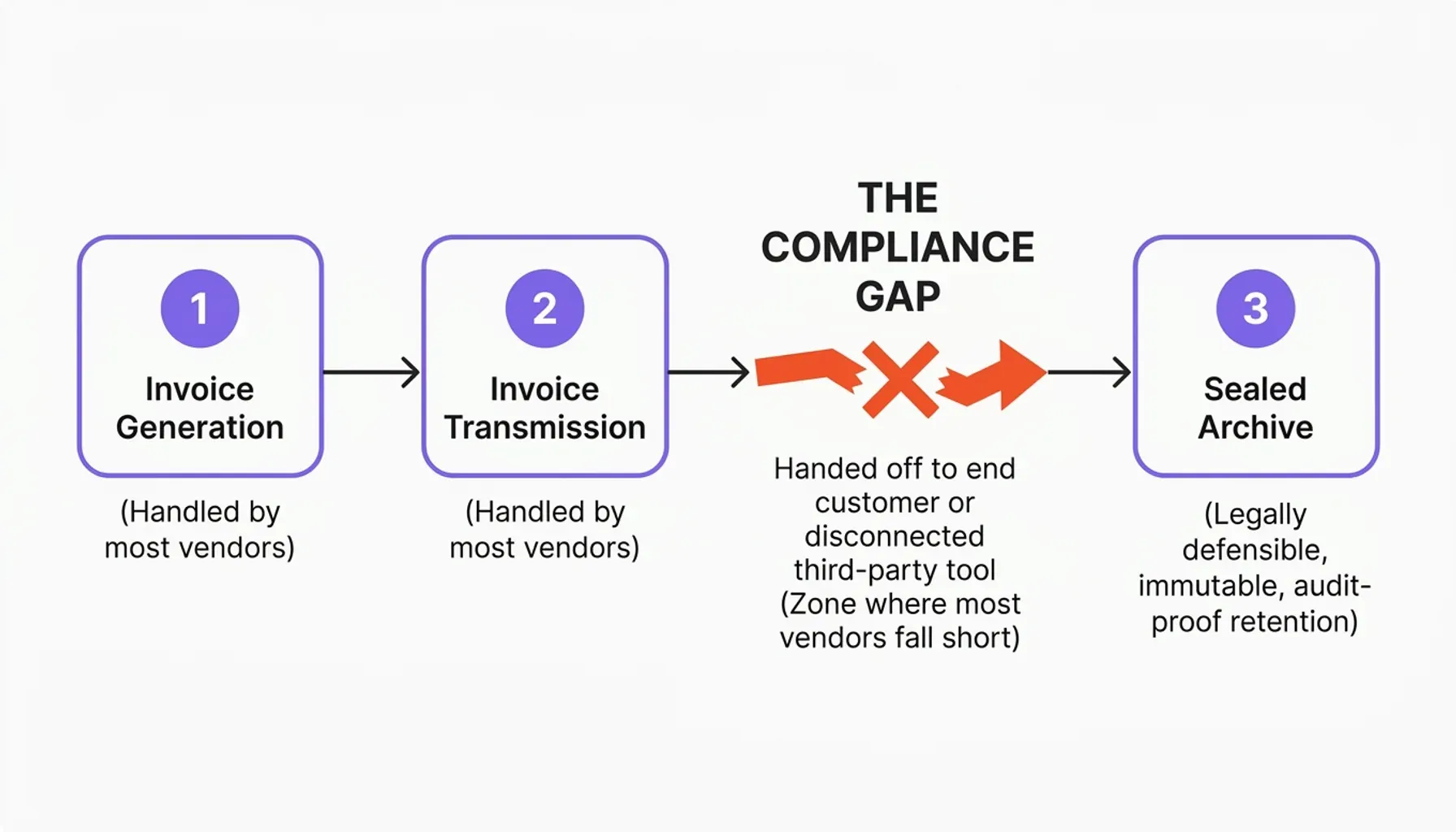
This creates what I call the compliance gap: the distance between the moment an invoice leaves your platform and the moment it is sealed in a legally defensible archive. Most software vendors live squarely inside that gap. They handle generation and transmission, then hand off archiving to the end customer or some disconnected third-party tool.
That handoff is the whole problem. It breaks the chain of custody, it pushes liability around without resolving it, and it leaves margin on the table. For an ERP vendor, an accounting suite, or an EDI platform serving thousands of end customers, owning the document from generation to sealed archive is both a compliance obligation and a genuine moat. The vendors who close this gap first own the stickiest, highest-margin layer of the entire workflow.
Why Software Vendors Are Moving to White-Label Archiving Models
Most companies misread the business case. White-label e-invoice archiving is not, at its core, about compliance. It is about control, margin, and retention — compliance is just the door it walks in through.
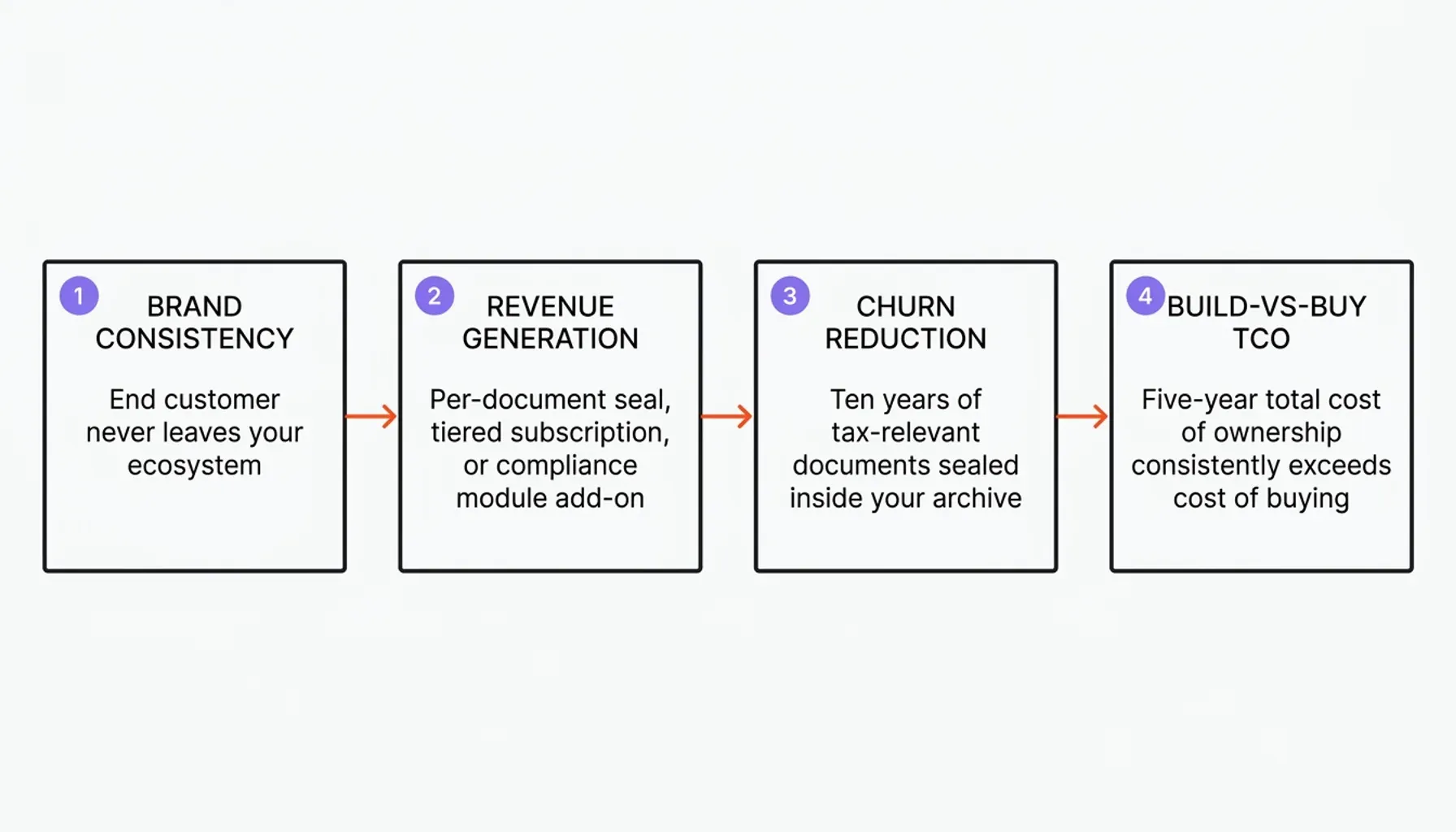
Brand consistency is the first driver. Route your users to a third-party archiving portal, even a reputable one, and you introduce friction the moment they hit an unfamiliar login. They authenticate against a stranger's system, see a stranger's interface, and quietly file the confusion under your product. White-label archiving closes that door. The end customer never leaves your ecosystem. Every archived invoice, every audit report, every retention certificate carries your name.
Liability transfer is the second, and it is the one that should change how you price the product. When an end customer's tax auditor asks for ten years of unaltered invoices, the question of who stands behind that archive becomes very concrete. Embedding a certified white-label layer moves the heavy part of that burden — the cryptographic integrity proof, the audit-defensible trail, the certification status — onto infrastructure that was independently audited to carry it. Your customer's auditor sees your brand on the certificate, while the underlying assurance rests on certified plumbing you did not have to build or vouch for alone. Be precise about what actually transfers: the technical and procedural integrity guarantees of the archive transfer to the certified provider, and the certification status flows through to your end customer. What does not transfer is the end customer's own bookkeeping correctness, their retention-policy decisions, or their statutory duty to produce records on request. You are transferring the hardest, most specialized part of the defense, not absolving anyone of keeping honest books.
Revenue generation is the third driver. Archiving has historically been a cost center, something vendors swallow to stay competitive. The white-label model flips it into a product line. The infrastructure cost is largely fixed; the revenue scales with your installed base. For a vendor with 10,000 active end customers, even modest per-tenant pricing produces a meaningful recurring margin line — more on the exact mechanics below.
Churn reduction is the fourth. Compliance features create switching costs that raw functionality never will. A customer with ten years of tax-relevant documents sealed inside your archive does not casually migrate. The archive becomes a retention mechanism — not through cynical lock-in, but through genuine, hard-to-replace utility.
Then there is the build-vs-buy question, which is where most vendors land on the buy side. Building a certified, audit-grade archive in-house means cryptographic engineering, legal expertise across several jurisdictions, and never-ending certification maintenance — so most teams buy the layer instead of bleeding roadmap into it. The full five-year total-cost-of-ownership case is worked through in the build-vs-buy analysis for compliant e-invoice archiving; for the purposes of this article, the verdict is enough.
For vendors evaluating that decision, OriginVault's white-label invoice archiving layer is a concrete reference point: a single API integration that delivers audit-ready, blockchain-sealed archiving under your own brand.
Technical Architecture: One API Call, No Crypto on Your Side
For a software vendor, the technical story is mercifully short. At the point your pipeline finalizes an invoice, it makes one REST call. The service generates a SHA-256 hash of the invoice and anchors that hash to a public blockchain, so the resulting proof is independent of your storage, your platform, and the customer's IT environment — the document can live anywhere, while its blockchain-anchored tamper-evidence lives somewhere nobody can quietly rewrite. The mechanics of why that beats encrypted storage — the difference between mathematical and merely administrative integrity, the auditor's view of who can write to a file — are covered in depth in the guide to tamper-proof archiving versus secure storage. The vendor-facing payoff is the part that matters here: one REST call, no cryptography to build, maintain, or certify on your side.
What Exactly Gets Hashed? The Multi-Tenant Ingestion Trap
The archive has to ingest the structured formats your customers actually send — XRechnung, ZUGFeRD/Factur-X, UBL, CII — natively. The definitions and trade-offs of each live in the EN 16931 standard explainer and the XRechnung-versus-ZUGFeRD comparison; what matters for a white-label layer is a question almost no demo answers: what exactly gets hashed?
This is where a surprising number of implementations quietly break. ZUGFeRD and Factur-X are hybrid files — a human-readable PDF wrapped around a structured XML payload. If your ingestion pipeline "normalizes" them to flat PDF for consistency before hashing, you strip the embedded XML. The hash then faithfully certifies an incomplete document: you can prove nobody touched the PDF, but the machine-readable data an auditor's system needs is simply gone. A properly architected archive ingests the original format intact, hashes the complete file including every metadata layer, and stores both the canonical binary and its integrity proof. Any conversion for display happens in a separate rendering layer — never on the archived original. In a multi-tenant context, where you are making this promise on behalf of thousands of customers at once, that single design decision is the difference between an archive that survives an audit and one that fails it silently.
Multi-Tenancy and Provisioning at Scale
Embedding archiving into a platform is not a one-to-one integration. It is a one-to-many problem. A vendor serving 15,000 end customers needs a layer that provisions, isolates, and manages thousands of distinct tenant environments automatically, with no human in the loop.
Make it concrete. Picture a mid-sized German ERP vendor — call them VendorX — whose enterprise client, a manufacturer with €200M in annual revenue, gets audited by the Finanzamt in 2027. The auditor wants ten years of outbound invoices in machine-readable form, plus proof that none were altered after issuance. Here is exactly where VendorX's stack breaks:
- Tenant isolation fails the audit-trail test. VendorX kept every customer's invoices in one shared S3 bucket, separated by folder prefix. The auditor asks who else had write access. The honest answer — platform admins, DevOps, a third-party backup service — is not an answer you want to give a tax authority.
- Format conversion destroyed the structured data. VendorX normalized incoming ZUGFeRD invoices to PDF/A on ingestion "for consistency." The embedded XML is gone, the automated extraction the auditor's system expects cannot run, and manual review of 40,000 PDFs is suddenly on the table.
- The audit log is not tamper-proof. VendorX logged document events to a relational database. The auditor wants evidence the log itself was not modified. There is none — the log lives in the same infrastructure platform admins can write to.
- Retention certificates carry the wrong brand. VendorX outsourced archiving to a provider the client never heard of. Now the auditor is asking why the compliance certificates reference a stranger. That is a credibility problem, not a technical one.
None of these failures are exotic. They are the default outcome when archiving is bolted on instead of built in — and every one is preventable with a properly architected white-label layer.
Tenant provisioning via API is the operational core. Onboard a new end customer and the archiving environment spins up automatically: a dedicated storage partition, its own retention policies, its own audit log, its own compliance certificates. This has to complete in seconds, not days.
Data isolation is non-negotiable. One tenant's financial records must never be reachable — even theoretically — by another tenant or by platform administrators. That demands strict logical separation at the data layer, enforced by ISO/IEC 27001-aligned access controls. The AES-256 data seal in a well-built system means even the infrastructure provider cannot read or alter a document without leaving detectable evidence. That is not a marketing line; it is an architectural property you can test.
Scale for high-volume environments is the last piece. EDI providers and large ERP platforms push millions of invoice transactions a month. The archiving layer has to absorb burst volumes without degrading, hold hashing and anchoring latency steady, and scale horizontally without a redesign. Benchmark against your peak, not your average.
Audit-Grade Compliance and the Certification You Inherit
Compliance is not a checkbox. It is a set of specific, enforceable requirements an archive must satisfy to stand up in front of a tax authority — and for a white-label vendor, the interesting question is not just what the rules are, but whose certification answers for them.
In Germany, end customers must meet GoBD: invoices stored in their original format, machine-readable, indexed, and protected by a tamper-proof audit trail for the full retention period. The complete requirement set — original-format rule, ten-year window, Verfahrensdokumentation, machine-readability — is detailed in the guide to GoBD-compliant e-invoice archiving. For a vendor, the point is simply that your customers are on the hook for it, so your archive had better satisfy it by default.
This is where certification inheritance becomes the heart of the white-label thesis. GeBueV (Switzerland) governs audit-proof bookkeeping for Swiss businesses, and it expects archiving systems to hold KRM certification — an independent, audited attestation (from Switzerland's KRM body) that a system genuinely meets the technical and procedural bar for compliant retention, rather than just claiming to. KRM certification is not self-declared; it is verified by a third party. OriginVault holds KRM certification for GeBueV compliance, which means an ERP vendor embedding it inherits that certification status for its end customers. You did not pass the audit yourself — you embedded infrastructure that did, and the assurance flows downstream to every tenant on your platform.
The audit trail is where weak implementations die. Every event in a document's life — ingestion, retrieval, export, an attempted deletion, a retention-policy change — has to be logged with a timestamp that is itself tamper-proof. If the log can be edited, it is not an audit log. Blockchain-anchored event logs settle this: each entry is hashed and anchored, so any retroactive edit becomes detectable.
White-labeling the compliance certificate is the element vendors overlook most. When an end customer's auditor asks for proof of compliant archiving, the response should come from your platform, on your letterhead — not from a third-party name the auditor has never encountered. A properly white-labeled layer issues compliance certificates, audit reports, and retention confirmations under your brand, while the certified infrastructure underneath carries the technical weight. From the end customer's chair, that is what professional-grade compliance looks like: their trusted vendor stands in front, and a KRM-certified engine stands behind.
The Economics: Per-Document Seals, Modules, and Attach Rate
Once the infrastructure cost is fixed, the white-label financial model is refreshingly simple — and it is distinct from the general "monetize compliance" case, because here you are selling into an installed base you already own.
Pricing falls into two structures. A per-document seal charges a fee for each sealed invoice — fractions of a cent at scale, with real margin once it is multiplied across millions of monthly transactions. A tiered compliance module charges end customers a flat monthly or annual fee regardless of volume. Most vendors run a hybrid: a base subscription with a bundled document allowance, plus overage above the threshold. The right mix depends on your customers' invoice volumes — a high-throughput EDI tenant and a small accounting client should not sit on the same curve.
Attach rate is the number that decides the business. Take your active end customers, apply a conservative attach rate for the compliance module — typically 40 to 60 percent in markets with live e-invoicing mandates — and multiply by the module price. Subtract the fixed infrastructure cost. The remainder is new, high-margin recurring revenue that needs no fresh sales motion: it sells through the product your customers already use. Because the seal rides on an existing relationship, your customer-acquisition cost on this line is close to zero, which is precisely why the white-label attach economics beat selling a standalone archiving SKU. The broader monetization argument — turning compliance into a deliberate revenue stream across EDI and accounting platforms — is made in full in the revenue-strategy guide for e-invoicing archiving.
Selling it upward means translating capability into risk at the end-customer's C-level. The question that lands is not "how does blockchain timestamping work?" It is "what happens when an auditor asks for ten years of invoices and you cannot prove they were never altered?" Penalties, legal exposure, a failed audit — that is the value proposition. The seal is not a feature; it is risk you delete.
Automated retention policies add a quieter economic benefit. A system that enforces retention windows on its own — flagging documents for deletion the moment their legal window closes — trims long-term storage overhead without manual babysitting and keeps you from accumulating data you are no longer required, or allowed, to hold.
Building the Defensible Layer, Not the Best Invoice Generator
The e-invoicing rulebook of 2025 is not the rulebook of 2027, and regulation is moving faster than most product roadmaps. A few concrete forces are worth tracking.
Peppol is becoming the default for cross-border structured exchange, mandated or strongly encouraged across the EU, Australia, Singapore, and New Zealand. A platform that handles Peppol-formatted invoices needs an archive that ingests, hashes, and seals those formats natively rather than converting them and risking metadata loss — the same ingestion trap described above, surfacing again where audits actually happen and demos never do.
Data sovereignty is a hardening requirement, especially in the DACH region. Swiss-based infrastructure paired with cloud-agnostic deployment — AWS, Azure, or on-premises — lets vendors meet customer data-residency rules without re-architecting. For anyone serving regulated industries like healthcare, financial services, or public administration, that flexibility is not a nice-to-have.
Automated regulatory monitoring is emerging as the next compliance layer. As mandates multiply and retention rules shift, platforms that can detect a relevant change and translate it into a configuration update will pull ahead of those still tracking it by hand.
The vendors who lead the next decade of ERP and accounting software will not be the ones with the slickest invoice generator. They will be the ones who built the most defensible, most integrated, most trusted compliance layer around it. Moving from plain document storage to a high-integrity, white-labeled archive is not a someday project — it is the work that decides who keeps their customers when the auditor calls.
Choosing between a document-management system, a full ECM platform, and a dedicated archive is its own strategic call, worth thinking through before you commit to an architecture; the comparison of DMS, ECM, and archive approaches is a useful map if you are still drawing your stack.
If your platform sends invoices but does not yet seal them with legally defensible, blockchain-anchored proof, explore OriginVault's white-label e-invoicing archiving solution and close the compliance gap — under your own brand — before your competitors do.
Thomas Hepp
Co-Founder
Thomas Hepp is the founder of OriginStamp and creator of the OriginStamp timestamp, which has set the standard for tamper-proof blockchain timestamps since 2013. As one of the earliest innovators in the field, he combines deep technical expertise with a pragmatic focus on solving real business problems, and is a recognized voice in blockchain security, AI analytics, and data-driven decision support. His work has earned multiple international awards, including a top Best Project recognition from ETH Zurich and the Swiss Confederation. He publishes regularly on blockchain, AI, and digital innovation.