
Turn E-Invoicing Compliance into a New Revenue Stream
Jun 4, 2026

Thomas Hepp
Jun 4, 2026

The E-Invoicing Mandate Is Already Here. The Revenue Opportunity Isn't Obvious Yet.
Picture this: a mid-size ERP vendor in Stuttgart loses a long-standing manufacturing client. Not to a larger competitor, not on price, but to a niche compliance tool that offered GoBD-certified invoice archiving. The ERP vendor processed the invoices. The niche tool stored them compliantly. The customer decided the niche tool was the more essential relationship. The ERP vendor never saw it coming.
That scenario is playing out across Europe right now. Most software vendors treat e-invoicing compliance as a checkbox, a legal obligation to satisfy and move on from. That framing is quietly handing recurring revenue to someone else.
Behind every e-invoicing mandate comes a secondary obligation that most platforms ignore: long-term, audit-proof archiving. The vendors who fill that gap with a branded, scalable service will own a defensible revenue stream for years. The rest will keep watching their customers solve the problem elsewhere.
This article is about the money side of that decision: the market, the monetization models, and the unit economics that turn e-invoicing compliance into a real product line. The two adjacent questions, whether to build the archive yourself or buy it and how the white-label architecture actually works, each have their own home. Here we stay on the P&L.
From Regulatory Burden to Business Asset
The VAT in the Digital Age (ViDA) initiative is pushing the EU from voluntary to mandatory structured invoicing, with phased rollouts already live in Germany, France, and Italy. By 2028, B2B e-invoicing is a legal baseline, not a differentiator. The ViDA directive itself sets the real-time reporting backbone the national mandates plug into.
Here is the part most platforms underestimate: document exchange is only step one. The legal obligation doesn't end when the invoice is transmitted. It begins there. Every jurisdiction that mandates e-invoicing also mandates verifiable, long-term retention, and those retention periods run 7 to 11 years depending on the country.
This is the Compliance Gap: the space between what most EDI and accounting platforms offer (transmission and basic storage) and what the law actually requires (tamper-evident, audit-proof retention). Regulatory pressure doesn't just create compliance problems. It creates captive markets. When your customers are legally required to archive invoices in a specific way, and you already process those invoices, you hold a structural advantage no competitor can easily copy. The only question is whether you build a product around it or let a third party fill the gap.
Market Size, Growth Drivers, and the Revenue Opportunity
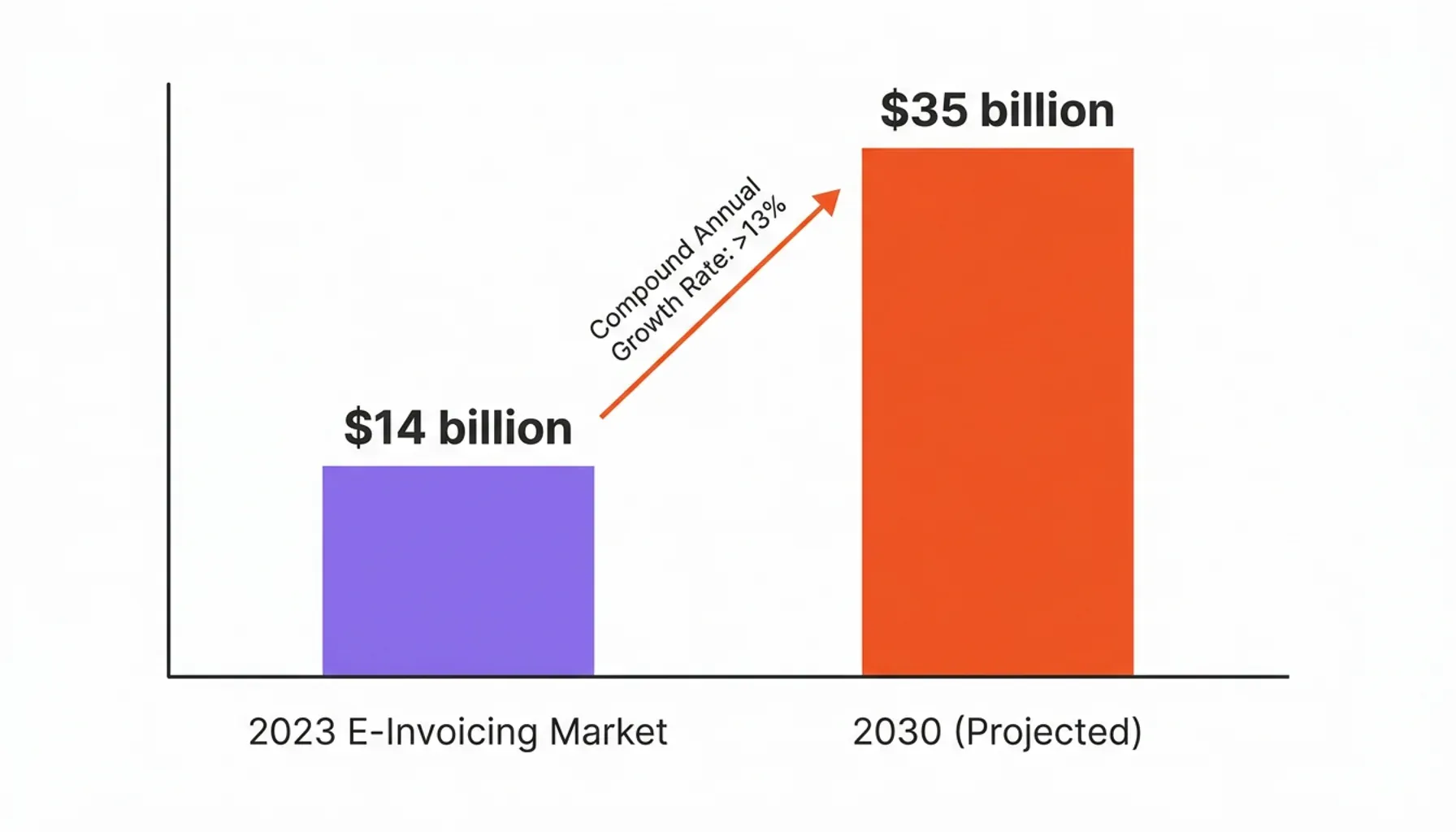
The numbers make the opportunity concrete. The global e-invoicing market was valued at roughly $14 billion in 2023 and is projected to exceed $35 billion by 2030, growing at a compound annual rate above 13%. That growth isn't driven by technology enthusiasm. It's driven by regulatory mandates that give businesses no choice but to adopt compliant systems.
Two forces are compressing the adoption timeline at once. ViDA sets a hard EU-wide deadline, while national mandates layer jurisdiction-specific rules on top of it (the country-by-country format differences are covered in the individual mandate guides). On top of that, cross-border transaction volumes keep rising, so more businesses face multi-jurisdiction obligations simultaneously.
For software vendors, this is a market where customers are actively shopping for compliant solutions and willing to pay for them. The question isn't whether demand exists. It's whether your platform captures it or cedes it to a specialist.
The Economics of Archiving: Why EDI Providers Leave Money on the Table
Standard EDI transmission is a commodity. Margins on per-transaction document exchange have compressed steadily as competition increased and infrastructure costs dropped. Most vendors compete on price, volume discounts, and integration breadth, none of which build durable revenue. The model is the problem: transaction-based revenue scales linearly with volume and collapses the moment a customer churns or slows down. There's no floor.
Archiving inverts that dynamic. Selling e-invoicing without archiving is like selling a printer with no ink subscription. You've handed the recurring revenue to someone else. The transmission is the printer sale, a one-time event. The archive is the ink, a relationship that lasts the entire retention period.
When you offer compliant retention as a service, you're not selling a transaction. You're selling a contractual obligation your customer cannot walk away from. Every invoice they process through your platform becomes a document that must live in a compliant archive for the next decade, generating storage and service revenue the whole time. And the archive itself becomes a sticky data asset: customers come back to it for audits, disputes, and financial reporting, which is a retention mechanism no feature update or discount can match.
The strategic case is simple to state: the archive is the product, and transmission is just the entry point. OriginVault's white-label invoice archiving infrastructure is built for exactly this transition, letting ERP and accounting platforms add a compliant, branded archiving layer without building it from scratch.
E-Invoicing Revenue Models and Monetization Strategies
Understanding the opportunity is one thing. Pricing and packaging it is another. Vendors who monetize compliance archiving well typically run one of three models, or a blend.
The three pricing models
Tiered subscription is the most common entry point. The base tier covers transmission; a compliance tier adds certified archiving, priced on document volume or storage. This fits SME-focused platforms where customers are price-sensitive but still need coverage.
Per-document retention fees suit high-volume enterprise customers processing thousands of invoices monthly. A small fee per document archived, with volume discounts at scale, ties revenue directly to usage and keeps the cost transparent.
Compliance-as-a-Service bundles wrap archiving, audit support, retrieval SLAs, and compliance reporting into one annual contract. This commands the highest average contract value and the strongest renewals, because customers are buying peace of mind, not storage. A single compliance contract is also far easier for enterprise procurement to sign off than a list of individual features.
The layer most vendors leave on the table is retrieval and audit services. When a customer hits a tax audit, they need fast, certified retrieval of specific documents, usually under time pressure. Priority retrieval, audit-ready export packages, and compliance reporting sold as premium add-ons create a high-margin stream that activates exactly when willingness to pay is highest.
What the math actually looks like
The unique value of archiving only lands when you put numbers on it, so here is one illustrative worked example. Take an SME accounting platform with 2,000 customers, each archiving an average of 400 invoices a year.
- Price the compliance tier at a modest €0.05 per document archived. That is €20 per customer per year on archiving alone, or €40,000 in new annual recurring revenue across the base, layered on top of the existing transmission fee.
- Because retention is legally mandated for ~10 years, that document doesn't churn out. A single year's intake of 800,000 archived documents keeps generating retrieval and storage value across the full retention window, not just the year it was created. The recurring base compounds as each new vintage of invoices stacks on the last.
- Now add the premium retrieval layer. If even 15% of customers face an audit or dispute in a given year and buy a €150 audit-ready export package, that's another €45,000, at near-software margins.
The churn delta is where the model really pays. SaaS benchmarks put healthy annual logo churn around 5 to 7%; once a customer has a decade of legally required, integrity-sealed invoices living in your archive, ripping that out becomes a migration project nobody wants to run mid-retention-period. Industry data on why retention beats acquisition for recurring-revenue economics is well established: shaving even two points off annual churn can lift customer lifetime value by 20 to 40%, and a sealed archive is one of the strongest switching-cost moats a compliance product can build.
Put those pieces together and the picture flips. A commodity transmission line worth a few euros per customer per year becomes a multi-year, multi-stream recurring asset whose lifetime value climbs with every invoice ingested. That is the difference between selling the printer and owning the ink contract. For a fuller model of how these tiers translate into a five-year projection, the whitepaper on digital archiving as a strategic advantage walks through the business case in depth.
Regulatory Compliance as a Revenue Driver
Most companies misread the relationship between regulation and revenue as purely adversarial. It isn't. Mandates create captive demand, and captive demand creates pricing power that market competition alone never delivers.
Look at it from your customer's side. A business facing a GoBD audit cannot negotiate its way out of the retention requirement, and it cannot defer the obligation to next quarter. It needs a compliant archive, and it needs one now. That urgency shifts leverage toward the vendor who can deliver certified compliance immediately, which is why regulatory-driven markets tend to command higher willingness to pay than feature-driven ones. Customers buying a productivity tool optimize for price. Customers buying compliance are managing legal risk, a completely different purchasing psychology.
The practical move is to frame archiving as risk mitigation, not storage. The conversation shifts from "how much does this cost?" to "what does it cost us not to have it?" A tax penalty, an audit failure, or a lost contract over weak documentation controls can dwarf the annual price of a certified archiving service. Vendors who treat compliance itself as the product and build their sales motion around that framing close larger deals at higher margins than those who lead with storage specifications.
What the Law Demands (and Why It Justifies the Premium)
You can sell compliance confidently only once you can name what "compliant" means. The short version: German GoBD requires invoices kept in their original format, protected against alteration, retrievable, and held for up to ten years; Swiss GeBüV mirrors that and adds strict record-integrity rules; ISO 27001 adds the security-management layer auditors expect. The detailed obligations for the German side live in the GoBD requirements for e-invoicing, and the Swiss equivalents in the guide to revisionssichere archiving of e-invoices. OriginVault holds KRM certification for GeBüV from the Kompetenzzentrum Records Management, so the infrastructure meets the Swiss standard out of the box.
The commercial point is what matters here: all three frameworks demand that records survive not just outside attack but internal modification, the kind of guarantee ordinary cloud storage cannot make. A cryptographic blockchain seal makes that integrity mathematically provable rather than an administrative promise, which is precisely why it lowers audit cost and underwrites premium pricing. Platforms that offer certified, tamper-evident archiving shift legal risk off their customers' books. That isn't a feature line. It's a trust proposition customers pay more for.
White-Label Archiving as a Premium Tier
Running the archive under your own brand is where the revenue story and the product story meet. When customers retrieve an archived invoice, they see your product name, your interface, your support team, never a third-party logo. That continuity matters commercially: brand ownership in compliance is itself a trust asset, and a consistent branded experience keeps the relationship, and the renewal, anchored to you.
That lets you position compliant archiving as a premium tier: higher monthly fees, longer contract terms, stronger renewals. Customers who archive with you are customers who stay. The architecture that makes this work, multi-tenant isolation, per-customer retention policies, branded onboarding, is the subject of the white-label e-invoice archiving vendor guide. And the decision of whether to stand it up yourself or license it, with the full cost and time-to-market comparison, belongs in the build-versus-buy analysis. For a monetization money page, the relevant takeaway is narrower: a branded archive turns a back-office obligation into a margin-rich product line you control end to end.
Integration: A Single API, Not a Rebuild
Adding a compliant archiving layer doesn't mean rebuilding your platform. In practice the archive integrates through a single compliant-retention API that hashes, seals, anchors, and retrieves each invoice in the background while your existing transmission flow runs untouched, so the end customer experiences it as a feature that simply works. That same API surface is where the workflow mechanics and the integration checklist live, so there's no need to reinvent them here.
One detail does carry commercial weight: cloud-agnostic deployment. Some enterprise customers insist on AWS, others on Azure, and a meaningful slice of the DACH market, especially healthcare and public administration, requires on-premises hosting for data sovereignty. Supporting all three without architectural compromise turns "where does our data live?" from a blocker into a selling point. Where this archive sits within a wider ERP archiving strategy and which structured format it ingests, ZUGFeRD or XRechnung, shapes the deployment conversation from day one. OriginVault's compliant invoice archiving layer covers AWS, Azure, and on-premises out of the box, with full white-label branding through that single integration point.
The Road to 2026: Preparing for Global Data Integrity Standards
The e-invoicing mandates landing between now and 2028 are the opening move, not the endpoint. They point toward a broader shift to digital sovereignty: the expectation that organizations can prove the integrity and provenance of their data independent of any single vendor. Global investment in digital sovereignty infrastructure shows consistent double-digit growth through 2030, driven by regulation, enterprise risk management, and AI systems that need auditable inputs. Vendors who add certified, tamper-evident archiving now lock in customers, build brand authority in compliance, and lay the foundation for whatever rules follow.
A quick gut check on your current archiving strategy:
- Can you prove document integrity cryptographically, independent of your own infrastructure?
- Does your system meet GoBD and GeBüV requirements, with documented certification?
- Is your archiving layer cloud-agnostic and deployable on-premises when required?
- Can you offer multi-tenant isolation for each end customer?
- Is your archive a branded product line, or an afterthought?
If the honest answer to any of these is no, the gap is already costing you revenue and creating legal exposure. Moving from basic retention to a certified, brandable compliance engine isn't a multi-year project. With the right infrastructure partner, it's a single integration.
Conclusion: Compliance Is the Product
The e-invoicing mandate is not a problem to manage. It's a market to own.
Every invoice your platform processes is a document that must be retained, verifiably, for up to a decade. That obligation doesn't go away. The only open question is whether your customers solve it inside your platform, generating recurring revenue for you, or outside it, with a competitor who then owns the stickiest part of the relationship.
The vendors who move first will have the archive, the brand trust, and the customer lock-in. The vendors who wait will be explaining to their customers why they need a different system for compliance.
The infrastructure exists. The certifications are in place. The API is ready. Explore OriginVault's white-label compliant archiving for e-invoicing and see what it takes to add a certified, blockchain-sealed archiving layer to your product, under your brand, on your infrastructure, generating revenue from day one.
Thomas Hepp
Co-Founder
Thomas Hepp is the founder of OriginStamp and creator of the OriginStamp timestamp, which has set the standard for tamper-proof blockchain timestamps since 2013. As one of the earliest innovators in the field, he combines deep technical expertise with a pragmatic focus on solving real business problems, and is a recognized voice in blockchain security, AI analytics, and data-driven decision support. His work has earned multiple international awards, including a top Best Project recognition from ETH Zurich and the Swiss Confederation. He publishes regularly on blockchain, AI, and digital innovation.