
Tamper-Proof vs. Secure Storage: What Auditors Really Require
Jun 4, 2026

Thomas Hepp
Jun 4, 2026

Auditors don't care how many firewalls protect your data. They care whether the document in front of them is byte-for-byte identical to the one that was created, and whether you can prove that without taking anyone's word for it. That single distinction separates secure storage from tamper-proof archiving, and it decides whether your organization passes or fails a high-stakes audit.
Why 'Secure' Does Not Mean 'Compliant'
Security and tamper-proofing get used interchangeably all the time. They are not the same thing, and the confusion quietly costs organizations audit failures, regulatory penalties, and lost deals.
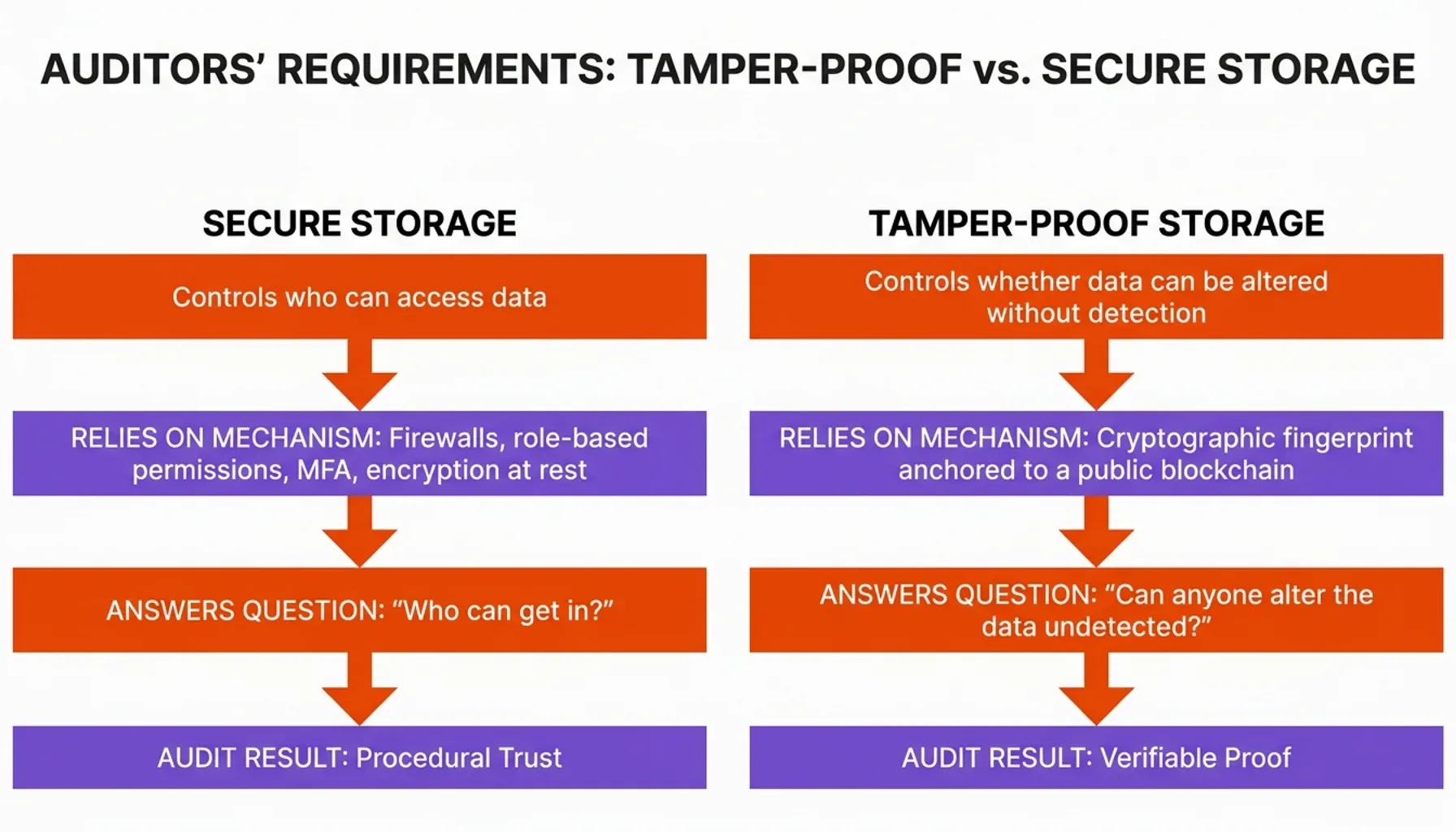
Secure storage controls who can touch the data. Firewalls, role-based permissions, multi-factor authentication, encryption at rest: these are access controls. They are necessary, but they answer exactly one question: who can get in?
Tamper-proof storage answers a different question: can anyone, including your own administrators, alter the data without it being detectable?
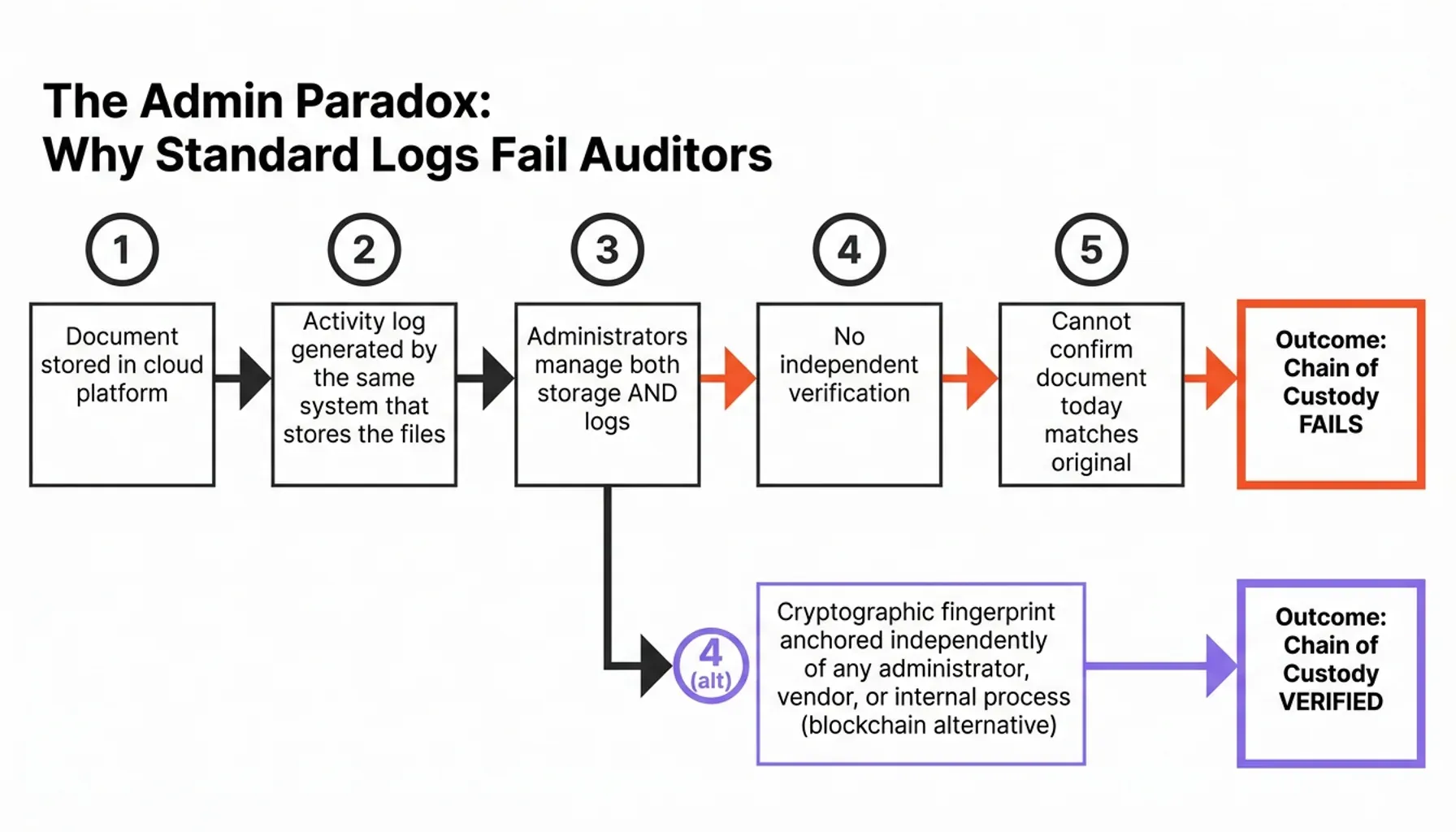
This is the Admin Paradox. In nearly every enterprise cloud environment, system administrators hold elevated privileges. They can modify files, roll back changes, and in some configurations edit the very logs that record those actions. To an auditor, that is a single point of failure. The integrity of the entire record rests on trusting the provider's internal controls, and trusting people is not the same as verifying data.
ISO/IEC 27001 and NIST SP 800-53 define strong controls for access management, but neither standard guarantees that a stored document is identical to the original. They govern process, not mathematical certainty.
The shift auditors increasingly demand is from procedural trust ("we have controls in place") to cryptographic verification ("here is proof this document has not changed"). A cryptographic fingerprint anchored to a public blockchain delivers that proof independently of any administrator, vendor, or internal process. It turns a trust assumption into a verifiable fact. That gap, between security controls and integrity proof, is where most organizations are exposed without knowing it.
The Auditor's Perspective: Moving Beyond Provider Logs
Put yourself in the auditor's chair for a moment. You're reviewing financial records for a German mid-size manufacturer under GoBD. The company hands you a folder of digital invoices stored in a major cloud platform. The platform's activity log shows no unauthorized access. Everything looks clean.
Here is the catch. The log was produced by the same system that stores the files. The administrators who manage the storage also manage the logs. Nothing about that arrangement independently confirms that the invoice you're looking at today matches the one that was originally issued. The evidence is self-referential, and self-referential evidence is exactly what an auditor is trained to distrust.
What an auditor actually asks for
In practice the auditor isn't asking "is your storage secure?" They are asking three sharper questions. Can you show me this record is unchanged since creation? Can I verify that without relying on your systems or your staff? And can you detect a change even if no one was caught making it? Standard system logs answer none of these convincingly, because every answer routes back through the provider that is also the custodian.
What auditors are really looking for is a verifiable chain of custody: documented, cryptographically provable evidence that a record has stayed identical from the moment of creation through every subsequent access. A chain of custody is not a log. A log says "no one we know of changed this." A chain of custody says "the mathematics show this is the same document, and anyone can check." The difference is independent verifiability, and it is the whole game in a contested audit.
Why WORM doesn't close the gap
WORM (Write Once, Read Many) hardware was historically the answer here. Physical WORM media blocks overwriting at the hardware level. But in a cloud-first, software-defined world, WORM gets operationally awkward fast. Nobody is couriering physical tapes to an auditor. They are running distributed, multi-cloud setups where hardware write protection simply does not translate.
Software-defined WORM exists, but it drags the Admin Paradox right back in: the same vendor providing the storage also enforces the write protection. An administrator with enough privileges can often override software WORM, and that override may never be logged independently.
The German audit standard for software product certification, IDW PS 880, explicitly examines whether a system can produce tamper-evident records that are verifiable independently of the software itself. The KRM (Kompetenzzentrum Records Management) guidelines in Switzerland apply the same scrutiny for GeBüV certification. Both frameworks converge on one point: the proof has to stand on its own, outside the application that created the record.
The corruption nobody flags
There is a quieter failure mode auditors have learned to probe for: silent data corruption. Bit rot, degrading storage media, and administrative changes that slip past monitoring can all alter a document without firing a single alert. Years later the file opens fine and looks plausible, yet it no longer matches what was created. Without an independent integrity check captured at the point of creation, there is no honest way to detect this after the fact. An access log will not catch it, because nothing about the access was unauthorized. Only a fingerprint taken at creation and checked later can surface it, which is exactly the assurance an adjudicator wants on the record.
Why Digital Signatures and Certificates Have an Expiry Date
Digital signatures get treated as the default proof of document authenticity, and they are strong, but only for as long as the underlying certificate infrastructure stays valid.
Here is the technical reality of Public Key Infrastructure (PKI): every certificate carries an expiry date, typically one to three years. Certificate Authorities (CAs) can be compromised, revoked, or simply shut down. When a CA is revoked or a certificate lapses, the cryptographic chain that validates a signature breaks, even if the document was legitimately signed years earlier.
For records that need 10+ years of retention, financial records, contracts, medical files, this is a real problem. The eIDAS Regulation (EU) No 910/2014 and ETSI standards for long-term validation (LTV) tackle it through timestamp renewal and signature re-anchoring, but those require active management, ongoing cost, and genuine operational complexity.
Re-signing documents at scale is expensive. It means maintaining PKI infrastructure, tracking certificate expiry across thousands or millions of records, and running renewal cycles without opening new holes. Miss one renewal, hit one compromised CA, and the legal validity of a signed document becomes contestable.
Cryptographic hashes anchored to a public blockchain solve this structurally. A SHA-256 hash of a document, recorded in a Bitcoin or Ethereum transaction, does not expire. The transaction is permanent. The hash is mathematically tied to the document's exact content at a specific point in time. No certificate to renew. No CA that can revoke it. The proof exists independently of any provider, indefinitely.
This is not a theoretical edge. For any organization keeping records beyond a five-year horizon, the cost of maintaining PKI validity versus anchoring a blockchain timestamp once at creation isn't close. The blockchain approach wins on cost, simplicity, and long-term reliability.
How Blockchain Timestamping Actually Works
The mechanics of blockchain timestamping are refreshingly plain, and that plainness is a feature.
When you submit a document for timestamping, a SHA-256 cryptographic hash is generated. The hash is a fixed-length string that uniquely represents the document's exact content. Change a single character and the hash changes completely. It reveals nothing about what the document says: it is a fingerprint, not a copy.
That fingerprint gets anchored to a public blockchain, Bitcoin, Ethereum, or both. The transaction lands in a decentralized ledger maintained by thousands of independent nodes worldwide. No single entity controls it. No administrator can rewrite it. The record is permanent.
To verify later, you reverse the process. Generate the SHA-256 hash of the current document and compare it to the hash recorded on the blockchain. Match, and the document is provably identical to what existed at timestamp time. No match, and it has been altered, which is equally provable. Crucially, any third party can run this check themselves, which is precisely the independent verifiability an auditor asks for.
This is what digital sovereignty looks like in practice. Your proof of integrity does not hinge on your storage vendor staying in business, on their internal controls, or on their logs. It rests on Bitcoin and Ethereum, two of the most heavily scrutinized, independently maintained ledgers in existence. Even if your software provider vanished tomorrow, the blockchain record stays valid and checkable by anyone with access to the public chain.
OriginStamp's approach has been validated through peer-reviewed academic publications and more than 12 years of production deployment. This is not experimental technology. It is infrastructure.
E-Invoicing: Why This Matters Now
E-invoicing mandates across Europe are why this proof layer suddenly matters to far more organizations than before. Once a structured electronic invoice is the legally binding record, "we stored a copy" is no longer good enough; you have to be able to prove the stored record is the one that was issued.
A couple of practical points keep this concrete. The relevant content is the structured data itself, not a printout of it, so a stored PDF is not automatically a valid e-invoice (is a PDF a valid invoice in 2026?), and the format you actually have to preserve depends on whether you are dealing with XRechnung or ZUGFeRD under EN 16931. On the retention side, satisfying GoBD archiving requirements and the broader integrity and audit-trail expectations comes down to one thing for the integrity layer: the structured record has to be sealed at the moment of receipt so that any later change is detectable. A storage bucket, even a secure one, does not do that on its own.
For ERP and software vendors, the cleanest way to deliver that sealing under your own brand is to embed a white-label compliant invoice archiving layer rather than build the cryptographic plumbing yourself. OriginVault's white-label invoice archiving handles the blockchain sealing at the point of creation so your team doesn't have to.
WORM vs. Encryption vs. Blockchain Sealing
Plenty of teams evaluate storage on security features alone, then discover mid-audit that security and integrity are two different things.
| Method | Verification Independence | Admin-Tamper Resistance | Long-Term Cost | Cloud Portability |
|---|---|---|---|---|
| WORM Hardware | Low (vendor-controlled) | Medium (hardware-level) | High (physical media) | Very Low |
| Software WORM | Low (vendor-controlled) | Low (admin override risk) | Medium | Medium |
| AES-256 Encryption | None (confidentiality only) | None | Low | High |
| Blockchain Sealing | High (public chain) | Very High | Low | Very High |
AES-256 encryption is often cited as the security measure for archived documents. As a confidentiality control it is excellent: it stops unauthorized parties from reading the content. But encryption does not prove integrity. An encrypted file can be decrypted, modified, and re-encrypted by anyone holding the key. The result is still encrypted, just no longer the original, and encryption alone offers no evidence either way.
Data sealing, pairing AES-256 encryption with a blockchain fingerprint, covers both dimensions at once. The encryption protects confidentiality. The blockchain hash proves integrity. Together they deliver what auditors actually require: a document that can't be read by unauthorized parties and can't be altered without detection.
Portability is the practical advantage teams tend to overlook. When an organization shifts data between AWS, Azure, and on-premises over a 10-year retention period, the integrity proof has to travel with it. A blockchain timestamp is infrastructure-agnostic. The SHA-256 hash and the transaction record stay valid no matter where the underlying data lives, so moving data never breaks the chain of custody.
The BSI Cloud Computing Compliance Controls framework recognizes this requirement, noting that compliance controls must stay effective across hybrid and multi-cloud architectures. Blockchain sealing satisfies it structurally, not through procedural controls that have to be re-implemented at every infrastructure layer.
What Auditors Will Demand Next
The regulatory direction across the DACH region and Europe is not subtle: requirements are tightening, not loosening. The question is not whether your archiving will face harder scrutiny over the next decade. It is whether you'll be ready when it does.
Moving from reactive security to provable integrity is mostly a shift in architecture philosophy. Security controls defend against known threats. An integrity layer makes the threat question almost moot: the data is mathematically provable regardless of what happens to the systems around it.
Automation is what makes this hold up under fieldwork. Human-managed archiving introduces error at scale, while a record sealed at creation, automatically and with no manual step, removes the inconsistent application and missed records that auditors love to find. ISO 27001:2022 leans harder on automated controls and continuous monitoring, which maps directly onto blockchain-sealed workflows. For software providers, the practical route is an API that performs this sealing and audit-trail generation at the point of receipt, rather than rebuilding core architecture every time the rules change; the design specifics are covered in compliant archiving APIs for retention.
Auditors are not going to get less rigorous. The organizations that treat tamper-proof integrity as infrastructure, rather than a compliance checkbox, are the ones that walk into audits confidently and keep enterprise customers. If you're an ERP or software vendor ready to embed audit-grade invoice archiving directly into your platform, OriginVault's white-label e-invoicing archiving is blockchain-sealed, GoBD-ready, and deployable under your own brand without rebuilding what you already have.
Thomas Hepp
Co-Founder
Thomas Hepp is the founder of OriginStamp and creator of the OriginStamp timestamp, which has set the standard for tamper-proof blockchain timestamps since 2013. As one of the earliest innovators in the field, he combines deep technical expertise with a pragmatic focus on solving real business problems, and is a recognized voice in blockchain security, AI analytics, and data-driven decision support. His work has earned multiple international awards, including a top Best Project recognition from ETH Zurich and the Swiss Confederation. He publishes regularly on blockchain, AI, and digital innovation.