
What Is Peppol? A Deep Dive into the Global E-Invoicing Network
Jun 4, 2026

Thomas Hepp
Jun 4, 2026

The Plumbing Behind Every Cross-Border Invoice
Every time a government agency receives a supplier invoice, or a multinational pushes thousands of purchase orders across borders, something invisible makes it work: a shared set of rules that lets any sender reach any receiver without a custom integration. That infrastructure is Peppol. If you're a software vendor, ERP provider, or finance leader operating in regulated markets, understanding it is no longer optional.
The Evolution of Global Trade: What Is Peppol?
Peppol, Pan-European Public Procurement Online, is not a platform, a cloud service, or a marketplace. It's a set of open specifications that define how electronic business documents are structured, addressed, and transported between trading partners. Any software or system that implements those specifications can participate in the network.
The initiative began as a European Commission-funded project to streamline public procurement. What emerged was something more durable: a governance framework and technical standard that now underpins B2B and B2G electronic document exchange across dozens of countries. In plain terms, Peppol makes it possible for any business to send a structured, machine-readable invoice, or any other procurement document, to any other business or government body in the network, without negotiating a custom technical agreement first.
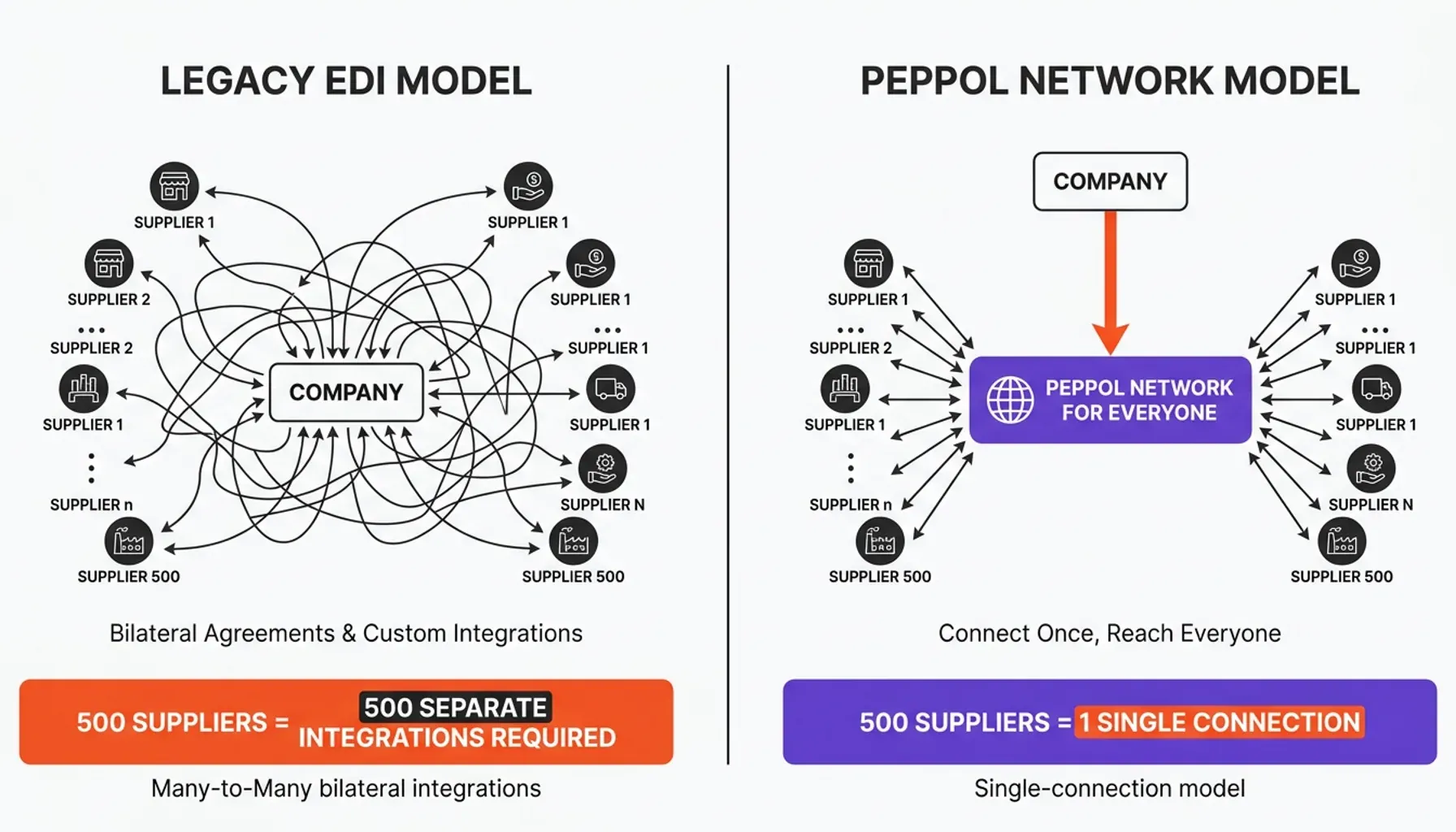
Before Peppol, the dominant approach was Electronic Data Interchange (EDI): a set of proprietary formats requiring bilateral agreements and custom integrations for every new trading partner. EDI works, but it scales poorly. A company with 500 suppliers potentially needs 500 separate integrations. Peppol collapses that complexity into a single connection.
The organization responsible for maintaining and evolving the specifications is OpenPeppol, a non-profit international association. OpenPeppol certifies access point providers, publishes the technical standards, and manages the governance processes that keep the network neutral and interoperable.
The fundamental promise of Peppol sounds almost too simple to trust: connect once, reach everyone. A business that connects to a certified Peppol access point can send compliant documents to any other participant in the network, regardless of their software, country, or bank.
That promise is what makes Peppol the fastest-growing e-invoicing infrastructure in the world.
The Four-Corner Model: How the Peppol Network Works
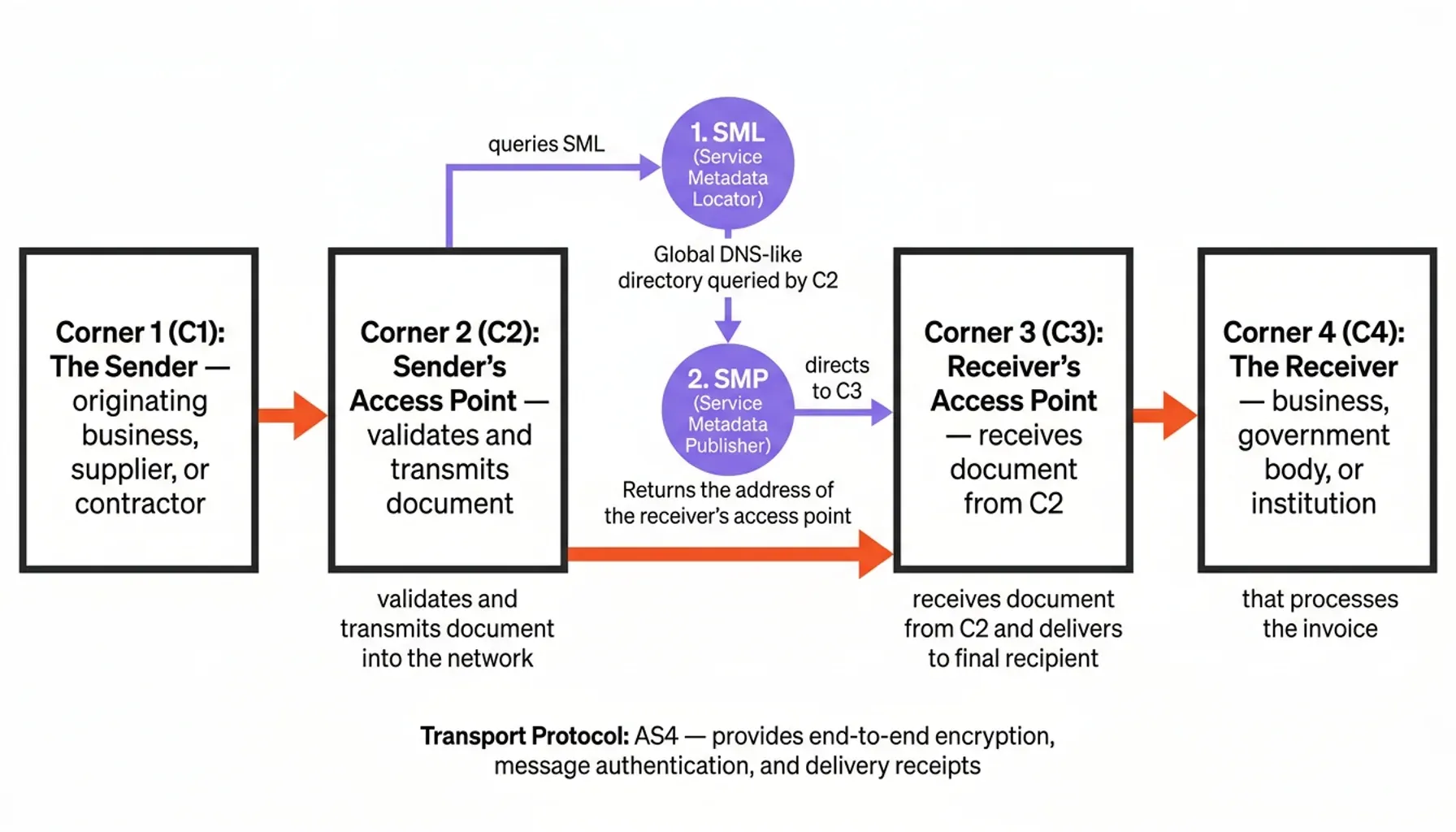
The operational logic of Peppol rests on a Four-Corner Model. If you're making any technical or product decision around e-invoicing infrastructure, this model is the place to start.
Corner 1 (C1), The Sender: The business or individual originating the invoice. This could be a supplier, contractor, or service provider using any compliant ERP or accounting system.
Corner 2 (C2), Sender's Access Point: The certified Peppol service provider that receives the document from C1, validates it against the relevant specifications, and transmits it securely into the network.
Corner 3 (C3), Receiver's Access Point: A separate certified provider that receives the document from C2 and delivers it to the final recipient. C2 and C3 are independent entities; they may be the same provider, but they need not be.
Corner 4 (C4), The Receiver: The business, government body, or institution that ultimately processes the invoice in their own system.
What makes this model powerful is the routing layer. Two components handle addressing: the Service Metadata Publisher (SMP) and the Service Metadata Locator (SML). When C2 needs to deliver a document, it queries the SML, a global DNS-like directory, to find which SMP holds the receiver's registration data. The SMP then returns the address of the receiver's access point (C3). No manual address lookup, no bilateral agreement needed.
A receiver's SMP registration record is more specific than a name and address. It pins the participant to an identifier scheme, for example 0088 for a GLN (Global Location Number) or 9930 for a German VAT identifier, then lists which document types and processes that participant can actually receive. That's why a sender can route a credit note with full confidence the receiver's system will accept it: the capability is published before the first message is ever sent.
The transport layer uses the AS4 messaging protocol, an OASIS standard that provides end-to-end encryption, message authentication, and delivery receipts. Every transmission is signed and logged. That isn't optional — it's a baseline requirement for all certified access points.
The practical result: one Peppol connection lets you transact with any network participant without negotiating a single bilateral technical agreement. The four-corner model eliminates the integration sprawl that made traditional EDI expensive to scale.
For ERP vendors, this architecture changes the product calculus significantly. Rather than maintaining dozens of EDI connectors, a single Peppol integration opens access to an entire ecosystem. If you're thinking about how document archiving fits into this picture, What Is an ERP Archive? Key Benefits & Requirements is worth a read.
Standardizing Communication with Peppol BIS 3.0
Transport solves the delivery problem. But what travels over that transport layer must also be structured so any receiving system can parse, validate, and process it automatically. That's the job of the Business Interoperability Specifications (BIS).
Peppol BIS 3.0 is the current standard document profile for cross-border invoicing within the Peppol network. It defines the exact data fields, validation rules, and syntax a compliant invoice must follow. The underlying document syntax is Universal Business Language (UBL), an XML-based standard maintained by OASIS, though UN/CEFACT CII syntax is also supported.
Peppol BIS 3.0 aligns with EN 16931, the EU's semantic standard for electronic invoicing. An invoice conforming to BIS 3.0 automatically satisfies the structural requirements for public procurement across EU member states, which is precisely why the two are designed to lock together.
The benefits of this standardization are concrete:
- Automated validation: Documents are checked against Schematron rules before transmission, catching errors before they reach the receiver's system.
- Reduced manual intervention: Structured, predictable data fields allow straight-through processing in ERP and accounting systems.
- Cross-border tax handling: BIS 3.0 includes VAT category codes and tax scheme identifiers that accommodate different tax regimes across member states.
- Currency consistency: The specification supports multiple currencies with explicit exchange rate fields, reducing ambiguity in cross-border transactions.
For software vendors building compliant invoice workflows, BIS 3.0 is not a technical detail, it's the foundation. Get it wrong and you're looking at documents that fail validation at the access point, rejected invoices, and manual remediation costs that wipe out the efficiency gains e-invoicing was supposed to deliver.
Access Points: Your Gateway to the Peppol Ecosystem
Most companies get this wrong. They assume that adding Peppol support to an ERP system means becoming an access point. It doesn't.
A Peppol Access Point (AP) is the technical intermediary that connects a business or software system to the Peppol network. To become a certified AP, a provider must pass an OpenPeppol certification process that validates their implementation of the AS4 transport protocol, SMP registration, and document handling procedures. An ERP system connects to an access point; it does not become one.
The AP sits between the business application and the network, handling transport, addressing, and security so the ERP doesn't have to.
For ERP vendors, the integration decision typically comes down to two paths:
- Partner with a certified AP provider: Integrate with an external AP via API, offloading network complexity while retaining control over the user experience and document generation.
- Become a certified AP: A more resource-intensive path, but one that gives full control over the network layer and potentially opens a new revenue stream by offering AP services to your own customers.
When evaluating AP providers, the relevant criteria go beyond the technical:
- Geographic reach: Which Peppol authorities does the AP support? A provider certified only in Germany cannot route documents to Australian Peppol participants.
- Scalability: Can the AP handle peak volumes without degraded delivery times?
- Interoperability guarantees: Does the provider support all mandatory document types, including credit notes and catalogues?
- Support for archiving integration: Can the AP deliver a copy of each transmitted document to an archiving system immediately upon receipt?
That last point is where most e-invoicing discussions stop, and where the real compliance risk begins. For software vendors building thorough solutions, understanding the right archiving system for your use case matters just as much as the transport layer itself.
The 'Fifth Corner': Where Peppol Stops
Here's the insight that catches teams off guard: Peppol solves delivery with real precision, but it says nothing about what happens to the invoice afterward. The four corners get the document from sender to receiver. They do not keep it.
Once an invoice has been transmitted and received, a separate legal obligation takes over: storing it in a compliant, tamper-evident form for the full retention period. Think of that as a "fifth corner" the transport model never covers. The mechanics are an entire discipline of their own, from the 10-year GoBD retention and immutability rules in Germany to how tamper-evident storage actually differs from ordinary secure storage. Both are governed by statutory standards such as Switzerland's GeBüV, and both sit outside the Peppol specification entirely.
For ERP and SaaS providers, that gap is also an opening. Customers who adopt Peppol for delivery still have to solve retention somehow, and a white-label archiving layer wired into the invoice workflow closes that gap before the customer feels it. Software vendors looking to turn this compliance requirement into a competitive advantage should read Compliance as a Revenue Driver: Archiving for SaaS Vendors, a detailed breakdown of how archiving capabilities translate into measurable revenue.
Global Adoption and the Future of Peppol
Peppol is no longer a European phenomenon. The specifications have been adopted and adapted across multiple continents, with each jurisdiction maintaining alignment to the core model while accommodating local regulatory requirements.
Australia adopted Peppol as its national e-invoicing framework in 2019, with the Australian Taxation Office mandating its use for government suppliers. Singapore's IMDA operates its own Peppol authority and has integrated e-invoicing into its national digital economy strategy. Japan and New Zealand have followed with their own Peppol implementations.
In the United States, the PINT (Peppol International) billing profile is under active development: a jurisdiction-specific adaptation of BIS 3.0 designed for North American tax and legal requirements.
The correlation between mandatory e-invoicing and Peppol adoption is not coincidental. As governments implement Continuous Transaction Controls (CTC), meaning real-time or near-real-time invoice reporting to tax authorities, they need a standardized transport layer. Peppol provides exactly that.
Beyond invoicing, the network is expanding into full digital procurement:
- Purchase orders and order responses
- Advance shipping notices
- Product catalogues
- Punch-out procurement integration
This expansion transforms Peppol from an invoicing network into a B2B document exchange infrastructure with much broader reach. For organizations focused on ESG reporting and supply chain transparency, structured digital procurement data becomes the foundation for accurate scope 3 emissions tracking and supplier due diligence.
The trajectory is clear: Peppol will become the default infrastructure for structured business document exchange globally, in the same way that SMTP became the default for email.
Why Peppol Connectivity Is Only Half the Job
Peppol removes one of the most persistent friction points in B2B commerce: the inability to send structured, machine-readable documents to any trading partner without a custom integration. The four-corner model, the BIS 3.0 standard, and the AS4 transport protocol together create a network that is open, scalable, and increasingly global.
But Peppol is a transport specification, not a compliance solution. Treat connectivity as the finish line and you inherit a retention problem the moment the first invoice lands, the gap that tamper-proof, audit-grade archiving exists to fill. The vendors who win the next decade of digital finance are the ones who treat the invoice journey as ending not at delivery, but at the moment a tax auditor asks for proof and the record holds up.
Explore how OriginVault's white-label invoice archiving solution gives software vendors a production-ready compliance layer they can embed directly into their Peppol-connected workflows, without building it from scratch.
Thomas Hepp
Co-Founder
Thomas Hepp is the founder of OriginStamp and creator of the OriginStamp timestamp, which has set the standard for tamper-proof blockchain timestamps since 2013. As one of the earliest innovators in the field, he combines deep technical expertise with a pragmatic focus on solving real business problems, and is a recognized voice in blockchain security, AI analytics, and data-driven decision support. His work has earned multiple international awards, including a top Best Project recognition from ETH Zurich and the Swiss Confederation. He publishes regularly on blockchain, AI, and digital innovation.