
KSeF Poland: A Guide to Mandatory E-Invoicing Compliance
Jun 4, 2026

Thomas Hepp
Jun 4, 2026

Picture your AP team on the morning KSeF goes mandatory. An invoice your ERP submits comes back rejected because one schema field is missing. That is not a technical glitch you can shrug off and resend later. With no KSeF identification number, the invoice has no legal standing in Poland, and without a legally valid invoice there is no enforceable payment claim behind it.
That is the reality Poland has built. Every domestic B2B transaction now passes through a government-controlled clearance node before it counts as a valid invoice. If your ERP or accounting platform was not designed for that node, the exposure is legal, not merely operational.
The system behind it is the Krajowy System e-Faktur (KSeF), run by the Polish Ministry of Finance, and it ranks among the most structurally demanding tax-digitization projects in Europe. It also slots into a wider European push: the VAT in the Digital Age (ViDA) reform, now adopted by the EU Council, is steering every member state toward real-time reporting and structured e-invoicing. Poland is simply moving faster than most.
How Poland Inverted the Invoicing Model
For decades, businesses issued invoices in whatever format suited them: paper, PDF, EDI. The tax authority saw the numbers later, in aggregated VAT declarations filed after the fact. KSeF flips that sequence. The government now validates each invoice at the moment of issuance, assigns it a unique identification number, and only then does the document carry legal weight.
That single change ripples through everything. Unstructured PDFs and paper invoices are being retired for domestic B2B trade. Every invoice has to be machine-readable, schema-validated, and routed through one national API. The ambiguity of informal invoice formats disappears, and so does the flexibility many legacy systems were quietly built around.
For ERP vendors and software providers, this is not an incremental release note. It demands new integrations, new data pipelines, and a fresh approach to compliant invoice archiving that reaches well past what most existing systems offer. The contrast with the old world is the whole point: validation happens up front, at issuance, instead of months later during an audit.
The KSeF Roadmap: Critical Deadlines for 2026 and 2027
The mandatory KSeF timeline has been revised more than once, so the current schedule is worth getting exactly right. Poland originally aimed for 2024, then postponed after stress testing and stakeholder consultations exposed technical instabilities in the platform. The revised plan prioritizes stability over speed, which is a sensible call given the scale of the rollout.
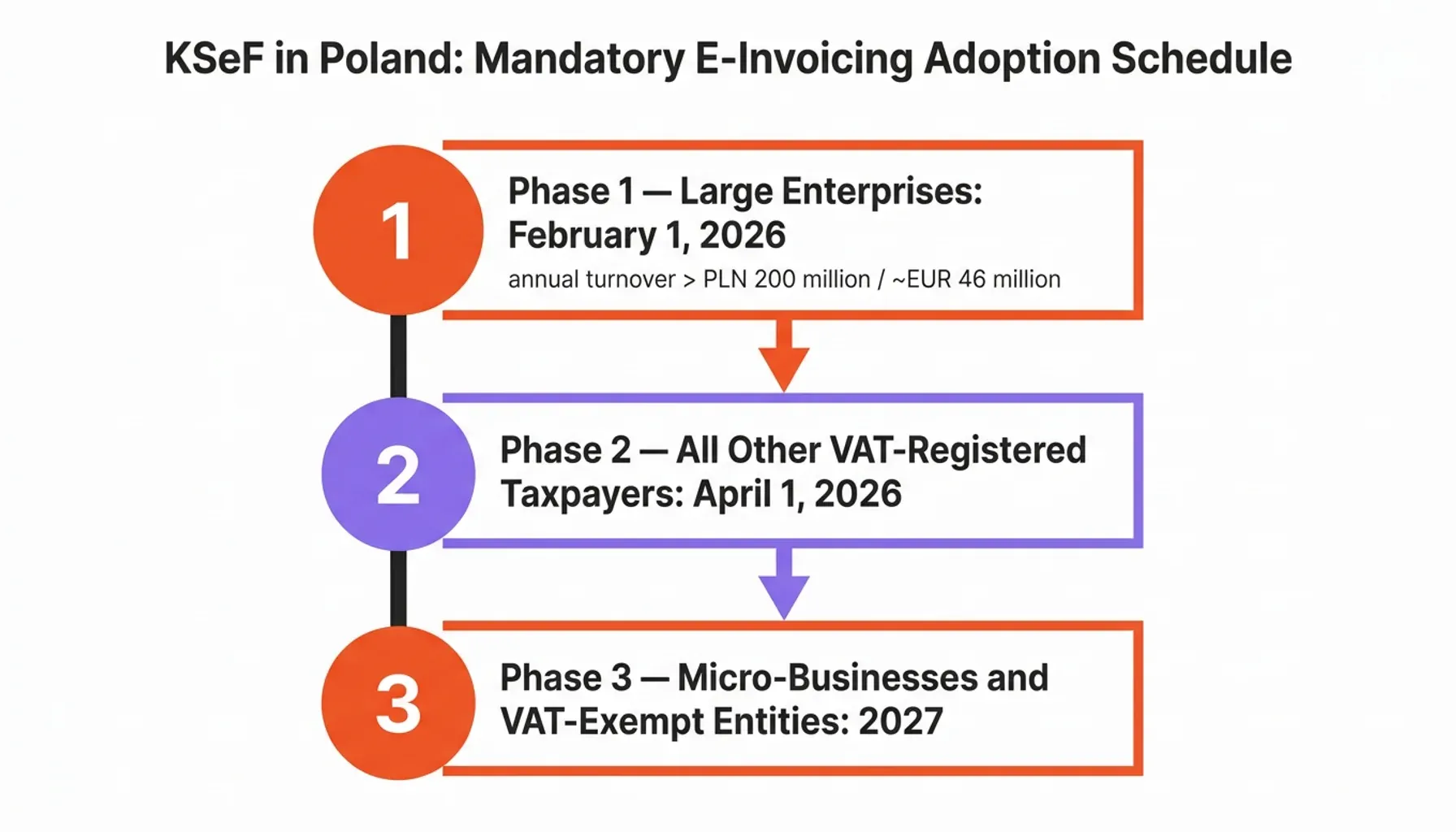
Here is where the mandatory adoption schedule stands today:
February 1, 2026 — Large Enterprises The first mandatory deadline applies to taxpayers whose annual turnover exceeded PLN 200 million (roughly EUR 46 million) in the preceding tax year. These are Poland's largest corporate invoicers, carrying the heaviest transaction volumes. Onboarding them first stress-tests the platform at full scale before smaller businesses are pulled in.
April 1, 2026 — All Other VAT-Registered Taxpayers Two months later, KSeF becomes mandatory for every remaining VAT-registered entity operating in Poland. This is the broad phase, and it reaches the overwhelming majority of businesses, from mid-sized manufacturers to small service firms.
2027 — Micro-Businesses and VAT-Exempt Entities The final phase extends KSeF obligations to micro-businesses and taxpayers currently exempt from VAT. This cohort tends to have the least technical infrastructure and the fewest resources to adapt, which is why the government granted it extra lead time.
Why the Postponement Matters
The delay from 2024 to 2026 was a recalibration, not a retreat. ERP integrators and tax-compliance teams had flagged real concerns about API reliability, data throughput under peak load, and the handling of edge cases in the FA(3) schema. The Ministry of Finance used the additional time to rebuild core components and republish updated technical documentation.
That gap handed businesses a valuable window. The ones who used it to audit their invoicing workflows, map their data to the FA(3) schema, and evaluate archiving solutions are now far better positioned than the ones who waited. The window is nearly shut, and there is no credible expectation of another delay. If you have not started your KSeF integration, you are already behind.
Poland is not acting alone, either. France's 2026 mandate, which also reaches German and other foreign suppliers, follows a similar centralized-clearance logic, and both countries are actively shaping what mandatory e-invoicing will look like across the EU.
Inside the FA(3) Logical Structure
Submit an invoice that does not conform to the FA(3) logical structure, and the KSeF API rejects it before it can ever receive a legal identification number. That single rule sits at the center of every Polish e-invoicing integration, and it is where most projects either succeed or quietly fall apart.
FA(3) is the XML schema defined and maintained by the Ministry of Finance, and its structured-document specification is published openly. It pins down the exact structure, field names, data types, and validation rules for every element of a Polish e-invoice, from seller and buyer identification (NIP tax numbers, addresses) through line-item detail, VAT rates, payment terms, and correction-invoice references. It is versioned, and the Ministry updates it periodically, which makes schema maintenance a standing operational commitment rather than a one-off task.
The move from human-readable layouts to machine-readable FA(3) XML is more disruptive than it first looks. A PDF invoice is built for a person to read; an FA(3) invoice is built for a system to process. Every field must map precisely. The kind of ambiguity a human reader resolves on instinct, an abbreviation in an address field or a non-standard date format, simply fails validation here, because the schema leaves no room for interpretation.
Mandatory vs. Optional Fields
FA(3) separates mandatory fields, which must be present and correctly formatted on every invoice, from optional fields that apply conditionally based on transaction type, VAT treatment, or business context. Getting that mapping right takes a thorough audit of your current invoice data and a careful translation of it into FA(3)-compliant structures.
The KSeF API Validation Flow
When you submit an invoice, the API runs a multi-stage validation: a schema-consistency check, business-rule validation such as VAT calculations, and taxpayer-registration verification. Only after all stages pass does the invoice receive its unique KSeF identification number, the legal proof of issuance. For vendors building connectors, rejection responses need to be logged, surfaced to users, and resolved without breaking downstream workflows.
Understanding FA(3) in depth also pays off for interoperability. Poland's structured format shares conceptual DNA with Peppol's model for standardized cross-border e-invoicing, even though the two systems operate independently.
Correction Invoices and Edge Cases
Correction invoices catch teams off guard with some regularity. FA(3) carries specific fields and rules for referencing the original invoice being corrected, and those references have to be exact. A correction invoice that fails to cite the original KSeF identification number correctly will be rejected outright. Fold the correction workflow into your integration testing from day one rather than treating it as an afterthought.
Offline Mode: What Happens When KSeF Is Down
The Ministry of Finance has defined an offline mode for periods when the platform is temporarily unavailable. In that mode, a business issues invoices using a locally generated offline token and then transmits them to KSeF once connectivity returns. The offline window is time-limited, so invoices issued this way must reach the platform within the defined period. Your integration has to handle that flow, including the re-submission logic and the reconciliation of offline-issued invoices against their eventual KSeF IDs.
The 10-Year Archiving Mandate: Beyond the KSeF Platform
Receiving a unique identification number from KSeF is the start of your compliance obligation, not the end. Polish law requires electronic invoices to be retained for at least 10 years, and that duty does not evaporate because a copy happens to sit on a government platform.
The KSeF platform is a clearance and validation gateway, not a long-term business archive. It is not built to serve as your primary retrieval system for historical invoices during internal audits, customer disputes, or tax inspections years after issuance. Government portals change, APIs deprecate, and access policies evolve, so leaning on portal access alone for a decade of invoice history carries real operational and legal risk.
In practice, KSeF gives you a clearance ID, not statutory, tamper-proof retention. You still need an independent archive that can produce a specific invoice years later in a legally admissible format, with proof that it has not been altered since issuance. That proof obligation, and why ordinary file storage in an S3 bucket or document-management system does not satisfy it, is covered in depth in our guide to tamper-proof versus merely secure storage and what auditors actually require. The short version for Poland: an auditor will not ask whether you have the file, but whether you can prove the file is unchanged, and only a cryptographically sealed archive answers that question.
Retention length itself varies widely across Europe. For a side-by-side comparison, the country-by-country e-invoice retention guide is a useful reference; Poland's 10-year requirement sits at the longer end of the spectrum. When a Polish inspection comes, the KSeF-specific point is narrow: auditors verify the KSeF identification number against your archived FA(3) XML, so your archive has to keep the two bound together and retrievable independently of the portal. The broader case for the three archiving pillars, original format, integrity, and a defensible audit trail, is laid out in our e-invoice archiving requirements and audit-trail guide.
Strategic Challenges for ERP and Software Vendors
For ERP vendors and accounting-software providers in the Polish market, KSeF is a compliance burden and a commercial opening at the same time. The teams that see both early tend to capture outsized market share.
The Integration Burden
Building a KSeF connector is not a weekend project. The FA(3) schema demands precise mapping from whatever internal invoice model your system uses. The API needs authentication, certificate management, and error handling that holds up under load. Schema versions shift, so the connector needs ongoing maintenance, all of it carried out while you keep shipping the features your customers actually asked for. Most vendors underestimate that running cost: a KSeF connector tracks regulatory updates, API changes, and schema revisions for as long as you operate in Poland, which is to say indefinitely.
Branding, Multi-Tenancy, and Differentiation
Your end-customers want KSeF compliance to feel native. They would rather their existing software handle the government API transparently, under the brand they already trust, than navigate it themselves. For a vendor, that means adding a KSeF connector plus a retention layer your customers expect to see under their own name, across many separate legal entities, each with its own NIP, invoice volume, and audit-trail requirements. The generic economics of running that as a multi-tenant, fully branded service, where the branding, tenancy model, and liability transfer become a competitive moat, are the subject of our guide to white-label e-invoice archiving for software vendors, and OriginStamp's white-label archiving infrastructure is built to carry exactly that load behind a single API. The KSeF-specific takeaway is simpler: buyers now ask compliance-first questions, including native KSeF support and provable invoice integrity, and vendors who answer with technical specifics win deals that feature-parity competitors lose.
Cross-Border Complexity
Multinational clients add another layer. A German parent with a Polish subsidiary has to ensure that subsidiary issues KSeF-compliant invoices for every domestic B2B transaction, even when the parent's ERP was never designed with Polish tax infrastructure in mind. The same pattern of mandates reaching foreign suppliers is repeating across Europe. Vendors who build flexible, jurisdiction-aware compliance modules will serve those clients far better than vendors who patch each country mandate as a one-off.
Operational Readiness: Preparing Your Business for 2026
With February 2026 close, readiness has shifted from planning exercise to execution priority. Here is a structured way to get a business ready for mandatory KSeF compliance.
Step 1: Audit Your Current Invoicing Workflows Before integrating with KSeF, map how invoices flow through your organization today. Trace every touchpoint: where invoices are created, what data fields are captured, how they are approved, and how they are stored. Identify manual steps, data gaps, and fields that do not map cleanly to the FA(3) schema. This audit surfaces the integration work ahead and heads off expensive surprises mid-implementation.
Step 2: Map Your Data to FA(3) Once you understand your current invoice model, perform a systematic mapping to the FA(3) logical structure. Confirm your system captures every mandatory field in the correct format, flag the optional fields that apply to your transaction types, and document the mapping formally. You will lean on that document for testing and for ongoing schema maintenance.
Step 3: Archive Each FA(3) Invoice in a Tamper-Evident, Independent Store For every invoice cleared through KSeF, seal the archived FA(3) XML with a tamper-evident integrity proof and keep it retrievable independently of the government portal. The mechanics of that sealing, and why it stands up to a tax inspection, are covered in the tamper-proof storage guide. Similar principles apply in Germany under the GoBD archiving framework, which is a useful reference point for what audit-proof retention looks like elsewhere in the EU.
Step 4: Train Your Teams Centralized clearance changes day-to-day work for finance and accounting staff. People who used to issue invoices by email or through a PDF workflow need to learn the new path: create the invoice in the ERP, transmit it through the KSeF API, receive the unique KSeF ID, and archive the sealed XML. Training should cover both the normal flow and exception handling, especially what to do when KSeF rejects an invoice or goes temporarily offline.
Step 5: Evaluate and Select Your Archiving Solution Archiving deserves the same scrutiny as your ERP selection, since the chosen solution will hold your invoice history for a decade. Judge candidates against three criteria: tamper-proof storage with cryptographic proof of integrity, multi-year retrieval that does not depend on the KSeF portal, and audit-ready export formats. The eIDAS Regulation sets the European legal framework for electronic signatures and trust services that underpins compliant digital archiving across member states, Poland included.
Step 6: Test Against Real Rejection Scenarios Most integration projects test only the happy path, a well-formed invoice that sails through validation. That is not enough. Deliberately test the failures: missing mandatory fields, invalid NIP numbers, malformed VAT calculations, correction invoices with incorrect original references. Build a suite that triggers every rejection code the KSeF API can return, and confirm your system handles each one cleanly. Your go-live readiness rests on it.
KSeF Is Not a Deadline, It Is a New Operating Standard
KSeF marks a permanent change in how B2B commerce works in Poland. The 2026 deadlines are milestones, not finish lines. Once mandatory adoption is complete, the infrastructure becomes the baseline expectation for every invoice issued in the country, indefinitely.
Plenty of companies will read it wrong. The ones that treat KSeF as a compliance checkbox will build the bare minimum and move on. The ones that treat it as a new operating standard will build systems that scale and stay genuinely audit-proof, capable of proving invoice integrity a decade from now rather than merely storing a file somewhere. The gap between those two approaches becomes visible the first time an auditor asks for proof that a 2026 invoice has never been modified.
If you are an ERP or accounting-software vendor looking to embed compliant, blockchain-sealed e-invoice archiving under your own brand without building the infrastructure yourself, explore OriginVault's white-label e-invoicing archiving solution to see how a single API integration delivers audit-grade compliance across your entire customer base. For the underlying EU policy direction that makes all of this permanent, the European Commission's e-invoicing and VAT digitization work sets the trajectory the whole bloc is following.
Thomas Hepp
Co-Founder
Thomas Hepp is the founder of OriginStamp and creator of the OriginStamp timestamp, which has set the standard for tamper-proof blockchain timestamps since 2013. As one of the earliest innovators in the field, he combines deep technical expertise with a pragmatic focus on solving real business problems, and is a recognized voice in blockchain security, AI analytics, and data-driven decision support. His work has earned multiple international awards, including a top Best Project recognition from ETH Zurich and the Swiss Confederation. He publishes regularly on blockchain, AI, and digital innovation.